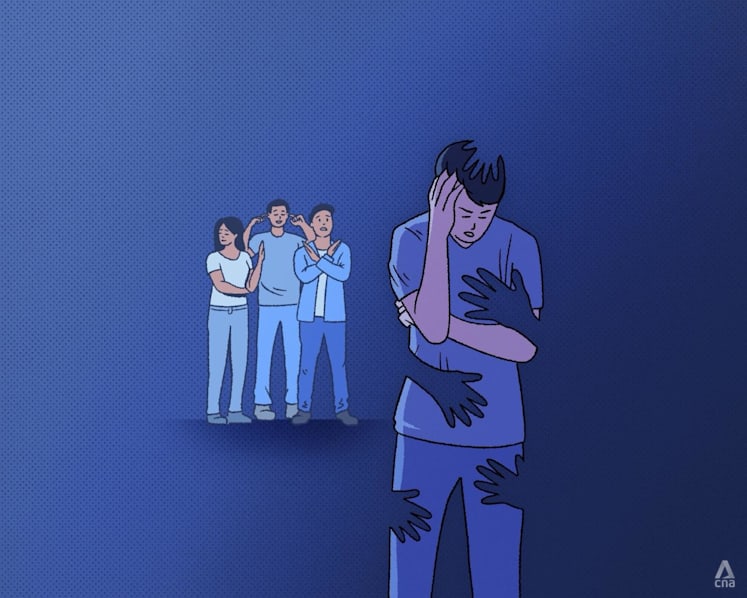
Now grown up, ex-bullies open up on what drove their behaviour and wish they could turn back the clock
Why do some children turn pain into cruelty, while others rise above it? Psychologists and reformed bullies unpack how early emotional wounds shape behaviour, and what it takes to effectively tackle the issue.
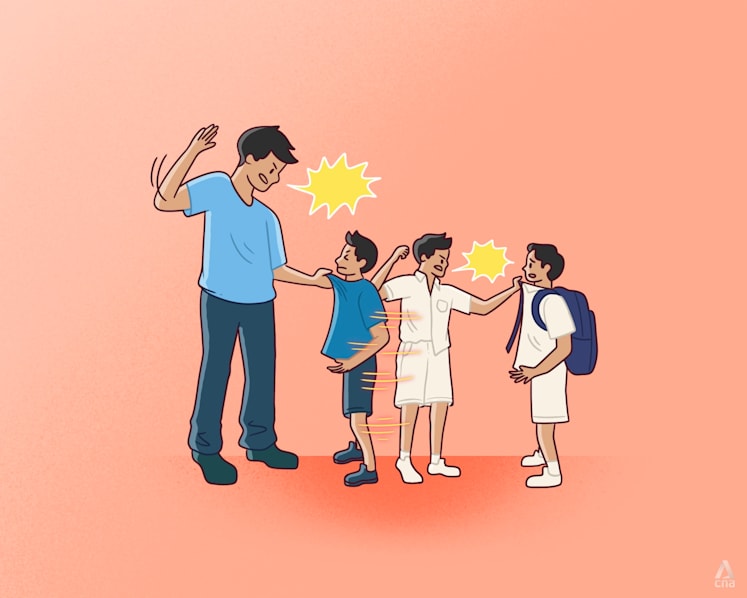
Experts stressed that bullying is rarely about random cruelty. It often stems from complex personal histories, unresolved distress or a need for control and social belonging. (Illustration: CNA/Nurjannah Suhaimi)

This audio is generated by an AI tool.


When an old video of Abdul Wafi Idris assaulting a fellow student resurfaced online in 2024, it reignited a national debate about youth violence and accountability.
The clip, recorded in January 2022, showed a then-14-year-old Abdul Wafi hitting and kicking a boy in the toilet. It spread like wildfire across social media and sparked widespread backlash.
The criticism was intensified because of Abdul Wafi's status as a national boxer representing Singapore on the world stage – someone associated with discipline, control and respect, not senseless violence.
Speaking to CNA TODAY on Oct 10, Abdul Wafi described feeling overwhelmed during his moment of virality, frustrated and embarrassed by the ghost of his past.





Now aged 18, he admitted that in his childhood and early teenhood, he was "angry and aggressive most of the time".
While he could not recall the exact details of the toilet incident, he clearly remembered how he felt that day.
"I snapped," he said simply. "It felt like something took over my body. I didn't even feel like myself."

Abdul Wafi's story is but one example of bullying drawing more attention as a national concern in Singapore.
This year alone, incidents at Sengkang Green Primary, River Valley Primary and Admiralty Secondary have sparked widespread debate and distress, despite the latter two incidents eventually being ruled as non-bullying incidents.
A new study led by the National Institute of Education (NIE), in collaboration with the Singapore Children's Society and the National University of Singapore, found that about one in four upper primary school students has experienced bullying.
The research, conducted among students aged nine to 13, highlights how emotional and relational bullying behaviours, such as gossiping, exclusion and online harassment, are increasingly common, even if their non-physical nature makes them harder to notice.
In May, a CNA Talking Point survey suggests that the problem may be more widespread than official statistics indicate, with around three in 10 secondary school students in Singapore saying they have been victims of bullying.
The survey, conducted in 2024, gathered responses from 1,010 students aged 13 to 17 across 149 secondary schools.
When bullying incidents make headlines, the bulk of the attention is often focused on victims and how they have been impacted – and understandably so. But experts said this may not be enough to effectively and holistically counter the problem of bullying.
In the NIE study, some of the children who reported experiences of being bullied also admitted to being bullies themselves. This draws attention to a less-discussed aspect of bullying behaviour: Hurt people hurt people, as the saying goes.
Why do bullies act the way they do? What prompts or enables them to reflect on their actions?
More importantly, could anything have been done earlier on to stop them from turning to violence in the first place?
In search of answers to these questions, CNA TODAY pulls back the layers on the psychology of bullying by speaking to former and reformed bullies.
WHEN THE HOME ENVIRONMENT TEACHES ANGER FIRST
At 13, Mr Sebastian Ong already carried an anger that felt too large for his body.
"If I didn't like a teacher, I'd just walk out of class," he said. "Sometimes I'd shout, throw chairs, even bully others.
"Back then, I told myself it wasn't bullying – just disturbing people."
As a child, his body spoke the language of rage fluently and instinctively, thanks in large part to his overly strict, quick-tempered father.
"I called the police once because he was hitting my mum," recalled the 36-year-old, who now works as a relationship coach. "Sometimes, he would also hit me."
While Mr Ong's father stopped beating him when he was in Secondary 3, the damage of constant exposure to violence at home was already done – and it was more than just physical damage.
At school, Mr Ong often deployed anger as a form of self-protection, especially against unkind remarks and disrespect.
"As Normal (Technical) students, teachers constantly told us we were useless, that we had no future. So I retaliated."
He felt validated in his anger when fellow classmates behaved the same way. "We encouraged each other to act out because if no one respected us, why should we respect them?"

Bullying often begins as an attempt to be seen, said Dr Ong Mian Li, founder and principal clinical psychologist from Lightfull Psychology and Consulting Practice.
"For many children and adolescents, visibility feels like proof that they matter. To be recognised, even feared, can feel safer than being invisible."
Over time, he said, this can harden into a recurring pattern of harmful behaviour.
Ms Esther Leng, a former Ministry of Education (MOE) teacher and current academic director of English Ninjas Enrichment and Tuition Centre, said that bullying rarely stems from a one-off incident. Rather, it is often intertwined with the child's lived experiences, social environment and emotional well-being.
Even children from stable families may act out when emotional support or connection is missing.
Ms Leng recalled a former Secondary 3 student of hers who bullied a quiet girl not out of anger, but as an outlet for his internal struggles with identity, belonging and acceptance.
"Children who grow up around harsh discipline or emotional inconsistency learn that power keeps them safe," said Dr Ong. "Aggression becomes their way of gaining stability."
WHEN IN SEARCH OF STATUS AND CONTROL
As children grow older, bullying can be an attempt to reckon with the unwritten rules of social hierarchies – their way of grappling with uncertainty or discomfort over who fits in, who is admired and who is not.
A school counsellor, who wanted to be known only as Mr Tan, said that subtle exclusion, gossip and social hierarchies can be equally harmful – for instance, the "queen bee system" among girls.

In these cases, a bully's motivations are less about brute force and more about control, belonging and perceived social status.
For Mr Ivan Tay, now a 45-year-old lawyer, those social hierarchies were already present in primary school, as early as Primary 1 to 3.
Teachers would often praise the well-behaved students in class and reprimand him in the next breath.
"They'd say, 'You're the naughty boy in school. You should learn from the good students'," he recalled.
To mitigate the sting of teachers' disparaging comparisons, he and his friends turned the force of their resentment on the pupils who often drew their praise by calling them names and ostracising them.
Looking back, he sees that he had been trying to soothe his shame by wresting back some social capital.
"It was (about) getting back at the good kids and showing the teachers that my friends liked me better. There was a 'food chain', and I wanted to be the popular boy."
A junior college (JC) teacher, who wanted to be known only as Ms Siti, said that in her experience, bullying at the tertiary level tends to be more insidious.
"You rarely see physical bullying in JCs. It's more about mockery and exclusion, often online," she said.
Even seemingly minor acts, like mocking peers for not having branded items or speaking in a different language to exclude someone, can hurt deeply, she added.

Dr Ong of Lightfull Psychology and Consulting Practice noted that bullies do not have to be physically stronger or bigger than the people they target.
"The power imbalance can come from many sources like popularity, confidence, social skills, cognitive ability, or even the capacity to influence others," he said, adding that some children hold several of these advantages at once, magnifying their control over peers.
Senior counsellor and psychotherapist Gopal Mahey, who works with youth offenders at Centre for Psychotherapy (C4P), said such behaviour can often be a symptom of unresolved distress or deeper insecurity in the bully, rather than malice or cruelty.
"It could also be driven by internal struggles, as feelings of shame, insecurity or anger are displaced onto peers who seem like 'safe targets'," he said.
WHEN IT'S "JUST HORSEPLAY"
When bullying behaviours are perceived or justified as harmless fun, it's also not unusual for bullies to be unaware of the harm they're causing.
Mr Mohamad, who previously attended a top boys' school and declined to give his full name, said: "We consistently targeted the boys (of minority races) in our class by calling them names, teasing and mocking them."
The teasing escalated at a school camp when he and his friends sprayed excessive amounts of deodorant into a tent until their targeted victim and another boy started coughing.
Later, Mr Mohamad unpitched the tent, causing it to collapse on the victims.
The bullying went on for nearly two years, throughout Secondary 3 and 4.
"I'm not making excuses, but it was an all-boys school. Back then, I genuinely didn't think what I did was wrong," he said.
He had tormentors of his own at the time – friends who made fun of his Malay identity by cracking insensitive jokes about him being a "terrorist".
"It felt like everyone bullied everyone at some point," he said.

Many bullies do not see themselves as perpetrators because their behaviour blends into group culture, explained Dr Ong, the psychologist.
Some may also tell themselves a narrative that makes harmful behaviour acceptable, he added – such as "It's just a joke", "They should toughen up", "Everyone was laughing".
"Social rewards, like attention, laughter and likes, make it easier to ignore the hurt caused."
Empathy also becomes much easier to disengage when one perceives a target as different, added Dr Ong, particularly on the basis of their race, ability, religion, gender or body type.
WHEN SELF-DEFENCE GOES TOO FAR
In truth, what seems like harmless fun to one can often come at the expense of another, said Mr Alex – yet another former bullying victim turned bully.
The 33-year-old who works in the tech industry remembered being relentlessly targeted in primary school – pinned against fences, having his pants forcibly pulled down, caught in rough play that often escalated into fights.
It was only natural, he said, to react in kind.
"Every time I got pinned, I'd hit back," he recalled. "Once you land a punch, it can turn into a full-on fight."
By upper primary, his self-defence had given way to self-initiated offence.
"I was angry and upset that people who started the fights often got away scot-free just to repeat the entire cycle yet again. So I started believing that to protect yourself, you must respond with maximum aggression to deter (aggressors)."
He became "a bit of a school gangster", often violently throwing tables and chairs about.
"Teachers didn't know what to do with me. They'd rather stay on my good side than antagonise me, because I had a nasty temper," he said.
In secondary school, his reputation for retaliation only grew. Classmates who provoked him often ended up on the receiving end of his fists.
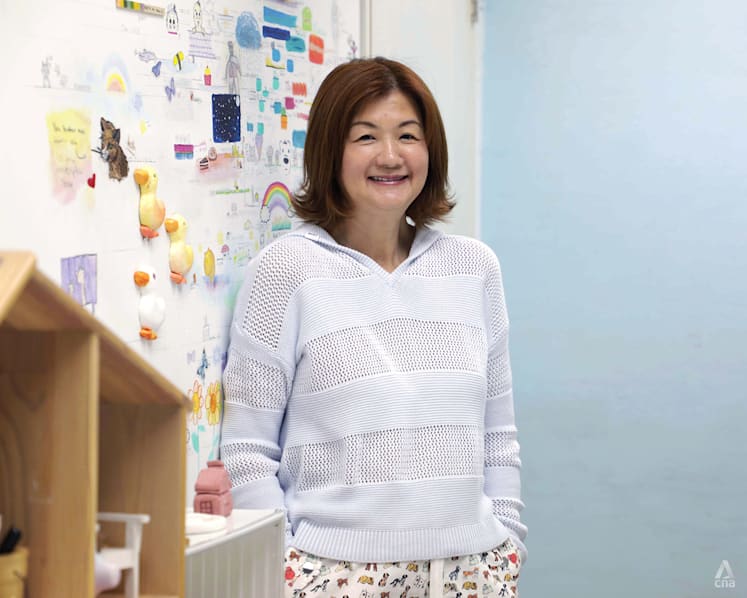
While victims of bullying can be bullies themselves, the history between two parties in any incident matters, said Ms Esther Ng, founder of the Coalition Against Bullying for Children and Youth.
"Investigation is needed to understand why the victim pushed back, sometimes without realising that it's also a form of bullying," she said.
Yet, not all victims respond by turning to aggression themselves.
Despite being bullied in primary school for being an "oddball", 45-year-old Edvarcl Heng, a publicist, never retaliated.
Instead of resorting to violence, he relied on humour and wit to diffuse tensions and distance himself from victimhood.
"I thought it was a better solution than trying to adopt a bully’s mindset, which I was not familiar with," he said.
SOLVING BULLYING STARTS WITH UNDERSTANDING IT
MOE is conducting a comprehensive review of bullying to strengthen policies and frameworks for discipline, rehabilitation and restorative practices in schools.
As part of this effort, it is studying ideas such as a centralised anti-bullying unit, expert guidance and closer involvement of parents and community partners, Education Minister Desmond Lee said in Parliament on Sep 23.
Reporting channels for students will be made more accessible, with greater emphasis on early intervention, values education and stronger partnerships between schools and families.
Nevertheless, experts are clear that effectively tackling bullying is not just about rules.
They said efforts must also be made to understand what drives bullies to hurt others – not to excuse the harm caused, but to enable educators and parents to prevent it rather than just punish it.
"To some (bullies), their behaviour feels normal, even logical," said Ms Ng of the Coalition Against Bullying for Children and Youth.
Ms Ng, who is also director and art psychotherapist at MySpace Psychotherapy Services, stressed that adults responding to cases of potential bullying need to employ a "responsible, discerning and reflective attitude" to avoid snap judgements.
"It's important to process the real reasons behind a child's actions, such as their home life, social environment and lived experiences, while still acknowledging the harm caused."
Ms Shirley Sim, a lead school counsellor, said that students who bully may struggle with managing their emotions or their need to control social situations, and misinterpret neutral situations as threatening.
With these students, the focus should be on addressing their underlying feelings of powerlessness and teaching them appropriate ways to establish social connections and influence, she added.
She also stressed the need for a more nuanced approach tailored to students' individual circumstances, such as their age.
Younger children may hurt others without realising it, she noted, while older ones wrestle with peer pressure and moral choice.
Many bullies, said Dr Ong the psychologist, only realise the harm they've caused when the short-term rewards of control and attention give way to loneliness and guilt.
Often, such a reckoning only comes later in life through therapy, major transitions, or empathy that comes with parenthood.
Now in his 30s and working in public relations, Mr Mohamad only began to reflect on his past behaviour while attending the top boys school in recent years, inspired by news stories and public conversations about bullying to re-examine his own experiences.
"If I could turn back time, would I treat them that badly again? No, I wouldn't," he said.
"And if I ever have children, I'd definitely scold them if I found out they behaved the way I did towards my classmates back then."
While Ms Sim acknowledged the usefulness of terms like "bully" and "victim" for clearly distinguishing perpetrators from their targets, she also urged caution.
"I avoid labelling students, as this may become part of their identity and limit their potential for growth," she said.
"Our role is to help them recognise emotions, understand the impact (of their actions) and build empathy so they can relate to others differently."
Ms Ng said facilitated formats such as fishbowl conversations – where participants take turns speaking and listening in rotating circles – can help victims feel heard and bullies grasp the impact of their actions.
TAKING RESPONSIBILITY, MAKING AMENDS
Despite the waves national boxer Abdul Wafi's graphic video made on the internet, what it didn't show was the aftermath.
After the incident led to his expulsion from Junyuan Secondary School, he was brought to Bedok Police Station for questioning – his third visit to the station that month due to repeated fights.
"The investigative officer said, 'We need to find you a hobby. What do you like to do?'" he recalled. "I said, 'I like to fight.'"
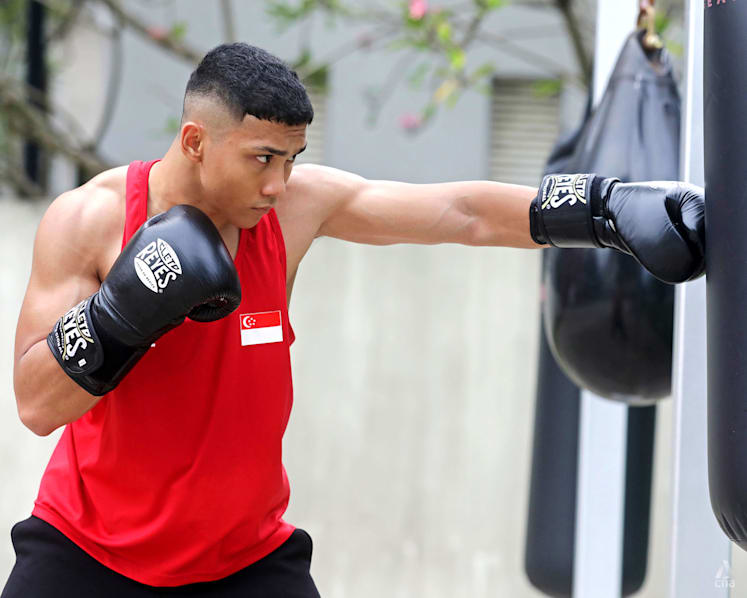
At the officer's suggestion and with his psychiatrist's encouragement, Abdul Wafi got his parents' permission to take up boxing as an outlet for his frustration.
This, along with regular counselling, became a turning point. Training at Kadir's Boxing School, a gym run by ex-national coach for boxing Syed Abdul Kadir, helped him redirect his "naturally hot" temper into discipline.
A month after training, he joined the national team. Six months into boxing, he competed in his first international tournament, where he clinched a gold medal.
Now, Abdul Wafi credits boxing for teaching him to stay calm even when situations heat up. "Boxing mirrors life. You can't fight angry, or you'll make mistakes."
While he's now able to acknowledge that his past violent tendencies were due to unresolved frustration from home and school, he doesn't see it as justification for what he did.
"Hurting someone doesn't just hurt that person. It humiliates them and it hurts their parents, too," he said.
He apologised to some of the people he had hurt and explained what he had been going through years ago – "not as an excuse, but so they'd understand where I was coming from".
He's not the only ex-bully who found healing in taking responsibility for his past behaviour.
When Mr Tay, the lawyer, ran into one of the boys he had once bullied in primary school decades later, he did not waste the opportunity – he apologised.
Likewise, Mr Ong, the relationship coach, confronted his own past at a class gathering when he was 17, where he met with one of his former victims.
"He told me, 'My secondary school days were traumatic because of you guys'," Mr Ong. "I told him that it was not my proudest moment, but I was glad he shared that with me, and I apologised."
Others resolved to change after facing hard reality checks.
In Mr Alex's case, after a heated confrontation in secondary school almost led to police charges, he realised that violence, even in self-defence, could have life-altering consequences.
"Even if you win a fight, violence still turns the tables against you," he said.
The case was dropped after further investigation revealed that the victim had instigated the incident by making derogatory remarks at Mr Alex. Nevertheless, he is thankful for the "second chance" it gave him.
"I realised things could have ended much worse, so from then on, I had to be very deliberate on how I responded or reacted to situations."
NOT A SCHOOL PROBLEM, BUT A SOCIETAL ONE
When high-profile bullying cases make the news, said Ms Leng of English Ninjas, the bulk of public blame tends to land on schools and teachers.
But while schools remain the frontline of anti-bullying efforts, experts warned that they cannot be the first and last line of defence.
In truth, bullying is often rooted in the social cues children absorb from their immediate environments beyond their classroom walls – their homes, neighbourhoods, and the online spaces they frequent most.
"If we only frame bullying as a disciplinary issue, we miss the chance to build resilience and empathy in our young people," said Mr Gopal of C4P.
He is part of a rising tide of voices advocating for a restorative approach to dealing with bullies.
Instead of only punishing, which reinforces shame, he said bullies must be offered real opportunities for transformation where accountability is balanced with compassion.
Remedial action should focus on repairing harm and building empathy through therapy and reflection, even when victims are not directly present, he added. Offenders must be guided to uncover the roots of their actions, manage their emotions and confront the impact of their behaviour on others.
"Restorative justice is not just about one perpetrator and one victim. It is about shaping safer, more compassionate communities in Singapore."
An approach such as this could have benefited Mr Ong, the relationship coach who once felt rejected by both his father and teachers.
If his teachers had approached him empathetically back then instead of piling on punishment and shame, he thinks he would have likely responded very differently.
"One thing I hope to see today is for teachers to be trained in mental wellness – not just to identify struggling students, but to work on themselves first," he said.
"If teachers don't understand their own emotions or coping mechanisms, they can't help others."
But without more help, providing early preventive support is easier said than done.
"Teachers want to intervene," said Ms Leng – but systemic challenges play a big part in why they don't.
For instance, teachers are often overworked and overstretched. Ms Leng recalled how she typically slept only four hours a night while working in the public education system.
Heavy workloads aside, it's unrealistic to expect teachers to constantly monitor all students, she said.
She added that some parents "go into denial" when informed of their child's bullying behaviour, making them uncooperative.
On top of that, teachers are educators, not mental health professionals. "They're not always equipped to handle complex cases that require counselling or parental engagement," she said.

In order for sustained intervention to be made feasible, Ms Leng sees the need for a holistic care or mentorship programme that does not add to teachers' workloads.
Smaller class sizes would also help. "When you have 30 to 40 students per class, it's nearly impossible to provide meaningful support that would make a difference to the student," she said.
Ultimately, the consensus among former bullies, educators and mental health experts is clear: Bullying prevention needs to start early, long before a child enters school.
Mr Tay, the lawyer, lamented his own lack of guidance and open communication at home, where conversations typically centred on his grades rather than his struggles.
In his view, he would have fared better if his parents had made more effort to be more approachable to him.
"A child (should be able to) express how they feel, process those feelings, learn what's right and wrong and how to deal with emotions."
Outside the home, bullying can manifest in any shared social space, explained Ms Ng of the Coalition Against Bullying for Children and Youth, such as on the playground, during co-curricular activities, on public transport, or even online platforms.
Children and youths spend most of their formative years in schools, making these critical for forming foundational ideas of the world around them and human behaviour, she said – what is permissible, and what is not.
Even adults may model harsh or aggressive behaviour without realising it. Some children have told Ms Ng stories of their teachers hurling chairs or screaming at students in class.
"The goal is to raise a generation that demonstrates understanding, kindness and a reflective mindset, where each child knows they can make a difference in the face of unfair treatment," said Ms Ng.
Schools alone cannot solve bullying, said JC teacher Ms Siti, because it is a problem that requires reflection, accountability and empathy development at every level.
She pointed to the fact that bullying behaviour is also often observable in non-educational settings such as roads or workplaces, making it part of a larger culture of aggression and competition.
"Schools can do their best, but if society rewards dominance and 'winning', kids learn that. They see that bullies often succeed in the real world.
"Until we confront bullying everywhere – at work, at home, in public – the problem will only persist."