I spent 35 years chasing profits. Now, I chase bone marrow donors to save patients
Going from corporate high-flyer to leading Singapore's only national registry of volunteer marrow donors was a drastic change for Mr Charles Loh. Nearly eight years on, he reflects on how it has changed his understanding of leadership.
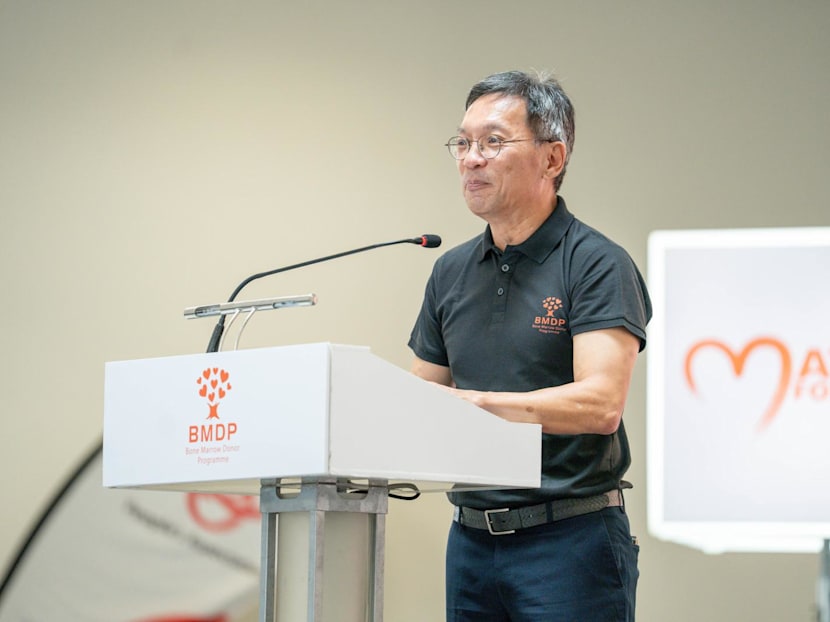
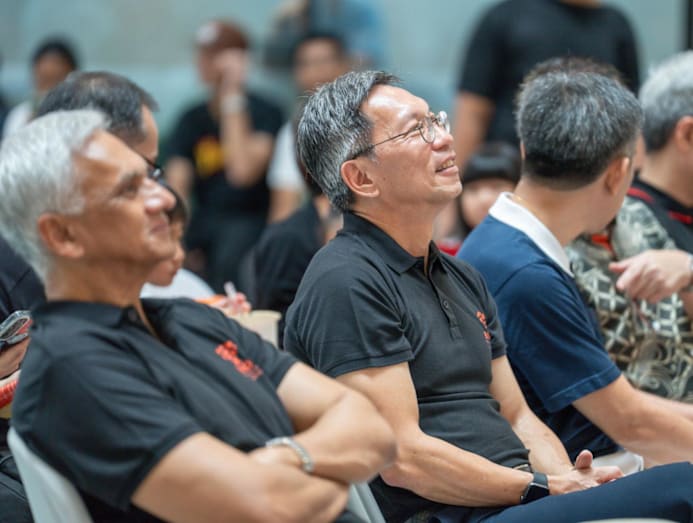
When he took over to lead Singapore's Bone Marrow Donor Programme, Mr Charles Loh (pictured) realised that he had to convince and inspire people to believe in something bigger than themselves.

This audio is generated by an AI tool.
In my long "rojak" of a career spanning over 35 years, I have worn many hats.
I’ve served in the Singapore Armed Forces, worked in listed family businesses, handled management consulting at two of the Big Four consultancies, and later joined a company linked to state investment firm Temasek.
In all of these roles, I drove performance, grew revenue and maximised profits. Everything I did – scouting for overseas joint ventures, building up consulting practices, creating operational capabilities – ultimately fed into the same bottom line: a healthy profit-and-loss statement.
By the time I reached my early 50s, I was feeling a little jaded by the endless chase for profits. Yet, for all my experience and expertise, I didn't really know what to do about this.
At this time, a friend introduced me to the Bone Marrow Donor Programme (BMDP). I was initially dismissive, as I had never even heard of the programme before. But curiosity got the better of me.
BMDP is Singapore's only national registry of volunteer marrow donors, finding and matching marrow donors with patients with life-threatening blood diseases.
The more I looked into the organisation, the more I realised that behind every name on the registry was a story of someone waiting desperately for a second chance at life itself.
I thought that maybe, just maybe, this was the renewed purpose I'd been searching for, so I decided to take the leap and leave the corporate world behind.
In May 2018, I officially became BMDP's chief executive officer.
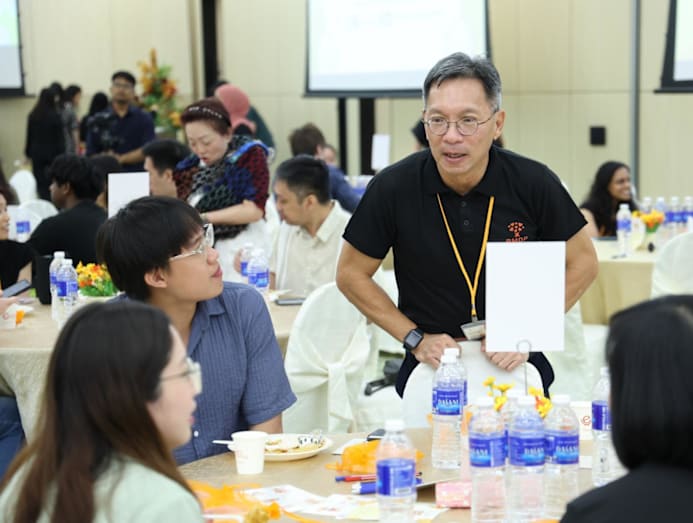
In the beginning, I approached the role with a very practical mindset: strengthen the organisation, steady the ship.
I had always been a problem-solver, so that's what I focused on: fixing what needed fixing, fast.
Right away, my experience from both public service and private sector roles helped me implement new approaches to existing processes and systems.
But I also quickly realised that my new role was very, very different to my previous ones.
ADJUSTING TO A NEW PURPOSE
One of my early priorities was introducing patient subsidy schemes. In fighting for their lives, many patients have to shoulder significant out-of-pocket medical expenses, with bills reaching S$150,000 to S$200,000.
I had to learn to fight the urge to act and instead, take time to sit down with patients to understand better their stories and needs.
We wanted to do more for our patients – not just medically, but financially and emotionally.
Still, there were many moments of doubt, both for myself and my team.
Were our goals even realistic? Was I pushing too hard and too high, to the point of endangering our mission?
That’s when I realised that leading a non-profit demands more than technical skills.
It’s not about chasing money or improving productivity.
The team has to buy into the mission, to feel it in their bones.

Coming from decades in the corporate world, this mindset felt unfamiliar to me. How would I even go about cultivating it in my new team?
I remember more than one staff member asking me: "Why not just be a 'normal' charity? Why not move at an easier pace?"
Strangely, these questions didn't discourage me. However, they did make me realise that I couldn't lead at BMDP the same way I had always led in the corporate world.
I couldn't just drive performance and grow revenues. I had to convince and inspire people to believe in something bigger than themselves.
I had to lead the charge not from above, but on the ground.
THE CASE THAT CHANGED EVERYTHING
In the early stage of the COVID-19 pandemic, on the night of the Singapore-Malaysia border lockdown, a Singaporean donor had just completed his stem cell donation – cells that were urgently needed for a patient in Kuala Lumpur.
With the borders closing and global aviation routes all but shut down, we had no way to get the cells across to the Malaysian capital. We were racing against time, with no precedent to deploy or fall back on for such dire, unique circumstances.
Drawing on my experience in airport operations, I wrote directly to the Minister for Transport (at the time, Mr Ong Ye Kung) and proposed a solution: a contactless handover in the airport transit area, where the overseas courier flew out on the next flight after taking the delivery, never setting foot in Singapore.
It took quite some time – and, admittedly, some rejection – before the proposal was eventually accepted. However, not once did it cross my mind to give up.
Just thinking of the patients desperately waiting for their transplants, so close yet so far, was enough to renew my determination each time.
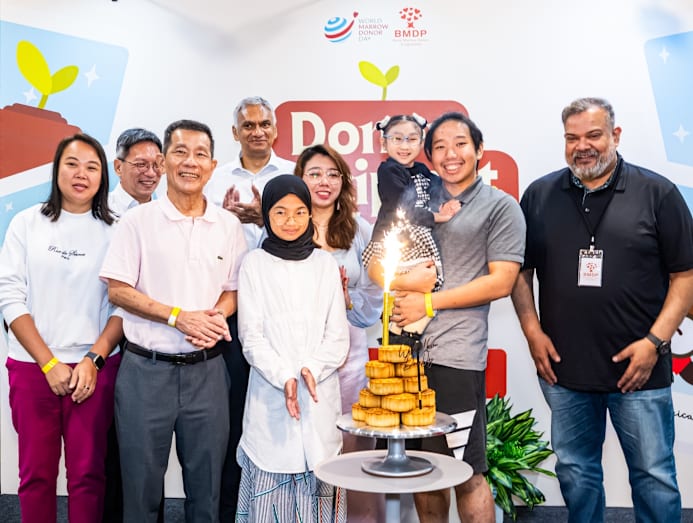
Throughout the rest of the pandemic, I'll never forget how my team stepped up to their tasks. Despite border closures, grounded flights and widespread fears around hospital visits, every single stem cell donation was delivered on time, thanks to their extraordinary efforts.
I hope that the small example I'd set at the beginning inspired them to think more creatively and try a little harder – even when we had to break convention to do so.
On another occasion, we had to transport precious stem cells from Taiwan, not on a regular flight, but on an aero-evacuation plane.
Imagine an entire aircraft mobilised, not to carry a patient but a small 60ml packet. I certainly don't recall this happening anywhere else in our country's history.
A NEW, EMOTIONAL WEIGHT TO LEADERSHIP
Another new lesson for me was handling my own emotions on the job.
In my previous corporate roles, you learn from disappointment and you moved on. But here, the work is deeply personal. You feel every life, every loss, every match found and every one that falls through.
Having forged such close connections with our patients and their families, they become more than just numbers on a screen. We witness both great joy and immense heartache, sometimes in the same week.
It's difficult to simply “move on” to the next case.


Even now, the hardest pill to swallow remains the disappointment of donor dropout – when donors withdraw after being confirmed as a match.
Still, I often remind my team: "One donor dropout is one too many."
I don't want us to become desensitised to the hurt. It's a living reminder for each of us of why each case, each donor and each recipient matters so much.
Some families, overwhelmed by uncertainty and heartbreak, ask to meet with us for a deeper explanation. Emotions often run high, and the weight of their fear and frustration is palpable.
In those moments, I have to turn off my problem-solving instincts again and simply be present. I sit with them, listen and do my best to provide the clarity and reassurance they need.
I've long known that leadership means showing up not just in the good times but also in the bad.
But now, I've learnt what it really means to navigate triumphs and trials, and keep the ship steady through both.
BREAKING THROUGH FEAR AND MISCONCEPTIONS
Nearly eight years on, I'm more determined than ever to do more – both for our patients and for my colleagues, to help them grow and thrive in their purpose here.
Beyond growing the registry of donors, we're also looking into expanding treatment options for patients who can't find a perfect match and making cell therapy more affordable.
One of our biggest ongoing challenges is public misconception.
It is easy to say, "Just educate people". That requires trust. And trust takes time.
In 2024, I led a national survey that confirmed what I had long suspected: Many Singaporeans (58 per cent of respondents) are unaware that they can help save a life through marrow donation. Several more (67 per cent) believe that donating marrow involves extracting bone or carries risks of infertility and spinal injury.
Admittedly, before joining BMDP, I had those same misconceptions, thanks in part to Jack Neo's enduringly popular 2002 film I Not Stupid.
In the movie, the protagonist Terry wants to donate his stem cells to his friend's mother, but concerns about it affecting his spine and potentially resulting in other complications create a comical situation.
It's an iconic scene that has stuck in the minds of many. These days, I joke that we should get Jack on board as an ambassador – to help correct the very myth he helped perpetuate.
In any job or industry, it's easy to get caught up in an endless chase for profits and sales. But there are some labours and rewards on which you just can't put a price.
I used to get bonuses for hitting quarterly key performance indicators and goals. Now, I get invited to parties celebrating patients' recoveries – and it fills my heart with even more joy and fulfilment than I ever thought it would.
It may sound cliched or naive, but success doesn’t always have to be about numbers and figures. Sometimes, the biggest win is simply in doing what we can to help someone in need.
Charles Loh is the chief executive officer of the Bone Marrow Donor Programme. Outside of work, he can be found in the gym or out on a run or walk.
If you have an experience to share or know someone who wishes to contribute to this series, write to voices [at] mediacorp.com.sg (voices[at]mediacorp[dot]com[dot]sg) with your full name, address and phone number.