What a defensive employee taught me about giving feedback
In many workplaces, people avoid giving honest feedback for fear of offending or upsetting others. Without uncomfortable conversations, there may not be real improvement, one business owner says.
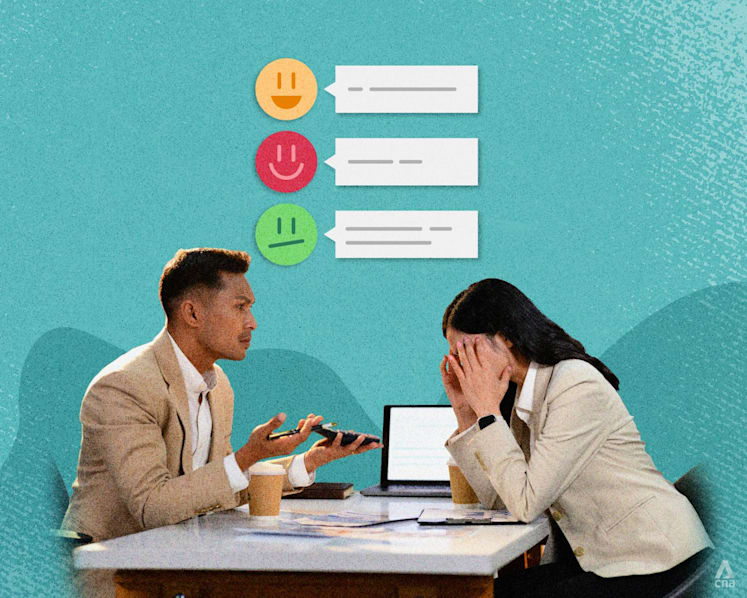
Feedback from your manager often feels like a personal attack, triggering defensiveness before the conversation even begins. (Illustration: CNA/Clara Ho)

This audio is generated by an AI tool.


It was that time of the month again for my regular check-ins with the team – an opportunity to both listen and offer feedback.
"So, Daniel, I wanted to work with you on a couple of areas that were highlighted to me as potential areas of improvement."
His lips tightened immediately. He leaned back in his chair and folded his arms, ending the conversation before it had even begun.
"We've recently identified some communication gaps in –"





I had barely started outlining the actionable steps he could take when I felt the shift in his demeanour and found myself running into a barricade of defensive manoeuvres.
"Oh, did Felicia say this about me? I can explain everything. When I received the brief …"
"Okay, just to be clear, Daniel," I tried to get a word in. "I would simply like to see how we can improve on our –"
"... the brief was really unclear, and I don't think it's fair that I should be blamed for this. Also …"
I hadn't said much at that point, but Daniel was stacking justification upon justification to defend himself. I listened, nodded and tried to seek the right timing to steer the conversation back to the topic of improvement, but I could hardly get a word in.
Needless to say, it was not a very productive feedback session.
WHY CRITICISM FEELS PERSONAL
Nobody likes receiving negative feedback. And frankly, it's not that enjoyable giving it either.
Even if we welcome feedback, our first reaction to it is often visceral.
The fight-or-flight response is triggered, and if the latter isn't an option, then it's time to get ready to rumble.
The mind starts racing: "This is not about work. It's because you don't like me."
And the words that follow, constructive or otherwise, land like limp arrows at the gate of an impenetrable fortress.


Feedback can feel personal and that's understandable.
If you have spent hours shaping an idea or writing lines of code, a part of you goes into the work. So when someone says "this isn't working", it rarely lands as a neutral observation.
More often, it sounds like: "You’re not good enough."
Heck, even writing a draft of this column and getting it back from my editors peppered with red-lined edits and entire paragraphs struck out can sting a little.
Oftentimes, the instinct is to go into self-preservation mode, but in the process, we can lose sight of why feedback exists in the first place: to offer a different perspective and to make the work better.
Feedback is a little like an MRI scan. Nobody looks forward to it, but if something is wrong, you would rather know so that you can fix it.
The same logic applies at work. If something is unclear or ineffective, someone has to say it. Without that signal, improvement becomes guesswork.

GIVING FEEDBACK THAT TRULY LANDS
There is a popular phrase in management circles known as the "sandwich method".
The idea is simple: start with something positive, deliver the critique and end with encouragement.
Feedback lands best when people feel the person giving it is rooting for them.
In Daniel's case, I should not have jumped straight into the critique. Even a minute acknowledging what he had done well could have softened the blow.
Framing feedback around someone's strengths makes the message easier to accept. After all, cough syrups are sweetened for a reason: they're easier to swallow.
Good feedback should also be specific.
Instead of saying "this isn’t good", take the time to explain why. Provide examples. Show what the standard should look like. Clarity makes criticism far more useful than vague disapproval.
Another useful principle is to use language that separates the work from the person.
Saying "this idea doesn't work yet" lands very differently from saying "you didn't think this through". One critiques the output. The other critiques the individual.
DON'T TAKE IT PERSONALLY
Of course, giving feedback is only half the equation. The other half is how we receive it.
You can defend the work, which is par for the course in any healthy professional discussion. But when feedback arrives, it should not trigger an existential crisis.
After all, it's important to remember: your work is not your identity.
Yet for many employees, a comment such as "this presentation is confusing" can be heard as "my boss thinks I'm incompetent". A suggestion to revise a draft becomes evidence that someone dislikes you, or worse, thinks they're better than you. How dare they?
In reality, criticism is often far simpler than that. Something could be improved. Someone is pointing it out so that the next version can be better. And it really is "nothing personal, kid".
The ability to absorb criticism without becoming defensive is one of the most valuable professional skills a person can develop.
It signals maturity and confidence, and shows that you care more about getting the work right than protecting your ego.
Daniel may well have had legitimate explanations, but he would have gotten far more out of the conversation by listening first.
The ability to absorb criticism without becoming defensive is one of the most valuable professional skills a person can develop.
WHY WORKPLACES NEED HONEST FEEDBACK
In many workplaces today, feedback has become strangely fragile as managers worry about demoralising people and colleagues worry about sounding harsh.
Was the comment fair? Did it come off as a personal attack?
We should be mindful of all of these things, but not at the expense of creating a workplace culture where everyone tiptoes around difficult conversations – or avoids them entirely.
While it is only right to be concerned about how our words may affect our colleagues and employees, kindness in the workplace should not mean the absence of honesty.
When managers become afraid to say difficult things, standards are abandoned.
When employees refuse to adopt feedback, the work stagnates.
Good teams are those that learn to challenge each other's thinking openly and honestly, in a safe environment.
It might never feel comfortable, but if we can give and receive feedback well, we won't just work better. We'll do better work.
Kelvin Kao is the co-owner of a creative agency.