Gulf shipping disruptions highlight need for alternative export routes, flexibility: ADNOC top exec
The United Arab Emirates’ Habshan-Fujairah pipeline transports oil to a port 70 nautical miles outside the Strait of Hormuz, allowing up to 1.5 million barrels to bypass the chokepoint daily.
People walk past a logo of Abu Dhabi National Oil Company (ADNOC) at a conference in Abu Dhabi, United Arab Emirates, Nov 3, 2025.(Photo: Reuters/Amr Alfiky)

This audio is generated by an AI tool.


The Iran conflict’s disruption of Gulf shipping is underscoring a fundamental change in the energy industry: Companies must build in options to withstand geopolitical shocks, according to a top Abu Dhabi National Oil Company (ADNOC) executive.
“Optionality is becoming a must in our business. It's no longer an option,” said Musabbeh Al Kaabi, upstream CEO at the state-run energy giant, on Wednesday (May 6).
“The last couple of months demonstrated that having optionality, investing in resilience, is the right approach for an integrated energy player.”
HORMUZ STANDSTILL HITS ENERGY FLOWS
Since attacks on Iran by the United States and Israel first broke out on Feb 28, Tehran has effectively blocked passage through the Strait of Hormuz to most non-Iranian vessels.
After more than two months, Iran and the US remain at odds over a variety of difficult issues amid a ceasefire, such as Tehran’s nuclear ambitions and its control of the vital strait.
The strategic waterway is a critical artery for global trade, carrying about a fifth of the world’s oil and liquefied natural gas. The conflict has forced Gulf producers, including ADNOC, to scramble for alternative routes.
The United Arab Emirates said on Monday that Iran used drones to attack an empty ADNOC crude oil tanker, the Barakah, as it attempted to transit Hormuz. No injuries were reported.
The UAE’s foreign ministry urged Iran to “halt these unprovoked attacks” and ensure the “complete and unconditional reopening” of the strait.
Al Kaabi confirmed the Barakah’s crew had returned home safely and stressed the state-owned oil company’s focus on supply continuity.
“ADNOC is taking all the measures to ensure that our system is resilient and that we fulfill our commitment to our customers,” he told CNA.
ADCOP PIPELINE A CRUCIAL WORKAROUND
A key pillar of that resilience is the Abu Dhabi Crude Oil Pipeline (ADCOP), also known as the Habshan–Fujairah pipeline.
The roughly 400km pipeline transports oil from Abu Dhabi’s fields to the eastern port of Fujairah and can carry about 1.5 million barrels per day.
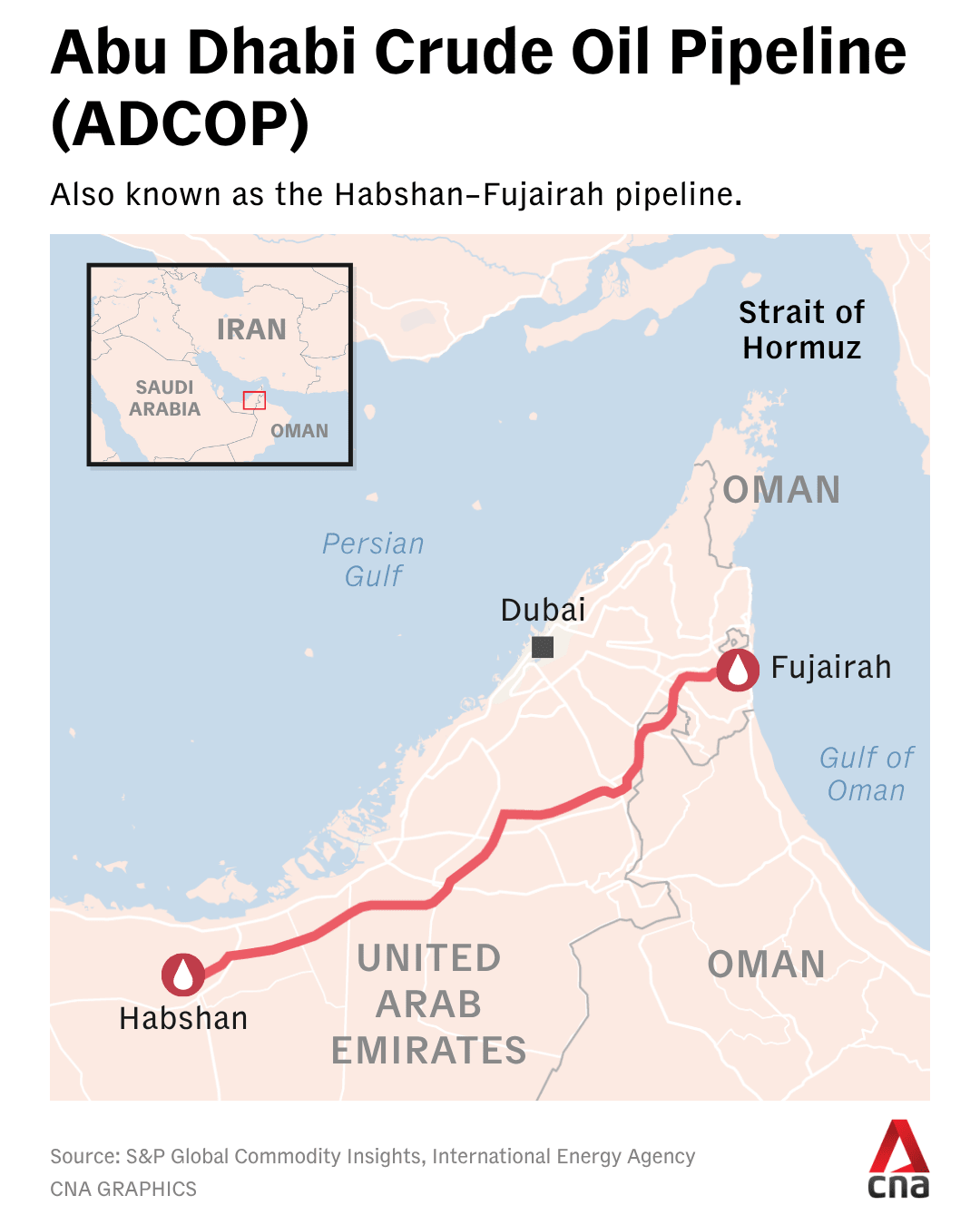
Al Kaabi said the pipeline is operating close to full capacity, adding: “This has provided us great resilience and flexibility in a very challenging time.”
Located about 70 nautical miles from the Strait of Hormuz, Fujairah is a major global hub for ship refuelling and energy exports.
Last year, it shipped more than 1.7 million barrels per day of crude and refined products, accounting for about 1.7 per cent of global demand.
The pipeline and port allow exports to bypass Hormuz entirely.
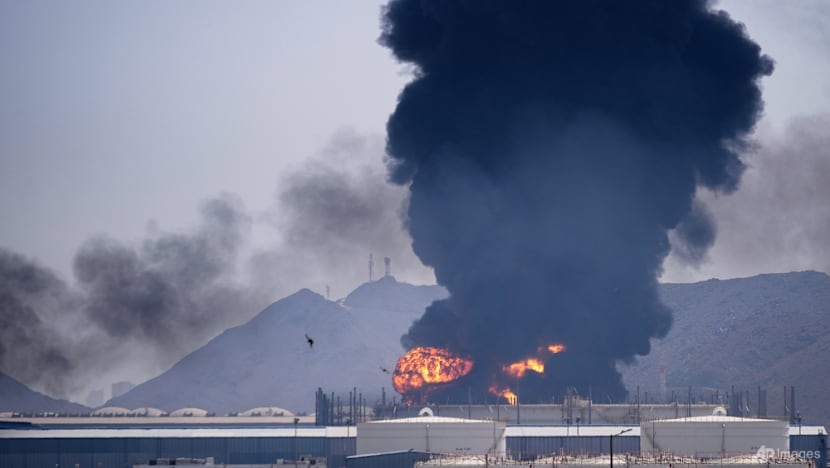
However, recent drone attacks have disrupted loading operations at Fujairah, raising the risk of further supply constraints.
ASIA DEMAND REMAINS A PRIORITY
With Hormuz largely shut, any sustained disruption at Fujairah could force the UAE to further curb output.
The port is a key outlet for Murban crude, much of which is sold to Asian buyers.
Al Kaabi pointed to ADNOC’s deep ties to Asian markets, noting partnerships across both upstream and downstream operations.
“The current circumstances are very challenging to the region (and) the global economy. We’ll (use) our best endeavours to ensure we maintain an acceptable level of operation and meeting the demand, especially in Asia,” he said.
He added that the energy industry must embed resilience into both infrastructure and strategy, noting that ADNOC has invested heavily to ensure operations continue safely across its offshore and onshore assets.
Still, Al Kaabi warned that no workaround can fully replace the Strait of Hormuz. Aside from energy, a third of the world’s fertilisers and helium, and a quarter of the world’s petrochemicals, pass through the narrow waterway.
“The Strait of Hormuz is so critical, not only for the UAE, but for the global economy,” he said. “It's very critical … that Hormuz goes back to unrestricted movement to serve the global economy.”