Imprisoned Iranian Nobel Peace Prize winner Mohammadi is in worsening health, husband says
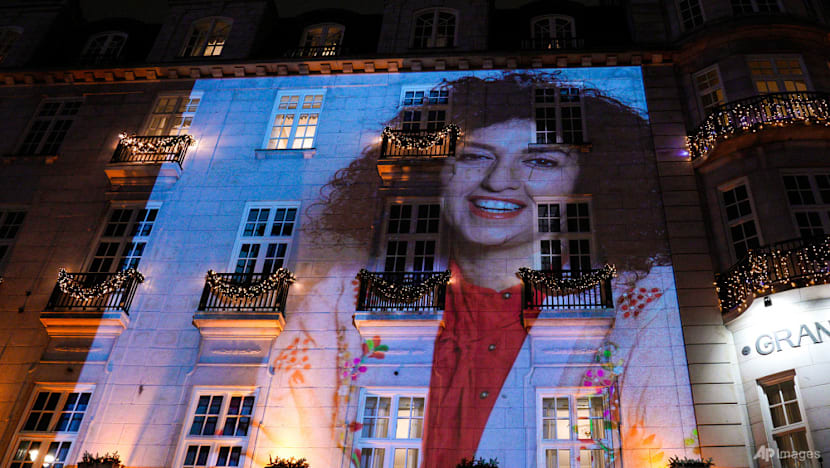
A file photo of Nobel Peace Prize recipient Narges Mohammadi projected on the wall of the Grand Hotel in central Oslo before the Nobel banquet on Dec 10. 2023. (Photo: NTB Scanpix via AP/Javad Parsa)
PARIS: Iranian authorities have, without prior warning, transferred Nobel Peace Prize winner Narges Mohammadi to a prison in the north of the country as concern grows over her health, her family said on Saturday (Feb 14).
Mohammadi, who won the peace prize in 2023 in recognition for more than two decades of campaigning, was arrested on December 12 in the eastern city of Mashhad after speaking out against Iran's clerical authorities at a funeral ceremony.
She spent time on a hunger strike earlier this month and had been hospitalised before being returned to prison.
The Norwegian Nobel Committee said this week it was "deeply appalled" by reports detailing "physical abuse and ongoing life-threatening mistreatment" of Mohammadi both during her arrest and in detention.





Following her arrest, Mohammadi had been held in Mashhad at the detention facility of the intelligence ministry.
But she has now been transferred to prison in the city of Zanjan in the north of the country, said her husband Taghi Rahmani, who is based in Paris.
"This action was carried out without informing her family or her lawyer," he said on X, adding it was "intended to exile and displace Narges".
Mohammadi's foundation, which is run by her supporters and family, said she had been transferred on Tuesday, but she had only been able to reveal the news on Saturday in a phone call with her Iranian lawyer Mostafa Nili.
Since her arrest in December, she has only been allowed one phone call with a brother inside Iran and now just two more with her Iranian lawyer.
"In our short conversation, she spoke of the violence inflicted during her arrest, the pressure of interrogations, and particularly severe blows to her head," Nili wrote in a post on X.
"These blows have resulted in dizziness, double vision and blurred vision. Bruises and marks of severe physical assault remain on her body," he added.

Mohammadi was arrested before protests erupted nationwide later in December. The movement peaked in January, with authorities launching a crackdown that activists say has left thousands dead.
Earlier this month, she was handed a further six years in prison on charges of harming national security and a one-and-a-half-year prison sentence for propaganda against Iran's Islamic system.
Over the past quarter of a century, Mohammadi, 53, has been repeatedly tried and jailed for her campaigning against Iran's use of capital punishment and the mandatory dress code for women.
Mohammadi was born in Zanjan but lived in Tehran. Her foundation said she had, on two occasions during previous jail stints, been transferred to Zanjan prison where she suffered ill treatment.
Her husband Taghi Rahmani, who has lived in exile since 2012, said he last spoke to his wife, who lives in Tehran, the night before she left for Mashhad.
She was attending a memorial there for a human rights lawyer who had died the previous week under unclear circumstances. At the memorial, plainclothes members of the security forces began to assault Mohammadi before she had finished her speech, according to her husband.
He said multiple men hit and kicked her in her side, head and neck.
Details of her deteriorating condition have come from released detainees who had been held alongside Mohammadi in Mashhad, Rahmani said.
"HER PHYSICAL CONDITION IS VERY SEVERE"
“Collectively, this information shows her physical condition is very severe because of the hits she got, her bruised body,” he said, adding that her heart condition had worsened.
Mohammadi suffered multiple heart attacks while imprisoned before undergoing emergency surgery in 2022, her supporters say. Her lawyer in late 2024 revealed doctors found a bone lesion they feared could be cancerous, which was later removed.
“Our main concern about Narges is her illnesses," Rahmani said. He said three of her four coronary arteries are constricted, and she has pulmonary problems. “These illnesses she has gotten from being in prison. When she is in prison, it isn’t possible to take care of her health,” he said.
Nationwide protests began to spread around Iran, culminating in marches by hundreds of thousands on January 8 to 9, until they were crushed by a heavy government crackdown. Rights groups have so far counted more than 7000 dead, and say the true number is likely far higher; the government has put the toll at more than 3,100 dead.
Rahmani said conditions for political prisoners in Iran have continued to deteriorate amid the suppression of the latest protests. The crackdown is the deadliest since the Islamic Republic was created in 1979.
“In these 47 years, the Islamic Republic hadn’t killed people to this extent. This is a flagrant crime. People very clearly want to put the Islamic Republic behind them," Rahmani said. “They want a republic, they want democracy.”