Oil price dips under US$100, stocks fall tracking Middle East war developments
Analysts say the record 400 million barrels released from International Energy Agency stockpiles had little impact.
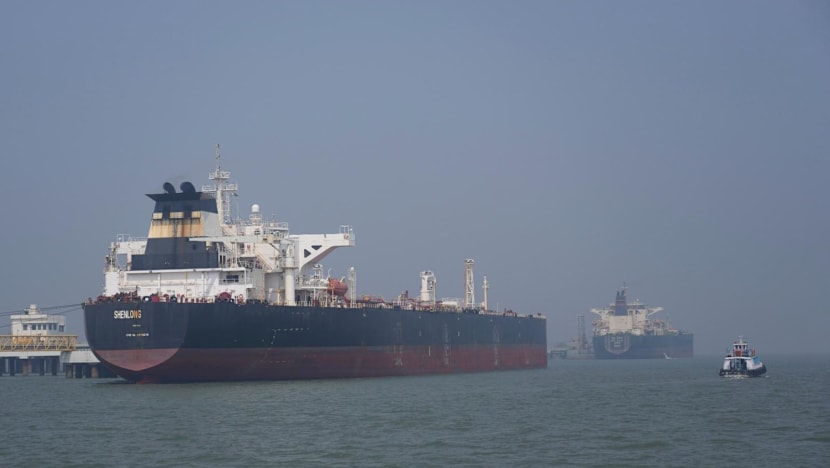
Liberia-flagged tanker Shenlong Suezmax, carrying crude oil from Saudi Arabia, is seen at the Mumbai Port in Mumbai, India, Thursday, Mar 12, 2026. (Photo: AP/Rafiq Maqbool)
TOKYO: Oil prices dipped under US$100 on Friday (Mar 13), but remained far above pre-Middle East war levels with no end in sight to disrupted crude supplies.
With the conflict heading towards its third week, equity markets mostly dropped as investors grew increasingly worried about an extended crisis that could fan inflation and hammer the global economy.
"Fears of a burgeoning energy crisis remain front and centre for investors," noted Joshua Mahony, chief market analyst at Scope Markets.
"Inflationary fears are particularly prevalent with each day that passes."





Major central banks, which prior to the war's outbreak were heavily forecast to keep on cutting interest rates, are now widely expected next week to freeze borrowing costs or even hike to keep a lid on inflation.
While top economies have agreed to release some of their strategic crude reserves, analysts argue that the move does little to address supply blockages, with Iran having vowed to attack oil resources in the Middle East and keep choking the crucial Strait of Hormuz.
In a further bid to ease the situation, the US Treasury Department said it would temporarily allow the sale of Russian oil that is at sea.
German Chancellor Friedrich Merz on Friday called the decision "wrong", claiming it could help fund Moscow's war against Ukraine.
This after French President Emmanuel Macron said that easing sanctions on Moscow - imposed over its war in Ukraine - was "in no way" justified.
Moscow, meanwhile, urged the United States to lift more sanctions on its oil exports, saying it would help to stabilise global energy markets.
On foreign exchange markets, the dollar held its gains against major rivals owing to its safe-haven status and expectations that US interest rates will remain elevated longer than expected.
Next week's "interest-rate meetings at the Federal Reserve and the Bank of England - and those of several of their global counterparts - come at a delicate time", said AJ Bell investment director Russ Mould.
"Markets will be watching closely for any signals on how they plan to deal with surging oil and gas prices and whether they see it as a short-term bump to look through, or a development that has significantly altered the prospects for inflation and interest rates."

As concerns over the impact mount, equity traders are taking flight, with Asian economies most at risk owing to their reliance on energy imports.
Tokyo, Hong Kong, Shanghai, Singapore, Seoul, Wellington, Manila and Jakarta were all down.
The dollar held its gains against major rivals owing to its safe-haven status, fears of inflation, and expectations that interest rates will remain elevated longer than expected.
Matt Weller, head of market research at City Index, warned that markets could be in for more pain after years of generally strong equity markets, subdued energy prices and broadly low interest rates
"Those trends have reversed, and the default assumption as long as the Strait of Hormuz remains functionally closed is that stocks will be under pressure, oil prices will trend higher, and interest rates will tick up in unison," he wrote.
"Unless or until we see meaningful progress toward a ceasefire in the Middle East, traders should shift their expectations that the coming weeks and months will look different than the past couple of years, weighing on risk appetite at an accelerating rate."
ENERGY & MARITIME RISKS TO PERSIST
Other energy analysts said emergency measures may struggle to fully offset the disruption if it continues.
Ben Cahill, director for energy markets and policy at the University of Texas at Austin, told CNA’s Asia First that while the coordinated 400 million barrel release is the largest in history, what matters is how quickly those barrels reach buyers.
In the US, for example, oil from the Strategic Petroleum Reserve typically takes nearly two weeks to arrive after authorisation, he said.
Cahill noted that some Gulf producers are redirecting volumes through alternative pipelines, and that Iran continues to export some oil despite the war.
Even with those adjustments, he said the remaining supply gap is significant: “This is just too big a market shortfall.”
Cahill added that the crisis is not only about oil. Qatar, which produces about 20 per cent of global liquefied natural gas (LNG), has halted output at key facilities after attacks on energy infrastructure.
An LNG disruption lasting about a month is “probably manageable”, Cahill said, but if outages extend beyond that, gas markets could tighten significantly, increasing pressure on energy-importing economies.
Ian Ralby, CEO of maritime security consultancy IR Consilium, said Iran may be better positioned than many countries to withstand prolonged disruption after years of sanctions and economic pressure.
Speaking to CNA’s Asia First, he said Tehran has demonstrated an ability to adapt in the maritime domain, employing unconventional tactics – including small craft, drones and other low-cost, high-impact methods – to sustain threats against merchant vessels in the narrow waterway.
Even if some of Iran’s traditional military capabilities are weakened, he said such lower-cost tactics could continue to keep commercial fleets on edge, complicating efforts to restore normal traffic.
He warned that convoys in the narrow and heavily trafficked waterway could also become targets, particularly if smaller, faster craft are deployed against them.
Escorting vessels through the strait would be “incredibly dangerous, difficult, and not in any way guaranteed", he added.