CNA Explains: Saudi Arabia's East-West pipeline is down. Why its oil 'insurance policy' matters
Built in the 1980s to bypass the Strait of Hormuz, the East-West pipeline has become a crucial route for Saudi oil exports. With the pipeline now out of action after drone attacks, a prolonged outage could hit buyers, including those in Asia, hard.
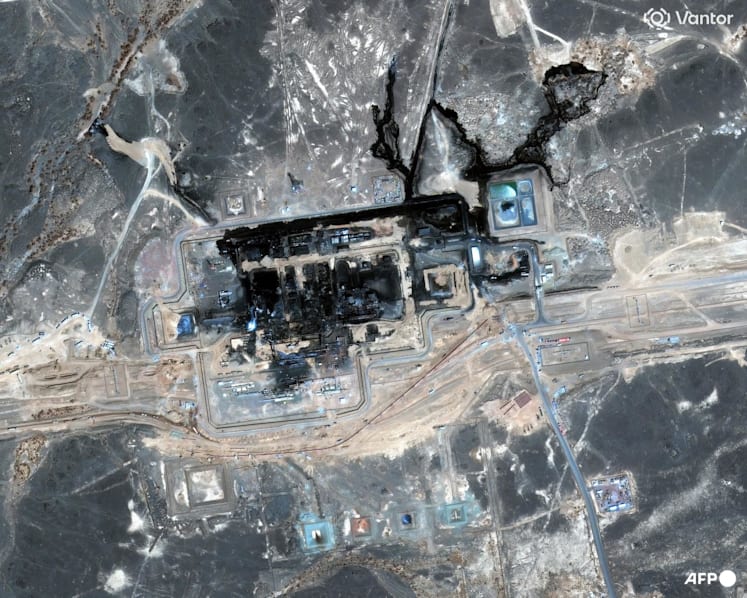
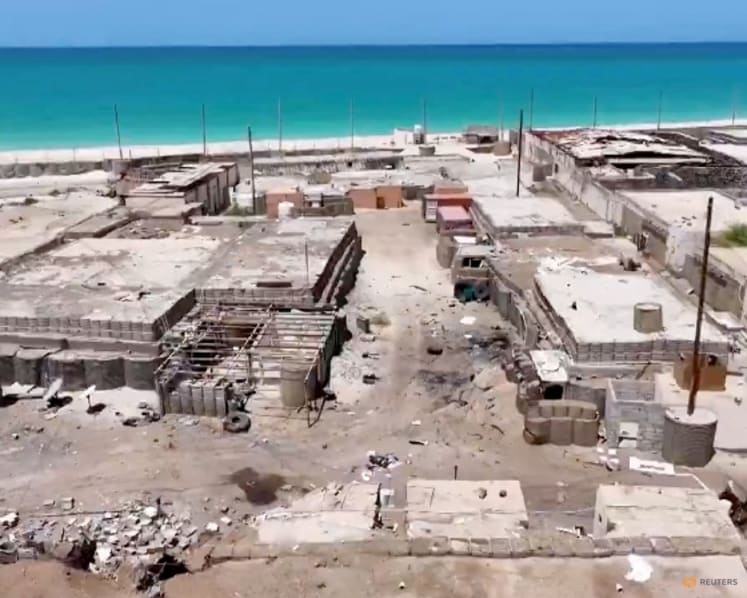
This handout satellite image released by Vantor shows a view of a pumping station along the general route of Saudi Arabia's East-West pipeline (Petroline) in al-Mesabaah, southeast of Medina, on Sep 13, 2026, following an attack and resulting fires on Sep 11 which caused significant damage to the site along the pipeline. (Photo: AFP/Satellite image Vantor)

This audio is generated by an AI tool.


SINGAPORE: With conflict in the Middle East disrupting oil flows through the Strait of Hormuz, Saudi Arabia's East-West pipeline has become a crucial alternative for getting the kingdom's oil to global markets.
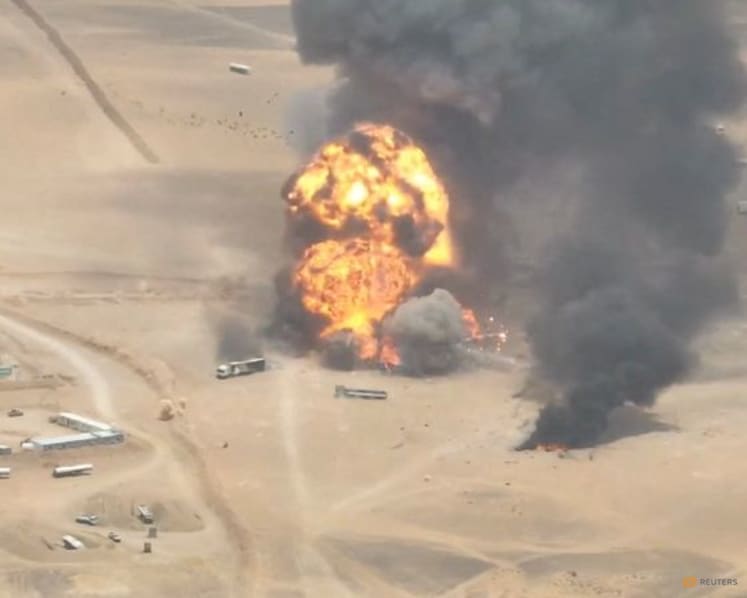
But the pipeline was shut down on Sep 11, a day after drone attacks, removing one of Saudi Arabia's main alternatives for bypassing the strait.
While Riyadh has described the shutdown as a "precautionary measure", the extent of the damage and how long repairs will take remain unclear. Estimates have ranged from several days to five or six weeks.
With the Red Sea route also facing growing threat from Yemen's Houthis, the disruption has raised questions about what happens if Saudi Arabia's main alternative to Hormuz remains unavailable – and what that could mean for global oil markets, particularly in Asia.
What is the East-West pipeline and why is it so important?





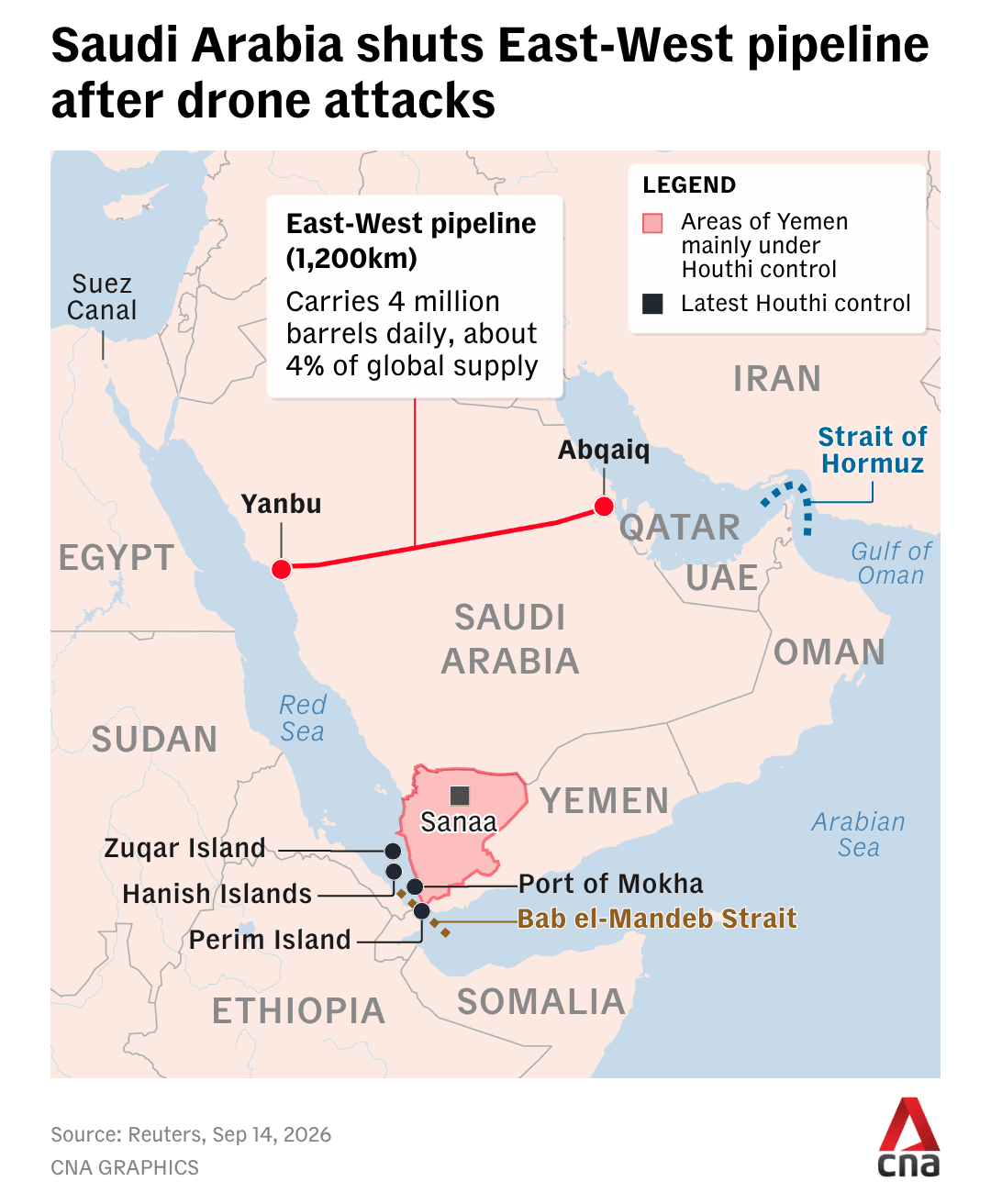
Built in the 1980s, the 1,200km East-West pipeline - also known as Petroline - carries crude from Saudi Arabia's oil fields in the east across the kingdom to the Red Sea port of Yanbu.
It has a maximum capacity of about 7 million barrels per day (bpd), allowing Saudi Arabia to move oil to the Red Sea without sending it through the Strait of Hormuz.
That function has become particularly important since the conflict in the Middle East disrupted shipping through the strait.
Saudi Arabia had increased the amount of crude sent west through the pipeline to about 4 million bpd, from roughly 973,000 bpd a year earlier, according to figures cited by industry sources. That accounts for about 4 per cent of the global supply.
The pipeline has therefore served as a crucial buffer, allowing the world's major oil exporter to maintain some exports even as its traditional routes through the Gulf have come under pressure.
But with the pipeline offline, that buffer is under strain.
Saudi Arabia has been drawing on crude stored at Yanbu and other facilities to keep exports moving.
The longer the shutdown lasts, the harder it becomes for Saudi Arabia to maintain those flows without finding alternative routes or cutting exports.
The International Energy Agency reported last week that Saudi oil supply had already fallen to a more than three-decade low in August on reduced flows via Hormuz and the Red Sea.
Can't Saudi Arabia export its oil another way?
In theory, yes. In practice, its alternatives are limited.
The most obvious route is the Strait of Hormuz, through which Saudi Arabia normally ships large volumes of crude. But oil flows through the strait have been severely disrupted by the conflict.
Another option is the Red Sea, via the Bab el-Mandeb Strait, which links the Red Sea with the Gulf of Aden.
But that route has also become increasingly difficult to use after the Houthis seized control of Yemen's entire Red Sea coast, capturing three strategic islands and the port of Mokha.
"The route being used for rerouting is also vulnerable now," Priyanka Sachdeva, senior market analyst at Philip Nova, previously told CNA.
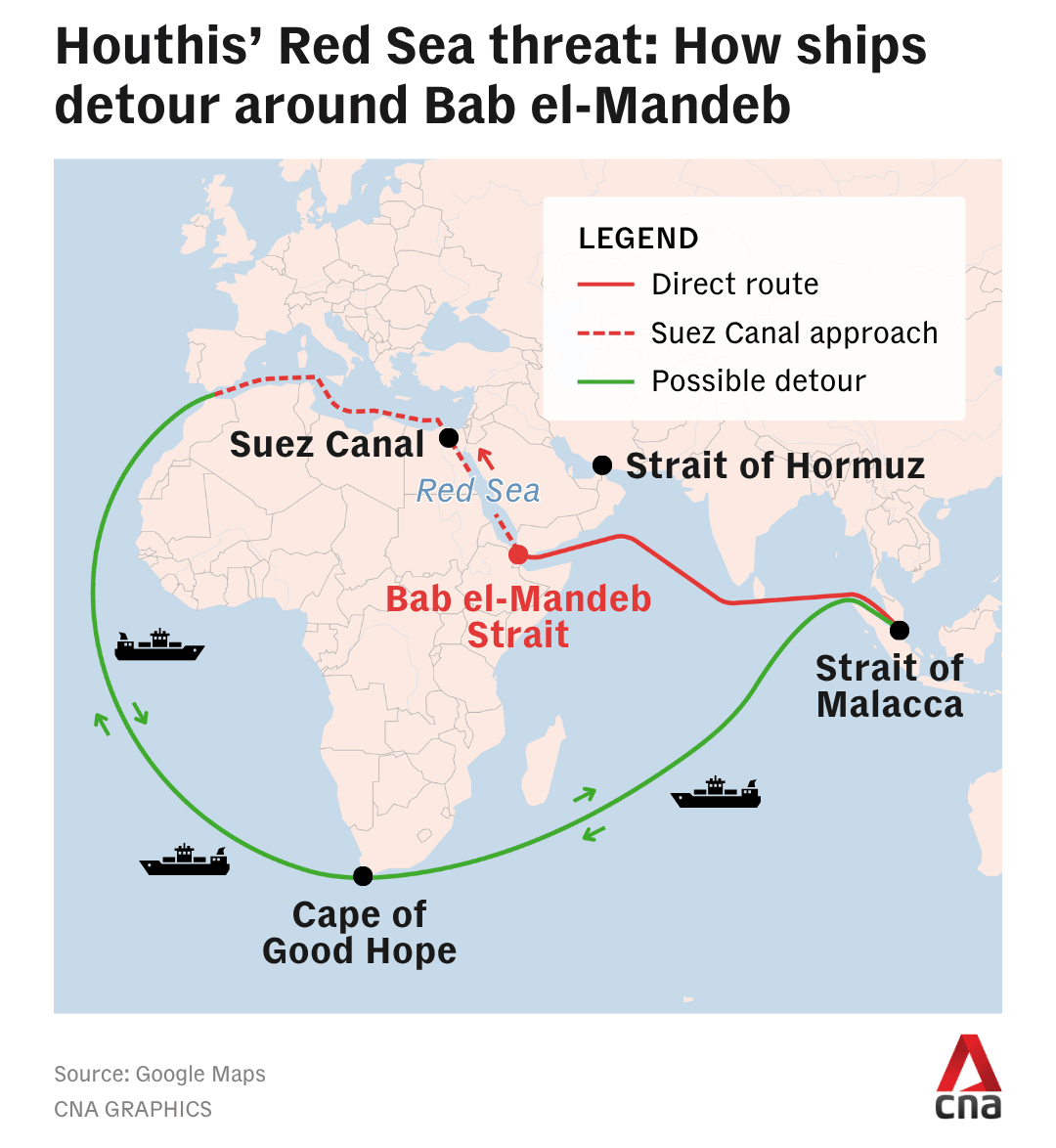
Saudi crude reaching Yanbu can be loaded onto tankers and shipped north through the Suez Canal or south through Bab el-Mandeb towards Asia.
But if those routes become too risky, ships may have to bypass the Red Sea entirely and sail around Africa via the Cape of Good Hope.
That can add weeks to voyages and significantly increase fuel, insurance and freight costs.
As Ms Sachdeva previously put it, there is "no such thing as a free detour in shipping".
Why does Saudi Arabia have limited options?
The problem is not simply that Saudi Arabia has lost one pipeline. It has lost a route that was specifically designed to provide an alternative to Hormuz.
Loadings at Yanbu had been a "rescue option" because Saudi Arabia had been relying on the Red Sea route as an alternative to Hormuz, Janiv Shah, vice president of oil commodity markets at Rystad Energy, told CNA on Wednesday (Sep 16).
If anything happens to the East-West pipeline, it would severely constrain Saudi export volumes, he said.
There are no other Saudi pipelines with comparable scale and capacity, he added.
Saudi Arabia is now looking at other ways of moving crude. Reuters reported that Saudi Aramco had offered additional crude cargoes to Asian refiners using ship-to-ship transfers off Oman's Sohar port, suggesting the kingdom is already looking for ways to work around its disrupted export routes.
Riyadh could also try to send more oil through Hormuz, including through so-called "dark shipments" in which vessels switch off their tracking systems.
But Mr Shah said that would be challenging given the security situation in the strait.
"So Saudi, what it's trying to do now is trying to export or push more volumes through Hormuz, but again, this is gonna be very challenging considering the state of play and the effective closure, although barrels are still flowing through the strait," he said.
Professor Mark Goh from the National University of Singapore Business School's Department of Analytics and Operations shared a similar view, saying that Saudi Arabia has "few true substitutes" for the East-West pipeline.
He noted that the country could tap its overseas stockpiles or redirect crude to domestic refining.
However, those options are constrained by logistics and infrastructure, and would not provide a long-term replacement for the pipeline.
"The harsh reality is that the East-West pipeline is Saudi's key insurance policy against the Strait of Hormuz risk," Prof Goh said.
"Without the East-West pipeline, Saudi Arabia loses its main land bridge from eastern oil fields to the Red Sea."
What happens if there is a prolonged outage?
The impact will depend heavily on how long the pipeline remains offline.
A decline in Saudi oil flow would push already elevated oil prices to potential record highs, with Yanbu reportedly now having stocks to maintain exports for just five to seven days.
It would worsen the global supply crunch, which has spurred worldwide inflation and sent US bond yields to the highest levels since the 2008 financial crisis.
Trade sources told Reuters on Tuesday that Saudi Arabia has already cut some oil shipments to Europe.
Oil prices rose US$3 (S$3.80) higher on Tuesday over such concerns, with Brent crude settling up 2.9 per cent at US$108.75 a barrel and WTI gaining 4.4 per cent to US$105.83. Both contracts closed at their highest since May 19.
Mr Shah expects the pipeline to remain offline for about three to five weeks, a disruption that could reshape the crude, refined products and tanker markets.
Buyers would likely have to source from other suppliers, and if the outage is prolonged, the current shortage in diesel, jet, and gasoline is unlikely to be built back up because the prices are too high, he said.
"Margins are strong, great, but the price for the consumer is too high," Mr Shah said.
Prof Goh said markets would be pricing in not just the loss of Saudi barrels but also the possibility of further attacks on energy infrastructure.
A short outage mainly creates a price and risk-premium shock, said Prof Goh.
"The tangible outcome of a short-term outage is typically in the knee-jerk reaction evidenced in the higher costs of crude, freight, insurance, and options volatility before physical shortages appear," he said.
A multi-week outage, however, could lead to more tangible supply problems, including missed cargoes, delayed loadings and refiners having to find replacement grades.
Governments could begin considering the release of strategic petroleum reserves if disruptions become sufficiently severe.
Prof Goh also cautioned that the global market could absorb only a brief disruption, as Saudi Arabia is a "central stabiliser in the oil production system".

What does this mean for Asia?
Asia is particularly exposed because of its heavy reliance on Middle Eastern crude.
According to data compiled by commodity analysts Kpler, Asia's crude oil imports from the Middle East rose to 11.11 million bpd in August.
Asian refiners are already preparing for tighter supplies of the heavier, sulphur-rich crude grades that Saudi Arabia and other Middle Eastern producers supply.
For these buyers, the problem is not simply finding another barrel of oil.
Refineries are designed to process particular types of crude, meaning that switching suppliers can affect the amount and type of products they can produce.
Prof Goh said Asian buyers would therefore have to consider factors including crude-grade compatibility, shipping security, delivery times and the reliability of contractual supplies.
Demand could shift towards crude from producers such as the UAE, Iraq and Kuwait, as well as suppliers outside the Middle East.
Mr Shah said Asian refiners could switch to other types of crude in the short term, depending on how long the disruption lasts.
But because refineries are configured to process particular grades, they are likely to return to Middle Eastern crude when supplies become available.
"The yield is much, much better," he said.
The outage could also trigger a deep rethink on long-term diversification of crude sourcing, Prof Goh added. "For businesses, the focus would be prices, term contracts, freight, insurance, and sourcing."
So is the world running out of detours and options?
Prof Goh believes that there are a handful of nations that could partially compensate for the lack of Saudi oil in the market.
Among them are the UAE, Kuwait, Iraq, the US, Brazil, Russia and Venezuela, although these countries have their own constraints.
Kuwait and Iraq have been impacted by the Middle East conflict and also depend on the Strait of Hormuz, while the US and Brazil have differing crude quality from what Asian buyers want, and Russia and Venezuela are bogged down by sanctions or political constraints, according to Prof Goh.
Mr Shah said that there are only a couple of other options for the flow of crude oil through pipelines or exit out of the Persian Gulf or Middle East.
He referenced the Kirkuk–Ceyhan Oil Pipeline, which goes to the port of Ceyhan in Turkiye and the Habshan-Fujairah pipeline in the UAE.
But the Kirkuk-Ceyhan pipeline has challenges regarding throughput, he said, while the UAE pipeline has a flow of 1.5 to 1.8 million barrels a day, and it is already functioning at maximum capacity.
While the UAE cannot replace the volume that Saudi Arabia produces, Prof Goh noted that it is the most important Gulf compensator because its pipeline to Fujairah bypasses Hormuz.
"But that does not solve the regional problem; it only protects part of UAE export capacity."
The longer-term response is to build more alternate pipelines in the current supply network, said Prof Goh, adding that the challenge is to build it at scale and at reasonable cost.
Mr Shah also said that a potential shipping corridor announcement link between Iran and Oman could help.
"That could allow for additional flow. But right now, with the elevated state of the geopolitical issue, that looks like it's going to be postponed."
Want an issue or topic explained? Email us at digitalnews [at] mediacorp.com.sg. Your question might become a story on our site.