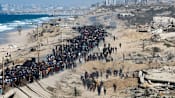
Some Palestinians pack up and move toward their homes in Gaza after ceasefire
The ceasefire between Israel and Hamas went into effect in Gaza on Friday.
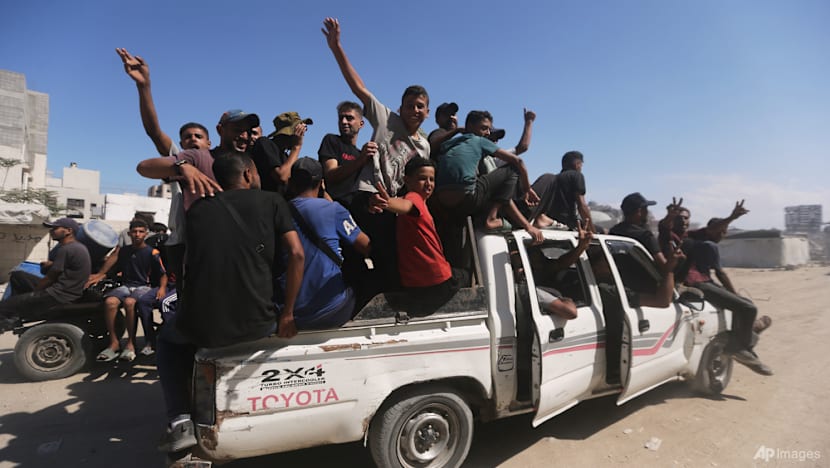
Displaced Palestinians wave to the camera as they move in the direction of Gaza City, in the northern Gaza Strip, Friday, Oct 10, 2025, after Israel and Hamas have agreed to a pause in their war and the release of the remaining hostages. (Photo: AP/Yousef Al Zanoun)
WADI GAZA: Tens of thousands of Palestinians displaced by the war in Gaza started walking north Friday (Oct 10) toward homes they were forced to flee — or what remains of them — after the Israeli military announced a ceasefire between Israel and Hamas had gone into effect.
Eager for the killings, displacement, and destruction to stop, many Palestinians in Gaza were relieved to hear that Israel and Hamas agreed to a ceasefire to the devastating two-year war. But it was mixed with pain from staggering losses and concern about what comes next.
“We packed our stuff as we may return home. But we are still suffering from the same struggles," said Jamal Mesbah, who was displaced from northern Gaza.
"There isn’t much joy, but the ceasefire has somewhat eased the pain we feel psychologically from death and bloodshed, and our loved ones and relatives who suffered immensely in this war.”
The ceasefire between Israel and Hamas went into effect in Gaza on Friday. It marks a key step toward ending the ruinous two-year war.
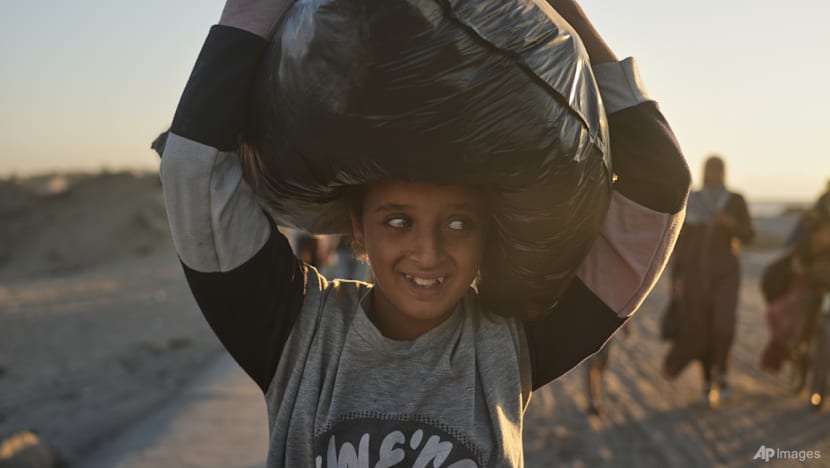
A STEADY STREAM OF PEOPLE
On Friday, a steady stream of people, the vast majority on foot, crammed onto a coastal road in the central Gaza Strip, heading north. Some carried backpacks and other belongings as they walked past tents overlooking the sea. Others sped by on bicycles and motorcycles. Horns sounded and some cars tried to weave through the crowds.
Ala Khandour said he no longer had a home to return to. Still, he wanted to go back north.
“I want to go and find a place to shelter in with my children," he said. ”We wish to go back and find a place in a school or a camp to live there.”
Some wondered how they could afford the trip back or if their homes were still standing. Others said they were not yet certain it was safe enough for them to immediately return.
“I will wait in Khan Younis until I am confident that all is safe for me and my family,” said Rana Saleh, who fled her home in September.
Similarly, Mahmoud Sharkawy was waiting in the Nuseriat refugee camp in central Gaza.
“I am planning to return to Gaza City, but not now," said Sharkawy, who fled Gaza City in late August. “I will wait a few days to make sure it is safe to return.”
On Friday, hundreds of Palestinians also tried to return to homes in Gaza’s southern city of Khan Younis, only to find wrecked buildings, rubble and destruction.
“There was nothing left, just a few clothes, pieces of wood, and pots,” said Fatma Radwan who was displaced from eastern Khan Younis. There was destruction everywhere, she said, adding that efforts were ongoing to retrieve bodies from under the rubble.
For some, the destruction has meant having no choice but to stay where they are.
“We want the truce to last. This is what we are hoping for. Enough displacement,” said Nawal Aboul Deeb. “Have some mercy on us. Have some mercy for all that we have witnessed."