Trump announces Greenland 'framework', backing off force and tariffs
The Greenland deal "gets everything we wanted" and will be in force "forever", says US President Donald Trump.
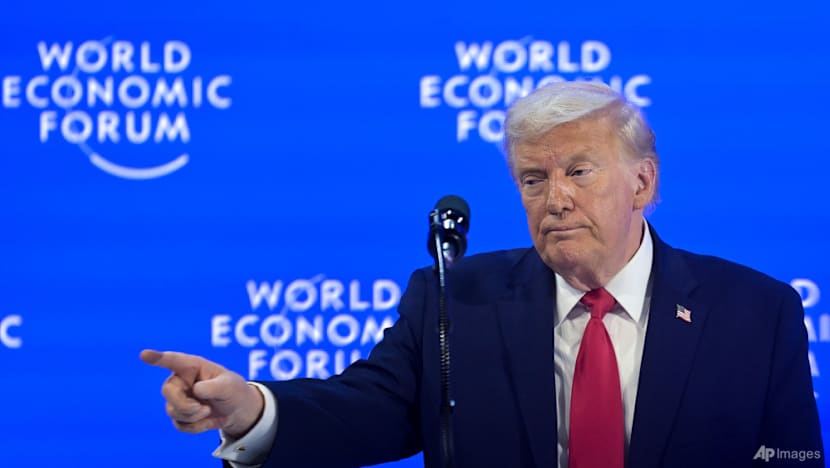
President Donald Trump at the 56th annual meeting of the World Economic Forum, WEF, in Davos, Switzerland, Wednesday, Jan 21, 2026. (Gian Ehrenzeller/Keystone via AP)
DAVOS: US President Donald Trump said Wednesday (Jan 21) he had reached a framework of a deal that satisfies him on Greenland, as he backed down both on threats to seize the island by force from Denmark and on imposing tariffs against European allies.
Trump said the deal was long-term but offered few details and was conspicuously silent on whether the deal would mean US control over the Arctic island, which he has repeatedly demanded.
Trump made the startling turnaround after talks with NATO Secretary-General Mark Rutte at the World Economic Forum in the Swiss ski resort of Davos.
"We have formed the framework of a future deal with respect to Greenland and, in fact, the entire Arctic Region", Trump said in a post on his Truth Social platform.





Trump said he would therefore scrap tariffs of up to 25 per cent that he had vowed days ago to slap starting Feb 1 on Denmark as well as close European allies that have sent troops to Greenland in solidarity, including Britain, France and Germany.
He later told reporters from outlets including AFP that the deal "gets everything we wanted" and will be in force "forever".
Asked if the United States would gain sovereignty over the vast but sparsely populated island, Trump hesitated and then said, "It's the ultimate long-term deal."
"I think it puts everybody in a really good position, especially as it pertains to security, and minerals and everything else," Trump said.
"It's a deal that people jumped at, really fantastic for the USA, gets everything we wanted."
Rutte told AFP on Wednesday that much work remained on Greenland. "I think it was a very good meeting tonight. But there's still a lot of work to be done," he said at the World Economic Forum in Davos.
Rutte also said he had not discussed the key issue of Danish sovereignty over Greenland in his meeting with Trump.
Asked about Greenland remaining a territory of Denmark, Rutte told Fox News' Special Report with Bret Baier that the "issue did not come up anymore in my conversations tonight with the president".
"He's very much focused on what do we need to do to make sure that that huge Arctic region, where change is taking place at the moment, where the Chinese and Russians are more and more active, how we can protect that," he added. "That was really the focus our discussions."
Rutte also echoed comments earlier to AFP that much work remained to reach an actual deal.
"We have a good agreement to really start working on these issues ... That means that we both agreed, when you look at NATO and what NATO collectively can do to make sure that the whole Arctic region is safe," he said.
NATO spokesperson Allison Hart said that allies would discuss the framework which addresses Trump's claims that the island is not protected from Russia or China.
"Negotiations between Denmark, Greenland, and the United States will go forward aimed at ensuring that Russia and China never gain a foothold - economically or militarily - in Greenland," she said.
RELIEF IN EUROPE
Trump's threats had triggered one of the biggest transatlantic crises in decades, with warnings that he could single-handedly destroy NATO through aggression against a fellow member.
His apparent climbdown eased jitters in Denmark, long a steadfast US ally where Trump's bellicose language has triggered shock and feelings of betrayal.
"Trump said that he will pause the trade war, he says, 'I will not attack Greenland'. These are positive messages," Foreign Minister Lars Lokke Rasmussen told Danish public television DR.
Dutch Prime Minister Dick Schoof said that the United States and Europe were "now on the path to de-escalation".
Trump has repeatedly said that the United States, the key force in NATO, deserves Greenland as it would be forced to defend the island against Russia or China, although neither country holds any claim to the island.
The issue dominated Trump's first address to the World Economic Forum in six years, in which he slammed Denmark as "ungrateful" for refusing to give up the Arctic island.
But he appeared to take the threat of military action off the table.
"I don't want to use force. I won't use force. All the United States is asking for is a place called Greenland," Trump said.
The shift in tone also brought relief to global markets, with Wall Street's key indices climbing.
FACING DOWN TRUMP
Before Trump's apparent turnaround, Greenland's government unveiled a new brochure offering advice to the population in the event of a "crisis" in the territory, saying it was an "insurance policy".
Trump repeatedly referenced Greenland in his speech, although he mistakenly called it Iceland several times.
The US president also lambasted Europe on a number of fronts from security to tariffs and the economy, saying it was "not heading in the right direction".
Europe and Canada had earlier closed ranks against what they viewed as a threat to the US-led global order from Trump's territorial ambitions.
Canada's Prime Minister Mark Carney won a standing ovation at Davos on Tuesday when he warned of a "rupture" to the US-led system. French President Emmanuel Macron for his part said Europe would not be bullied.
But Trump renewed his attacks on the two leaders, mocking Macron in particular for wearing sunglasses at Davos, which the French president said was because of an eye condition.
In remarks that veered from topic to topic, Trump also expressed hope of ending the Ukraine war soon, saying he expected to meet President Volodymyr Zelenskyy in Davos on Thursday.
International trade law expert Anu Bradford said uncertainty over the situation "remains very, very high" but there is a sense that Trump is facing pressure.
"Whether it's from the markets, whether from the business interests some people in his own party, (it) suggests that he's able to now think more clearly on how much is at risk if we were to move ahead with the kinds of military threats with a full blown trade war, and how costly that would be ultimately for the US," she told CNA's Asia First programme.
However, she noted the lack of details on the deal, adding that it most likely includes measures on missile defence and greater security.
"We don't know whether they are acceptable for Greenland, for Denmark and for Europe," Bradford added.
As for whether transatlantic trust can be rebuilt, she warned that it may not be permanently lost but will take a long time to be restored.
"I think this is the end of the illusion that the US and EU share certain values ... I think Europeans know that they cannot be at the mercy of the US," she said.