WHO says it has less than half funding needed to fight Ebola
"This outbreak requires resources that match the scale of the challenges that we are facing. And this is not a burden DRC can be allowed to carry alone," said the head of the WHO's Health Emergencies Programme.
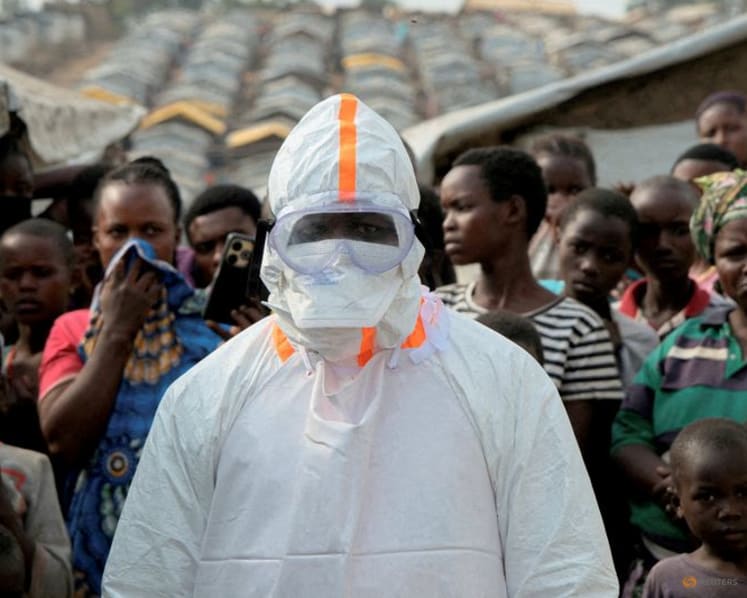
FILE PHOTO: A health worker in personal protective equipment stands near displaced people waiting for the burial of suspected Ebola victims at the Kigonze displaced persons camp, one month after an outbreak was declared, in Bunia, eastern Democratic Republic of Congo, June 18, 2026. REUTERS/Gradel Muyisa Mumbere/File Photo
GENEVA: The World Health Organization has received less than half the funding it needs to fight the Ebola outbreak in eastern Democratic Republic of Congo, a WHO official said on Tuesday (Jul 14), urging donors not to abandon the country at a critical stage of the epidemic.
The global health agency has received about 40 per cent of its US$115 million appeal to tackle the Bundibugyo outbreak, for which there is no proven treatment or vaccine. At least 1,926 people have been infected and 702 have died, government data show.
"This outbreak requires resources that match the scale of the challenges that we are facing. And this is not a burden DRC can be allowed to carry alone," Chikwe Ihekweazu, head of the WHO's Health Emergencies Programme, told reporters in Geneva after a visit to the worst-hit province of Ituri.
Ihekweazu said the response had reached a critical point, with intensified efforts needed to detect and isolate patients after cases spread this week to two new provinces.





"It's a bit like a marathon. You can't give up after the first lap or the second. You just have to keep pushing even when you're getting tired and exhausted," he said.
He repeated estimates that the true number of Ebola cases in Congo is at least double, and possibly over four times, the official tally.
On Tuesday, Singapore said it would contribute US$2 million to support the response to the virus outbreak in the DRC and Uganda.
The funds will go towards supporting efforts in laboratory testing and contact tracing, infection prevention and control, and case management on the ground.