Asian stocks tumble as Gulf war rages
Japan's Nikkei fell more than 3 per cent while South Korea's Kospi slid more than 6 per cent on Monday (Mar 23).
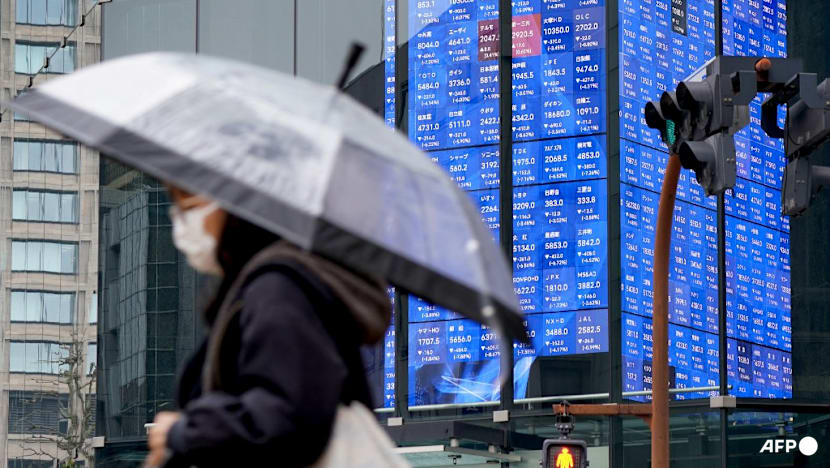
A pedestrian walks past an electronic quotation board displaying the Nikkei 225 stock prices on the Tokyo Stock Exchange in Tokyo on Mar 23, 2026. (Photo: AFP/Kazuhiro NOGI)
HONG KONG: Share markets slid in Asia and oil prices rose on Monday (Mar 23) after US President Donald Trump and Iranian leaders traded threats over the key Strait of Hormuz, while Israel said the Middle East war could last several more weeks.
With the conflict now in its fourth week and showing no sign of ending, the head of the International Energy Agency warned of the worst global energy crisis in decades and said the world economy was under "major threat" from it.
The US president on Saturday gave Iran 48 hours to reopen the Strait of Hormuz to shipping or face the destruction of its energy infrastructure.
The ultimatum, made just a day after the US leader said he was considering "winding down" military operations, came as the waterway - through which a fifth of global oil and gas flows - remained effectively closed.
Iran warned Hormuz "will be completely closed" if Trump acted on his threat.
The escalation hammered stock markets, with Seoul and Tokyo - which had been the standout performers before the war started - taking the brunt of the selling, shedding 6.5 per cent and 3.5 per cent, respectively.
MSCI's broadest index of Asia-Pacific shares outside Japan fell 3.2 per cent.
Stocks in China and Hong Kong were on track for their worst day in nearly a year.
China's benchmark Shanghai Composite Index slumped 2.5 per cent at the lunch break, heading for its biggest one-day drop since April 2025.
The blue-chip CSI300 Index lost 2.4 per cent to reach a four-month low.
Hong Kong and Shanghai shed more than 3 per cent, while Singapore, Taipei, Mumbai, Bangkok and Manila all lost between 2 and 3 per cent. Sydney and Wellington were also deep in negative territory.
Oil prices jumped more than 2 per cent with Brent above US$114 and West Texas Intermediate topping US$101.
Near-term supplies have been aided by the US allowing Iranian and Russian oil to be sold from tankers, but the growing risk of longer-term shortages was lifting futures down the curve. September Brent, for instance, was up US$1 at US$92.90, suggesting high prices were here to stay.
"The war could still go on for many weeks yet and see oil prices rise, say to US$150 a barrel," said Shane Oliver, head of investment strategy at fund manager AMP. "And the steady destruction of energy infrastructure means it will take longer to get supply back to normal."
"It's also worth noting that past oil shocks unfolded over many months in terms of the rise in oil prices as the full impact became clearer – it was over about 4 months in 1973 and a year in 1979."
Analysts at HSBC noted Singapore jet fuel was up 175 per cent this year to a multi-decade high, while Asian liquefied natural gas had climbed 130 per cent. Bunker fuel used in shipping had blown out, raising the cost of transporting goods, while surging fertiliser prices will make food more expensive.

SAY GOODBYE TO RATE CUTS
Observers have also raised the prospect of a surge in inflation that could force central banks to hike interest rates, while the choking off of fertiliser shipments has also fanned concerns about global food security.
Futures have wiped out expectations for 50 basis points of easing from the Federal Reserve this year, with even a small chance the next move could be up.
The hawkish sea change has hammered bonds and sent yields climbing, adding to borrowing costs for many governments already struggling with deficits and debt.
The prospect of higher costs and softer consumer demand has clouded the outlook for corporate profits, while the jump in yields made equity valuations look ever more stretched.
The energy shock, combined with pressure on fiscal budgets from higher defence spending, saw double-digit increases in bond yields globally last week.
Ten-year US Treasury yields were at an eight-month top of 4.4110 per cent, having climbed a steep 44 basis points since the war began.
The heightened volatility in markets has tended to benefit the US dollar as a store of liquidity. The US is also a net energy exporter, giving it a relative advantage over Europe and much of Asia, which are net importers.
The euro was a shade lower at US$1.1555, but some way from major supports at US$1.1409 and US$1.1392.
The dollar was flat versus the yen at 159.15, just off a 20-month top of 159.88, with investors wary in case a break of 160.00 triggers intervention from Japan.
In commodity markets, gold was 0.4 per cent firmer at US$4,511 an ounce, having lost ground last week as investors wager on higher interest rates globally.