Intern doctor deaths reveal dark side of Indonesia’s medical training system
Young doctors in Indonesia enter housemanship with dreams of saving lives, but face exhaustion, overwork and mistreatment from seniors, sometimes putting their own lives at risk.
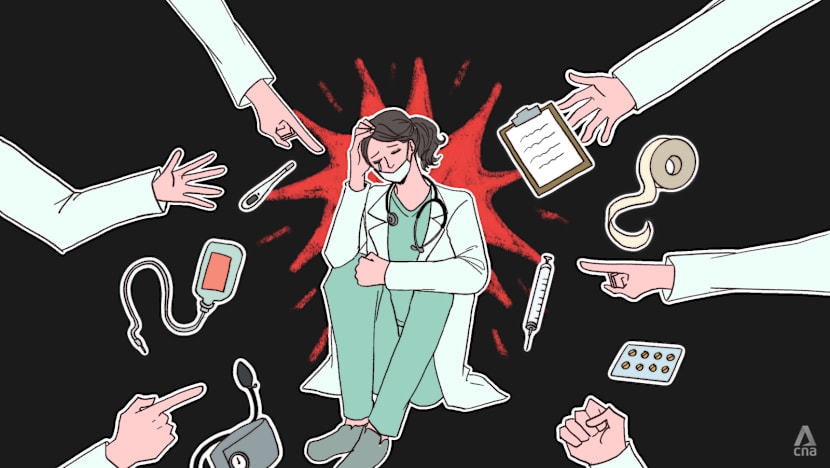
Gruelling hours and physical and verbal abuse from seniors and mentors are pushing Indonesian doctors undergoing housemanship to the brink. (CNA Illustration: Clara Ho)

This audio is generated by an AI tool.


JAKARTA: As soon as Annisa began recounting her days as an intern doctor two years ago, her voice started to tremble. At times, she became so breathless, it was like she was drowning in her own tears.
It was then early 2024, and the 25-year-old junior doctor was undergoing a year-long housemanship at a public hospital in East Java, Indonesia.
Sitting at the bottom of the hospital’s rigid hierarchy, Annisa took on the shifts other doctors avoided and the tasks no one else wanted. Once, she said, she worked for 36 hours straight, covering for more senior doctors who were away for the Muslim holiday of Idul Fitri which in 2024 fell on Apr 9 and Apr 10.
“As tiring as it was physically, mentally it was even worse. Every tiny mistake or the slightest hint of impoliteness could trigger outrage and name-calling, sometimes publicly,” Annisa, who declined to give her full name for fear of reprisal, told CNA.





“Every day I felt like crying. Every day I thought about quitting and giving up on my dream to become a doctor.”
In Indonesia, medical graduates seeking a licence to practise independently must first complete a 12-month housemanship, or internship, at hospitals or clinics, where they undergo supervised, hands-on training under experienced doctors.
Doctors undergoing specialist training must also complete a housemanship programme on top of the housemanship year. This can range between three and six years depending on the specialties.
For many doctors, these housemanship periods can be joyful, ripe with valuable lessons and guidance from nurturing seniors. But for others, they can be stressful and traumatising, with serious consequences, as shown in recent cases.
Four deaths amongst houseman doctors since the beginning of the year have pushed the sometimes strenuous workload and highly stressful environment of Indonesia’s intern programmes into the public spotlight.
In the latest case, on May 1, Myta Aprilia Azmy, a 25-year-old doctor interning at Daud Arif public hospital in Kuala Tungkal, a small town in Jambi province, died of a suspected lung infection.
Rudi Supriatna Nata Saputra, acting inspector general at the Indonesian ministry of health said at a press conference in Jakarta on Thursday (May 7) that there were “indications of overwork” among the 30 housemen at the hospital.
Myta and the other housemen were given 12-hour shifts every day and were only allowed four days sick leave during the entire programme, Rudi said.
The housemen were told that they had to compensate for additional sick leave days by staying longer with the programme. Every time they were absent, the housemen had to find colleagues willing to step in.
“This could be one of the reasons why (Myta) was reluctant to report her illness and continued to work,” Rudi said.
Myta, the inspector general said, first experienced symptoms of high fever and shortness of breath on Mar 26. She chose to self-medicate, at times prescribing herself oral medicines and injecting intravenous liquid with the help of another doctor.
Between Apr 15 and her death she was hospitalised multiple times, first in Kuala Tungkal, then in the city of Jambi, some three hours drive away and later in Palembang, South Sumatra, a further eight hours drive away.
These long drives were done using a private car arranged by Myta’s family and not by an ambulance, which Rudi said violated proper medical procedure considering her low oxygen saturation.
In Palembang’s Mohammad Hoesin Hospital, one of the biggest in Sumatra, Myta was diagnosed with a lung infection and put in intensive care. She died three days later.
Rudi said the investigation was ongoing but added that there were indications that the hospital violated the work hour limit while doctors responsible for the housemanship programme tried to manipulate data and hide evidence.
Speaking at the same press conference, Health Minister Budi Gunadi Sadikin promised to evaluate Indonesia’s housemanship programme.
“This year alone, four doctors have died. I am saddened, mournful and this should never happen again,” he said.


CULTURE OF SILENCE
Myta’s case was the latest in a troubling pattern.
On Feb 25, Kartika Ayu Permatasari, an intern at a hospital in Rembang, Central Java died after contracting measles from a patient.
The following month on Mar 17, another intern at a hospital in Denpasar, Bali, Edgar Bezaliel Hartanto died from dengue fever.
On Mar 26, Andito Mohammad Wibisono, who was interning at a hospital in Cianjur, West Java died from measles complications.
The health ministry has denied that the three interns were also overworked and were told to work even when they were sick.
Regardless, experts and professionals said the interns’ lives could have been saved had their mentors, colleagues and hospital management been more attentive to their wellbeing.
According to the 2003 Indonesian Law on Manpower, maximum regular working hours are seven hours a day and 40 hours a week in a six-day working week, or eight hours a day in a five-day working week. Anything else is classed as overtime, which is meant to be voluntary and must not exceed four hours a day or 18 hours per week.
The health ministry’s 2024 guidelines for the Indonesian Doctor’s Internship Programme echo these limits, and further stipulate that overtime should not exceed 20 per cent of normal working hours.
“The regulations are already clear. What is lacking is law enforcement,” Dicky Budiman, a public health expert from Jakarta’s Yarsi University, told CNA.
In August 2025 - the last time such data was made public - Health Minister Budi said the ministry had received 2,920 complaints related to housemanship programmes since opening a hotline in June 2023.
The complaints ranged from physical and verbal abuse to extortion and excessive working hours. Of these, only 733 cases had sufficient evidence to warrant investigation, and 124 were substantiated and resulted in sanctions.
But experts say the numbers likely represent only a fraction of the problem.
“In practice, there is no leave, the pay is (sometimes) below the regional minimum wage (UMR), and public holidays are not observed. On the ground, the workload is extraordinary,” Slamet Budiarto, chairman of the Indonesian Medical Association told CNA.
Housemen in Indonesia are paid between 3.2 million rupiah to 6.4 million rupiah (US$184 to US$368) monthly depending on the cost of living of a given area. Indonesia’s minimum monthly wage ranges from 2.3 million rupiah to 5.7 million rupiah depending on the regency.
Windhu Purnomo, a public health expert from Airlangga University in East Java, said many cases went unreported because the victims were too afraid to speak up.
“Interns are reluctant to report cases of bullying or overwork out of fear of reprisal, flunking the (housemanship) programme, being excommunicated by their seniors, or being seen as weak and (unable to) handle the pressure of being a doctor,” said
That silence, he added, has allowed such practices to persist across generations.
“Even when I was a junior doctor, overwork, bullying, hazing, exploitation existed, and things have not improved since,” said the 71-year-old.
HIGH STRESS ENVIRONMENT
But keeping quiet comes at a cost.
“I used to be confident in medical school,” Ayu, a doctor who recently completed her housemanship in Central Java, told CNA.
“When seniors scold you again and again, you start thinking, maybe they’re right. Maybe I’m not good enough. Maybe I deserve to be treated this way.”
Ayu, who also asked CNA not to reveal her full name, thought about speaking up against the long hours and unfair treatments she endured multiple times.
“But the other interns wouldn’t join me (in speaking up). Even my parents said: ‘Just endure, you’ll finish the programme in no time.’ So I kept all that frustration, fear and sadness to myself,” the 26-year-old said.
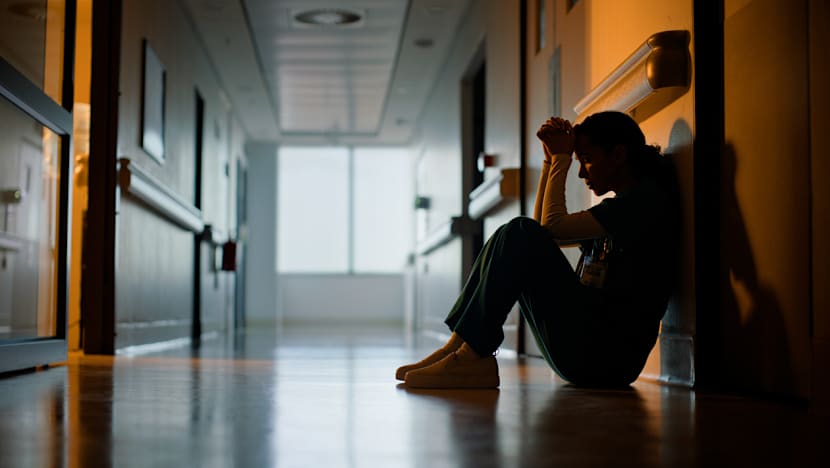
Experts warn that such patterns: chronic stress combined with suppressed emotions and a culture of silence, can heighten the risk of anxiety, burnout and depression.
In 2018, a group of students from Padjdjaran University’s Faculty of Psychology conducted research on the prevalence of stress among intern doctors and found that 3.16 per cent suffered from “high” levels of stress, 27.37 per cent from “slightly high” stress and 44.21 per cent from “moderate” stress.
Among the causes listed by the interns surveyed were: overwork, lack of scheduled days off, conflicts with senior doctors and lack of support from people around them.

And bottled up feelings of exhaustion, fear and humiliation have pushed some young doctors to the brink.
On Aug 12, 2024, Aulia Risma Lestari, a 30-year-old trainee anaesthesiologist at Kariadi Hospital in Semarang, Central Java, was found dead in her dormitory from apparent suicide.
Subsequent investigation from police and the health ministry revealed that her seniors had allegedly forced her to work up to 23 hours a day, while also making her pay for their meals and complete their paperwork.
Police later charged one of Aulia’s seniors, a hospital administration staffer and a programme manager in connection with the extortion case.
On Oct 1, 2025, the programme manager Taufik Eko Nugroho was found guilty and sentenced to two years in prison while Aulia’s senior: Zara Yupita Azra and admin staff Sri Maryani were handed a nine-month prison term each.
The health ministry temporarily suspended the hospital’s anaesthesiology housemanship programme before the suspension was lifted in May last year.


BREAKING THE CYCLE
Following Myta’s death, the Indonesian Medical Association (IDI) wrote a 12-point recommendation to the ministry of health urging it to strictly impose the 40 hour per week limit for intern doctors, cut the housemanship duration by half and provide interns with one day compulsory leave every month.
“There have been four deaths (this year) already. The health ministry must pay serious attention to the problem,” association chairman Slamet said.
IDI chairman Slamet said the association is also setting up its own hotline, so interns would have another avenue to report cases of overwork, bullying and abuse. The association will also revoke or suspend the practicing licence of mentors and seniors involved in cases of bullying and abuse, he added.
Windhu of Airlangga University said it is important for all sides to work together and reform how housemanship is run in Indonesia.
“At stake is people’s confidence in our healthcare system. Who would want to be treated at a hospital where doctors are dying from treatable diseases or where doctors are so overworked their hands are jittering?” he said.
Meanwhile, Dicky of Yarsi University said that there should be an independent body monitoring how housemanship programmes in Indonesia are run.
“Right now, the health ministry has authority over everything: from planning to execution to evaluation,” he said. “These functions should be separated. No matter how good the regulations are, someone has to enforce them and enforce them fairly and impartially.”
Health minister Budi said on Thursday that there would be “fundamental changes” to how the country’s housemanship programme is run.
“There should be no more bullying, extortion. We will erase these bad old traditions,” the minister said.
The ministry, he said, will get tough on the no more than eight hours per day working hour rule and raise the interns’ maximum salary to 7.5 million rupiah.
For Annisa, it is important for young doctors like her to break the cycle of abuse that has been going on for generations.
“Seniors should guide their juniors, because interns are there to learn so they can treat patients of their own. (Interns) should be treated as colleagues because in a few months time, they will be,” she said.
She added that she is sometimes jealous hearing stories of those who had tiring but rewarding experiences because they met nurturing seniors and mentors.
“I know how it feels to be at the bottom, to be shouted at, to feel small,” she said. “I would never do that to my junior.”