Johor proposes 12 ‘key’ drop-off points for Singapore cross-border taxis, may require tracking system
The proposed drop-off points include Senai International Airport, JB Sentral, Medini, Southkey, Mount Austin and Eco Botanic among others.
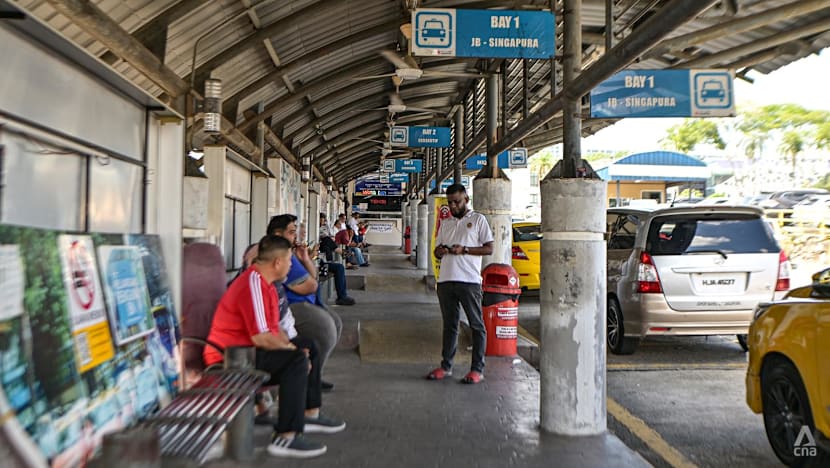
Cross-border taxi drivers wait for passengers at Larkin Sentral on Dec 5, 2025. (Photo: CNA/Zamzahuri Abas)
JOHOR BAHRU: The Johor state government has proposed 12 “key” locations where Singapore cross-border taxis could drop off passengers, as authorities consider requiring these vehicles to be installed with a location tracking system.
The proposed drop-off points include Senai International Airport, JB Sentral, Medini, Southkey, Mount Austin and Eco Botanic, according to Johor’s Works, Transportation and Infrastructure committee chairman and state executive councillor Mohamad Fazli Mohamad Salleh.
Six shopping malls are also under consideration, including Johor Premium Outlets (JPO) near Kulai. The other five malls were not specified, and CNA has since reached out to Fazli for more information.
“These drop-off points are locations the state government considers key destinations. When we mention taxis from Singapore, it could involve foreign tourists who arrive at Changi Airport and want to travel directly to Johor by taxi,” Fazli said in an interview with state news agency Bernama on Saturday (Mar 7).
Currently, cross-border taxis are allowed to drop off passengers only at designated points - Larkin Sentral in Johor Bahru for Singapore taxis and Ban San Street Terminal in Singapore for Malaysian taxis.
Meanwhile, Fazli said that it was understood that Malaysia taxis may be allowed to drop passengers at five locations in Singapore - Changi Airport, Kranji, Jurong, Shenton Way, and Rochor.
In December, the transport ministries of both countries announced that foreign taxis will be able to drop off passengers anywhere outside their home country. However, they can only pick up passengers at the designated pick-up points to prevent them from providing local point-to-point services.
The ministries did not specify when the changes would take effect, but also announced plans to increase the quota for licensed cross-border taxis from 200 to 500.





In the Bernama interview, Fazli said that Singapore cross-border taxis are expected to be required to install a location tracking system to monitor their movements in Johor.
This, he said, would ensure that passengers are picked up and dropped off only at designated locations.
Fazli noted the move would mirror Singapore’s requirement for Malaysia’s cross-border taxis to install the country’s Electronic Road Pricing 2.0 (ERP2) on-board unit system for the same purpose.
In a parliamentary written reply in January, Singapore’s Acting Transport Minister Jeffrey Siow said that licensed cross-border taxis from Malaysia entering Singapore would be required to install ERP2 on-board units, as part of efforts to curb illegal point-to-point transport services.
These Malaysian taxis must be clearly identifiable by their livery, tamper-proof vehicle plates with a predefined prefix and taxi toppers, the minister said.
The ERP2 on-board units will also become mandatory for Singapore-registered vehicles as the country fully switches to the ERP2 system from Jan 1 next year.
“Malaysia is expected to implement a similar or at least an equivalent measure. However, the matter of the installation cost is still under discussion,” Fazli said, with regards to the requirement for Singapore cross-border taxis to install a location tracking system.
He added that the approach would also facilitate monitoring of the Singapore taxis by Malaysia's transport ministry.
Meanwhile, Fazli said that cross-border taxi fares have not yet been discussed.
Currently, a one-way trip from the designated pick-up point at Larkin to Ban San Street Terminal is priced at RM120 (US$30) while a one way trip from the same location in Singapore to Johor Bahru costs about S$60 (US$47).