Tributes pour in for Mark Tully, BBC's 'voice of India' who died at 90
Indian Prime Minister Narendra Modi led the tributes to Tully, saying "his connect with India and the people of our nation was reflected in his works".
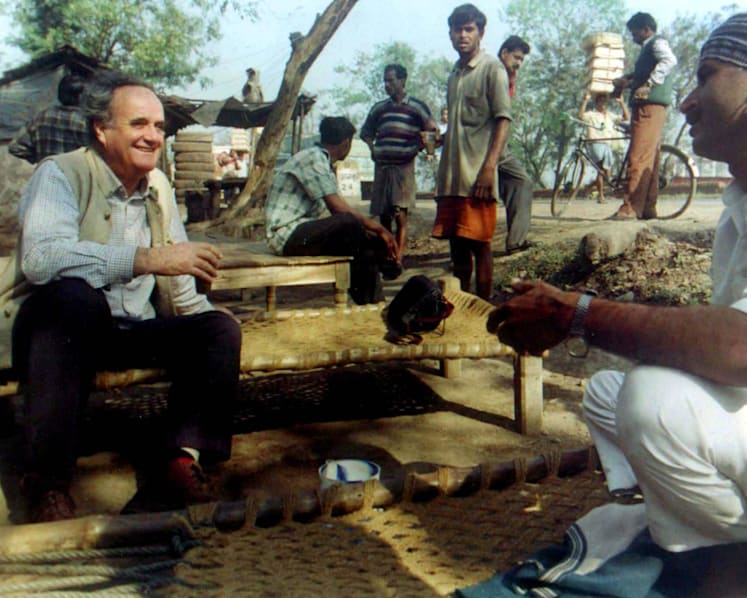
Mark Tully at a highway teashop in Dankuni, 20km northwest of Calcutta, India, Feb 18, 2002. (File photo: AP/Nilayan Dutta)
Tributes have poured in across India for the late BBC correspondent Mark Tully, known to millions as the broadcaster's "voice of India" for covering defining moments across the South Asian nation.
The veteran journalist died in New Delhi on Sunday (Jan 25), aged 90.
Indian Prime Minister Narendra Modi led the condolences in India, describing Tully as a towering voice of journalism.
"His connect with India and the people of our nation was reflected in his works. His reporting and insights have left an enduring mark on public discourse," Modi said.





"Condolences to his family, friends and many admirers."
Congress leader Pawan Khera said he grew up listening to Tully and reading his books.
"Many like me, grew up listening to his voice, reading his books. I ended up living in the very locality in which he lived for years and fell in love with," he added.
Tully reported on some of the most defining moments in the region's history, said India's Petroleum Minister Hardeep Singh Puri.
"For generations across our subcontinent, his calm and unmistakable voice was synonymous with news," he posted on X.
The Times of India called him "a chronicler of India".
Born in India in 1935 under British rule, Tully made the country his home and his career, becoming arguably the best-known foreign correspondent in the country.
He reported on events such as the 1971 India-Pakistan war that led to the creation of Bangladesh, the siege of the Golden Temple in 1984, the 1991 assassination of Prime Minister Rajiv Gandhi and the 1992 demolition of the Babri mosque, which triggered nationwide riots.
For his work, he received two of India’s highest civilian honours, the Padma Shri and the Padma Bhushan, which are rarely bestowed on foreigners.
"HONOUR TO INDIA"
Tully studied theology at Cambridge University before joining a seminary.
But he returned to India in 1965, joining the BBC in New Delhi as an office administrator.
After a brief stint in London at the BBC's Hindi and World Service, he was appointed the public broadcaster's correspondent in New Delhi in 1971.
Tully was named bureau chief a few years later, overseeing coverage of South Asia, including India, Pakistan, Bangladesh and Sri Lanka - a position he held for two decades.
He resigned from the BBC in 1994 amid a dramatic overhaul of the organisation, criticising the then director general John Birt, denouncing the "revolution" taking place at the corporation, beginning with a "sweeping attack on the BBC's journalism".
After resigning, he continued working as a freelancer and writing books.
Britain knighted Tully in 2002 for services to broadcasting and journalism - a recognition HE would later describe as "an honour to India".
BBC News interim chief Jonathan Munro said: "Sir Mark opened India to the world through his reporting, bringing the vibrancy and diversity of the country to audiences in the UK and around the world."