New Zealand can no longer take its security for granted, says defence minister as military spending rises
New Zealand could move faster towards its target of spending 2 per cent of GDP on defence if security conditions warrant it, Defence Minister Chris Penk tells CNA.
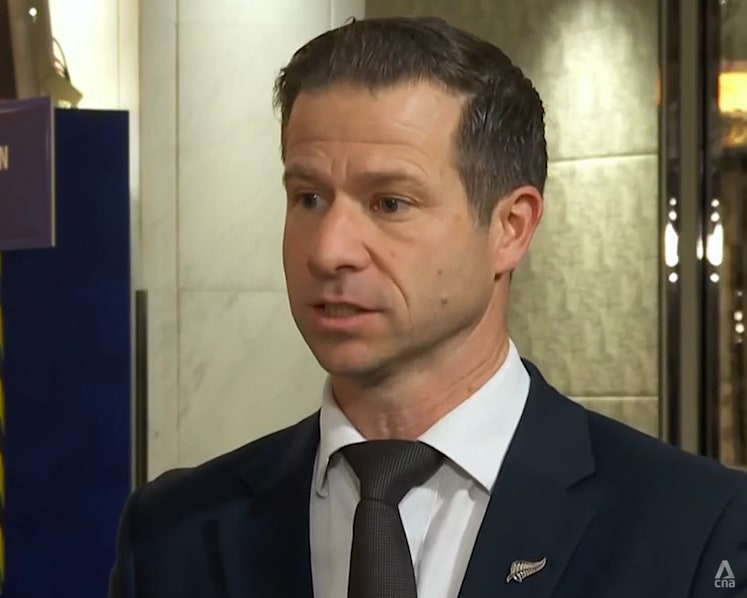
New Zealand's Defence Minister Chris Penk speaks to CNA during an interview on the sidelines of the Shangri-La Dialogue in Singapore on May 29, Friday.

This audio is generated by an AI tool.


SINGAPORE: New Zealand can no longer rely on its geographic isolation as a shield from security threats, Defence Minister Chris Penk said, as the country boosts defence expenditure and upgrades its forces.
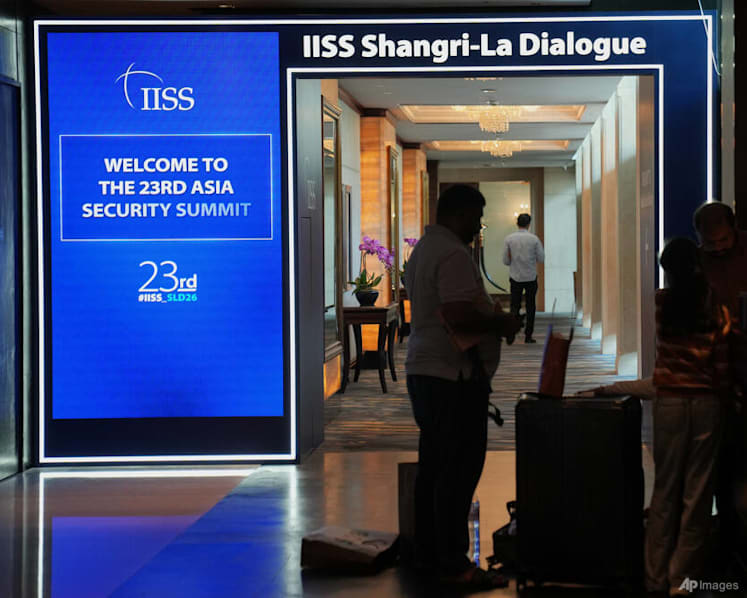
Speaking to CNA on the sidelines of the Shangri-La Dialogue in Singapore on Friday (May 29), Penk said New Zealand needs to better protect its sovereignty and maritime interests amid an increasingly contested security environment.
“As a maritime nation, we're heavily dependent on the sea. Once upon a time, (the ocean) felt as though it was a buffer – or a safety barrier – between us and the rest of the world,” he said.
“But (we’re) now realising we can't take for granted the integrity of the 12 nautical mile (internationally recognised territorial) limit that we have, our exclusive economic zone and freedom of navigation.”





His comments came a day after New Zealand announced a 9 per cent boost in defence spending in its 2026 budget, with a strong focus on maritime security, including drone systems and fleet renewal.
The increase follows the government's commitment last year to nearly double defence spending to 2 per cent of gross domestic product (GDP) within eight years.
Defence spending is expected to reach 1.23 per cent of GDP in the coming year, according to budget documents.
“There's an open question about whether we should move faster. We've committed to reviewing progress and, if necessary, speed up our trajectory to 2 per cent of GDP,” Penk said.
A MORE CONTESTED WORLD
The defence minister said the military investment reflects a changing threat environment shaped by growing strategic competition and conflicts beyond New Zealand's shores.
“We live in a world where there is competition and contest, even within our region. Further afield, there's conflict,” Penk said, pointing to wars in Ukraine and the Middle East and their implications for the international rules-based order and global economic security.
“We need to increase our defence investment to resource our navy, army and air force to be able to meet the needs of New Zealand in our region and further afield.”
Maritime capability is one of New Zealand’s most urgent priorities, he said, noting that by the mid-2030s most ships in the nation’s naval fleet are expected to have reached the end of their design life.
The government is evaluating options to replace its frigates and other naval assets, alongside investments in air assets and uncrewed technologies.
DEEPENING ENGAGEMENT WITH ASIA
Alongside military modernisation, Wellington is seeking to strengthen its engagement across Asia.
"The Asia region is really important for us," Penk said, citing deep trade, economic and people-to-people links across the region.
"For all the reasons that we consider ourselves an Asian nation, it's important that we retain those links."
Penk stressed that New Zealand has long maintained a presence in the Indo-Pacific and intends to remain actively engaged in the region.
He also underscored his nation's commitment to supporting Pacific Island neighbours, saying Wellington supports their aspiration for the Pacific to remain an "ocean of peace".
To that end, New Zealand will continue contributing to humanitarian assistance and disaster relief operations, fisheries protection, maritime surveillance and efforts to combat transnational organised crime such as drug trafficking, he said.
“STRONGER TOGETHER”
Penk pointed to cooperation between New Zealand and Singapore as an example of how smaller countries can amplify their influence and capabilities through defence cooperation.
“The way that Singapore and New Zealand interact well with other nations is a way that we can act as force multipliers,” he said.
The two countries maintain longstanding defence ties through military exchanges and training programmes.
Penk also highlighted cooperation under the Five Power Defence Arrangements (FPDA), which includes New Zealand, Singapore, Australia, Malaysia and the United Kingdom.
He added that partnerships and interoperability are particularly important for smaller countries seeking to contribute to regional security and stability.
“When we (conduct such defence) exercises together … we've got opportunities to make sure our personnel are well prepared for any eventuality in our region,” he said.
“We're stronger together.”