Asian markets rebound after Trump walks back tariff threats; South Korea's Kospi tops 5,000 for first time
Trump's comments eased market volatility, with Seoul, Tokyo, Hong Kong, Shanghai, Taipei and Singapore all closing higher on Thursday (Jan 22).
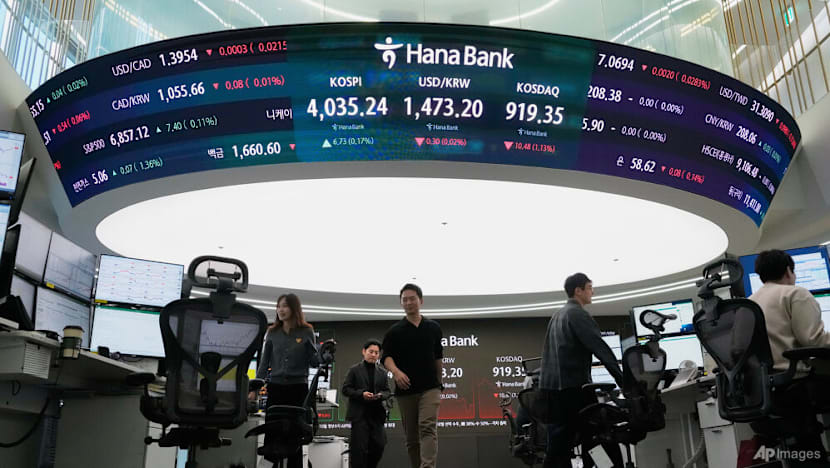
Currency traders pass by a screen at the foreign exchange dealing room of the Hana Bank headquarters, in Seoul, South Korea, on Dec 5, 2025. (File photo: AP/Ahn Young-joon)
Asian markets rebounded on Thursday (Jan 22), tracking gains on Wall Street after US President Donald Trump backed away from his threats to slap new tariffs on European nations.
Markets have been whipped with volatility this week after the US president said at the weekend that he would hammer several nations - including Germany, France, Britain and Denmark - with levies from Feb 1 for their pushback against his grab for Greenland.
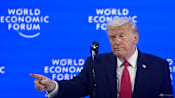
But traders breathed a sigh of relief Wednesday when the US president told the World Economic Forum (WEF) in Davos that he would not take the Danish autonomous territory by force - as he had hinted - and later said he had retracted his tariff threat.
Overnight, the S&P 500 posted its biggest one-day percentage gain in two months, gaining 1.16 per cent.





The Dow Jones Industrial Index and Nasdaq Composite also surged, gaining the most in percentage terms since Jan 5 and Dec 19, respectively. The Dow rose 1.21 per cent while the Nasdaq added 1.18 per cent.
Trump's comments eased market volatility, with Seoul, Tokyo, Hong Kong, Shanghai, Taipei and Singapore all closing higher on Thursday.
The gains were also fuelled by a surge in regional tech giants as the artificial intelligence trade roared back into the spotlight after the head of Nvidia said the sector needed "trillions of dollars" more investment.
Nvidia boss Jensen Huang told the WEF that the infrastructure to develop and power generative artificial intelligence models will require much more cash.
He told delegates that today's AI boom "has started the largest infrastructure buildout in human history".
"We're now a few hundred billion dollars into it ... there are trillions of dollars of infrastructure that needs to be built out" in fields including energy, cloud computing and electronics.
South Korea's benchmark Kospi topped 5,000 points for the first time, rising as much as 2.2 per cent to an all-time high of 5,019.54 in morning trade, before it closed the session up 0.9 per cent at 4,952.53.
It was powered by gains in chipmakers like Samsung Electronics and SK Hynix, reaching a level promised by President Lee Jae Myung in just over six months since he took office.
The index has risen 18 per cent so far this month, after emerging as the world's best performer in 2025 with a 76 per cent jump - its biggest annual gain since 1999 - on a chip rally fueled by artificial intelligence optimism and various capital market reforms.
Shares of chipmaker Samsung Electronics closed 1.9 per cent higher, after rising as much as 5 per cent on Thursday to a record high, while peer SK Hynix gained 2 per cent. The two chipmakers account for a combined 35 per cent of the benchmark index by market capitalisation.
Hyundai Motor has also been rallying this month to become the country's third-most valuable company, as investors cheered its newly unveiled humanoid robot technologies. The automaker surged as much as 7.5 per cent on Thursday to a record level, before closing down 3.6 per cent on profit-taking pressure.
"The bullish market trend this time is a fundamentals-driven one based on earnings growth, which makes the Kospi still cheap," said Kim Jae-seung, an analyst at Hyundai Motor Securities.
Under his "Kospi 5,000" initiative, President Lee has introduced a series of market reforms and tax measures aimed at boosting the domestic stock market and resolving the so-called "Korea Discount", since he took office in June 2025.
The Korea Discount refers to a tendency for domestic stocks to trade at lower valuations compared with global peers, due to factors such as opaque corporate governance structures and low dividend payouts.
The Lee administration last year revised the Commercial Act to better protect shareholder interests and plans to make share repurchases and cancellations a requirement for listed companies to boost shareholder value.
The government also aims to win developed-market status for the domestic stock market from global index provider Morgan Stanley Capital International (MSCI), with further loosening of foreign exchange restrictions planned for this year to improve foreign access.
Elsewhere, Japan's Nikkei 225 ended the day 1.73 per cent higher on Thursday after it saw its exports rise for the fourth straight month in December.
This comes after the Nikkei fell for a fifth straight session on Wednesday, pressured by global trade frictions and political uncertainties at home.
Japanese Prime Minister Sanae Takaichi is set to dissolve parliament on Friday to trigger a snap election, while the central bank meets on policy the same day.
Hong Kong's Hang Seng Index closed up 0.17 per cent, while the Shanghai Composite Index rose 0.14 per cent.
Taiwan stocks also closed higher at 1.60 per cent, with TSMC, the world's main producer of advanced AI chips, also gaining 1.15 per cent.
In Singapore, the Straits Times Index climbed 0.38 per cent at the close.
Australia's S&P/ASX 200 was also up 0.75 per cent on Thursday, snapping a three-day losing streak.