Sri Lanka faces long road to recovery as floodwaters recede; WFP warns of ‘catastrophic’ devastation
The United Nations food agency says the disaster could trigger rising hunger unless livelihoods are restored.

An elderly woman, along with a child, takes refuge at a relief camp inside a school after being evacuated following rapid floods in Wellampitiya on the outskirts of Colombo on Dec 1, 2025. (Photo: AFP/Ishara S. Kodikara)

This audio is generated by an AI tool.


Sri Lanka is confronting a growing humanitarian crisis following the country’s worst flooding in decades, with the World Food Programme (WFP) warning that families remain at risk of hunger and disease.
Speaking to CNA Asia Now, WFP’s country director in Sri Lanka, Philip Ward, described the situation as “catastrophic”, with 1.8 million people affected after Cyclone Ditwah triggered widespread flooding and landslides across the country last week.
“Farmland is completely inundated, supply chains are starting to cut off, and the needs of people are really escalating,” he said, adding that some 200,000 people remain displaced in temporary shelters.
Teams from the WFP – the United Nations (UN) agency that fights global hunger – have begun distributing essential items, including water tanks, generators and sandbagging equipment, while flying in fortified food to meet basic nutritional needs.





But Ward stressed that the crisis extends well beyond food insecurity.
“Because of the amount of water that is still (covering areas) across the country, there are issues around health, water and sanitation that also need to be addressed,” he said.
To manage these risks, WFP is working “closely with our other UN partners to make sure that both food security, nutrition and other needs can be met in a coordinated way”.
Authorities estimate Sri Lanka may require up to US$7 billion to rebuild.
"This is going to be a humanitarian disaster, not just in the short term,” Ward added.
“What we really need to do is make sure that over the longer term we protect people and ensure their livelihoods to prevent any rise in hunger and malnutrition."
“That ultimately will pull the people through to a more sustainable way of getting back to their lives.”
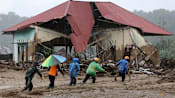
The WFP is also supporting the government in strengthening disaster planning and social protection systems so future cyclones do not push families “straight into hunger”.
Ward said these improvements are essential “so that the next time that a disaster of this magnitude happens, the government and the humanitarian community will be in a better position to be able to respond quickly and rapidly and effectively.”
To that end, he said the WFP is working with the government in "being able to gather data in emergencies like this, to be able to do rapid assessments, to know where the people are, and then to be able to support them".
ECONOMIC COSTS OF FLOODS
Floods have recently hit multiple countries in South and Southeast Asia, including Indonesia, Vietnam, Thailand and Malaysia.
Rajiv Biswas, CEO of research firm Asia-Pacific Economics, noted that the economic impact is expected to ripple across affected nations, with losses in household spending, business activity and infrastructure.
But the small economy of Sri Lanka is likely to suffer the most severe blow, he said.
Speaking to CNA’s Asia Tonight, Biswas said the estimated impact of the floods on Sri Lanka’s gross domestic product is about 0.8 percentage points.
Sri Lanka had previously been expected to grow around 3.5 per cent this year.
“The growth rate is likely to be well below the 3 per cent mark, probably around 2.7 per cent,” Biswas said.

He cautioned that the true economic cost may grow as the damage is assessed and reconstruction begins, adding that infrastructure damage remains one of the biggest concerns.
“It takes a lot longer to rebuild bridges, roads, railways,” Biswas noted, adding that housing has also been hit hard, impacting thousands of families.
“The concern is that (Sri Lanka) is fiscally quite constrained in terms of its ability to spend because of budget problems,” Biswas said.
“So, it will face a lot of challenges and will need international support to rebuild and recover.”