







China welcomes Thailand-Cambodia truce ahead of trilateral talks
China also announced 20 million yuan (US$2.8 million) of emergency humanitarian aid for Cambodia to assist the displaced.
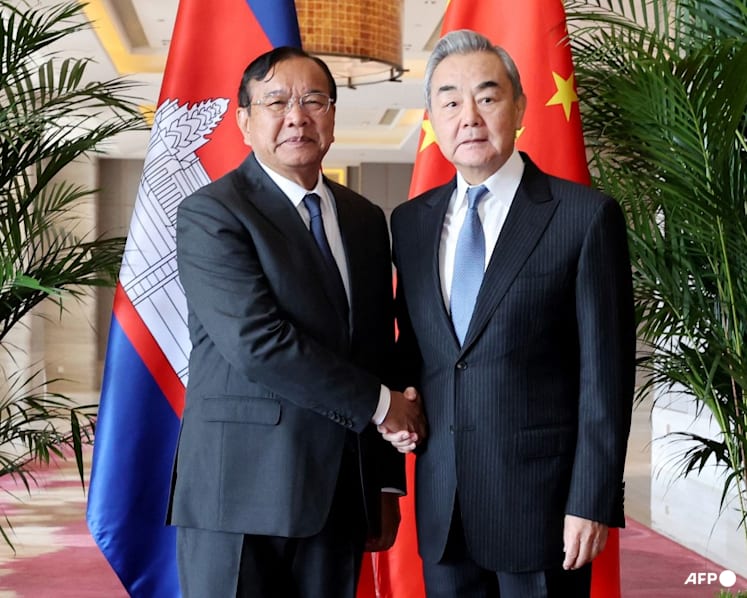
China's Foreign Minister Wang Yi shakes hands with Cambodia's Deputy Prime Minister Prak Sokhonn, who is also the country's Foreign Minister, during a meeting in China's Yunnan province on Dec 28, 2025. (Photo: AFP/Agence Kampuchea Presse/Handout)
BEIJING: China on Sunday (Dec 28) congratulated Cambodia on reaching a ceasefire with Thailand after weeks of deadly border fighting, as officials from the three countries prepared to open a two-day meeting in southwestern China.
Thailand and Cambodia on Saturday ended weeks of fierce border clashes that killed at least 101 people and displaced more than half a million by agreeing on their second ceasefire in recent months.
Chinese Foreign Minister Wang Yi, in a meeting with his Cambodian counterpart, called the ceasefire "an important step towards restoring peace" and said it was "in line with the shared expectations of countries in the region".
Cambodia's top diplomat, Prak Sokhonn, and his Thai counterpart, Sihasak Phuangketkeow, are both expected to meet Wang in the Chinese province of Yunnan on Sunday and Monday to discuss the border situation.





The talks aim to ensure a sustained ceasefire and promote lasting peace between the countries, according to a statement by Sihasak’s office.

Cambodia and Thailand should "promote a complete and lasting ceasefire, resume normal exchanges and rebuild mutual trust" Wang said, according to the official Xinhua news agency.
The two countries' diplomats and military officials should use the meeting in Yunnan as an opportunity to "communicate in a flexible manner and enhance understanding", Wang added.
The ceasefire agreement comes with a 72-hour observation period, at the end of which Thailand agreed to repatriate 18 Cambodian soldiers it has held as prisoners since earlier fighting in July. Their release has been a major demand of the Cambodian side.
China has sought to position itself as a mediator in the crisis, along with the United States and Malaysia.
A July ceasefire was brokered by Malaysia and pushed through by pressure from US President Donald Trump, who threatened to withhold trade privileges unless Thailand and Cambodia agreed.
Despite those deals, Thailand and Cambodia carried on a bitter propaganda war, and minor cross-border violence continued, erupting into heavy fighting in early December.
Prak Sokhonn, in a statement after his meeting with Wang, expressed deep appreciation for China’s "vital role" in supporting the ceasefire.
China also announced 20 million yuan (US$2.8 million) of emergency humanitarian aid for Cambodia to assist the displaced.
The first batch of Chinese aid, including food, tents and blankets, arrived in Cambodia on Sunday, Wang Wenbin, Chinese ambassador to Cambodia, wrote on Facebook.
Sihasak said Sunday he hoped the meetings would convey to China that it should both support a sustainable ceasefire and send a signal to Cambodia against reviving the conflict or attempting to create further ones.
"Thailand does not see China merely as a mediator in our conflict with Cambodia but wants China to play a constructive role in ensuring a sustainable ceasefire by sending such signals to Cambodia as well," he said.






