







China's factories snap years-long deflation spell on Iran war price shock
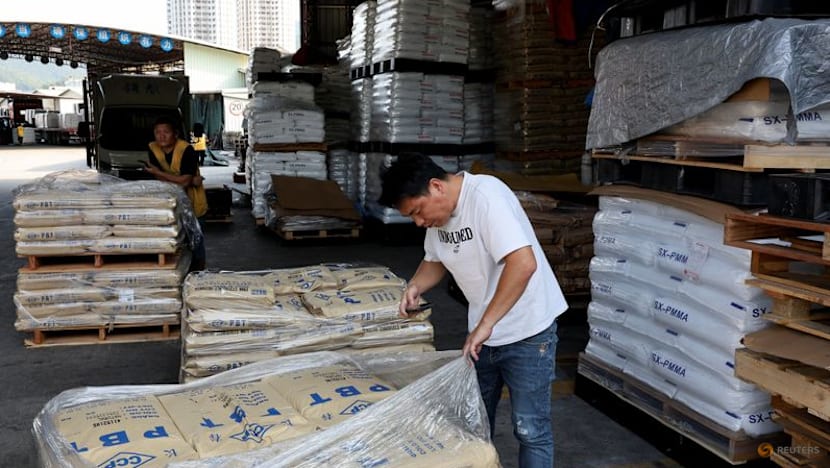
A worker takes a photo of bags of plastic pellets at a warehouse, as rising oil prices drive up production costs for plastic manufacturers, in Dongguan, Guangdong province, China, on Apr 1, 2026. (Photo: REUTERS/Go Nakamura)
BEIJING: China's factory-gate prices rose for the first time in more than three years in March, in an early sign that the war in Iran is feeding cost pressures into the world’s second-largest economy.
Economists warn that a shift to inflation driven by higher costs rather than stronger demand could leave Beijing boxed in, squeezing corporate margins, crimping growth and narrowing room for stimulus at a time when the economy is already fragile.
The producer price index (PPI) increased 0.5 per cent from a year earlier, data from the National Bureau of Statistics showed on Friday, ending a 41-month streak of declines driven partly by intense corporate price-cutting in a phenomenon dubbed locally as "involution". The reading slightly outpaced an estimated 0.4 per cent rise in a Reuters poll.
"Imported inflation is not friendly to the economy," said Xing Zhaopeng, senior China strategist at ANZ.





"To eradicate the risk of deflation, China still needs to continue to promote 'anti-involution' efforts and stimulate domestic demand."
An input-cost shock to the world's largest manufacturing base - which employs hundreds of millions - threatens to pile pressure on jobs and wages. Already, a quarter of manufacturing firms are operating at a loss after years of industrial overcapacity sparked relentless price wars. Chronically weak domestic consumption and fading external demand leave the economy with little cushion.
China needs to weigh rising inflation risks against slowing growth, a central bank adviser said in late March.
China's yuan held steady against the dollar after the inflation data, while mainland equity markets advanced in line with most regional bourses.
BAD INFLATION
Producer prices surged in energy-intensive industries, with the non-ferrous metal mining sector recording a 36.4 per cent jump last month and non-ferrous metal smelting and processing posting a 22.4 per cent rise.
"It is not clear how much of it was driven by weaker supply due to the conflict in the Middle East versus stronger demand driven by the (government's) anti-involution campaign," said Zhiwei Zhang, chief economist at Pinpoint Asset Management.
"The situation in the Middle East remains highly uncertain. So is the inflation outlook for many countries, including China."

Indeed, the war has upended the economic calculus globally as policymakers must balance slowing growth against the risk of a spike in inflation. Japan's wholesale inflation jumped in March, ratcheting up market nerves over the possibility of a rate hike as soon as this month.
Meanwhile, China's consumer price inflation eased slightly in March, but this may be a short-lived phenomenon as the Middle East war drives up costs.
The consumer price index (CPI) rose 1 per cent year-on-year versus a 1.3 per cent advance in February, and forecasts of a 1.2 per cent gain.
On a monthly basis, CPI fell 0.7 per cent, compared with forecasts for a 0.2 per cent decline and a 1 per cent rise in February.
"Among the Asia economies which have reported March inflation data so far, (China) is the only one that experienced a month-on-month CPI decline," said Xu Tianchen, senior economist at the Economist Intelligence Unit.
"In a cost-push inflation cycle, firms normally can't fully pass on price hikes to end consumers. As they absorb part of the cost increases, it hits their profits."
Since late February, China has allowed domestic fuel prices to rise but has capped increases to help cushion the blow from surging oil prices.
Core CPI, excluding food and fuel, grew 1.1 per cent year-on-year, versus a 1.8 per cent rise in February.
"Our framework suggests onshore prices would need to rise much more materially before generating the kind of inflation signal that would warrant a meaningful shift in policy bias," said Marco Sun, chief financial market analyst at MUFG (China).





