







Japan stocks surge to record, bonds slide with yen on Takaichi's landslide election win
Sanae Takaichi’s win paves the way for promised tax relief and big fiscal spending that have spooked markets since she came to power last year.
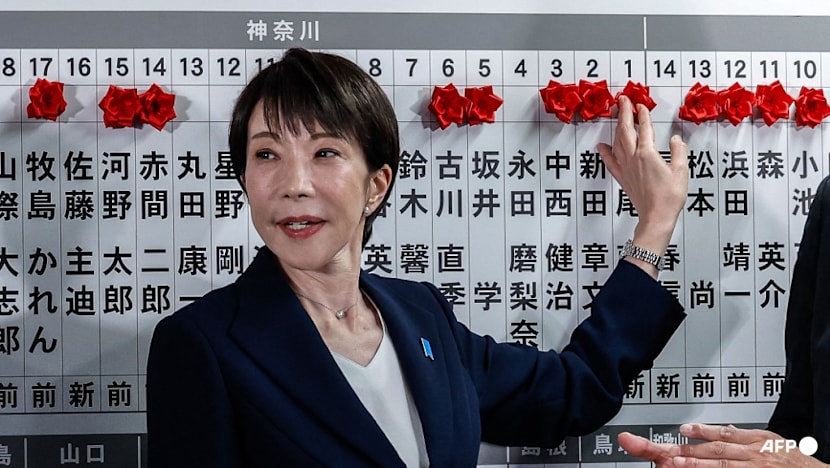
Japan's Prime Minister and President of the Liberal Democratic Party (LDP) Sanae Takaichi places a red paper rose on the name of an elected candidate at the LDP headquarters during the House of Representatives election in Tokyo on Feb 8, 2026. (Photo: Kim Kyung-Hoon/Pool/AFP)
TOKYO: Japanese stocks swept to record peaks while bonds slid and the yen sagged to an all-time low against the Swiss franc after Prime Minister Sanae Takaichi scored a landslide win in Sunday's (Feb 8) snap election.
Takaichi's Liberal Democratic Party won 316 of the 465 seats in parliament's lower house, giving her the mandate to push through her big spending plans and promised tax relief without negotiating with other parties. The so-called supermajority also allows the LDP to pass legislation without upper house approval.
The Nikkei 225 share average rallied 5.7 per cent to an unprecedented 57,337.07 by 01.46am GMT (9.46am, Singapore time). Of its 225 components, 197 rose while the rest fell, underscoring the breadth of the upsurge.
The broader Topix advanced 3.4 per cent to a record 3,825.67.
Heavyweight chip-testing equipment maker Advantest, a supplier to Nvidia, vaulted more than 13 per cent to be the Nikkei's top performer, leading a rally among shares linked to artificial intelligence.
The market "sees greater momentum for Prime Minister Takaichi's policy agenda", particularly her fiscal policy, said Shingo Ide, chief equity strategist at NLI Research Institute.
"It's not just a stable administration - What's coming into view is the prospect of a long-term administration."
For the Nikkei though, "I don't think it will keep rising at this pace. If it were to shoot straight to 60,000, that would be a bit overdone," Ide said, adding that it may eventually "settle down" around 56,000.
ELECTION MANDATE PUTS SHARP FOCUS ON FISCAL PLAN
Japanese government bond yields rose, with short-term yields reaching a three-decade peak. But the longest-dated bonds, which are most sensitive to fiscal worries, were little changed on the day after erasing an initial spike higher in yield.
Bond yields move inversely to prices.
Two-year JGB yields climbed 2.5 basis points (bps) to the highest since May 1996 at 1.3 per cent, and 10-year yields jumped 4 bps to 2.27 per cent.
Thirty-year JGB yields climbed as much as 6.5 bps to 3.615 per cent, but were last down 0.5 bp at 3.545 per cent.
"I think the reaction indicates that Takaichi has successfully convinced the market that she will be a strong leader, but not be a fiscally irresponsible one," said Zuhair Khan, a senior portfolio manager at UBP.
"But we will have to wait and see."
From a policymaking perspective, Takaichi's big win may be the best result for bond investors, because the LDP won't need to compromise with opposition parties targeting even deeper tax relief and broader fiscal stimulus.
The 30-year JGB yield surged to a record 3.88 per cent last month when Takaichi initially pledged to suspend the tax on food for two years, but it has been well below that for the past two weeks.
The yen also eased in early trading, but rebounded strongly after Japan's top currency diplomat Atsushi Mimura said the government is "closely watching currency movements with a high sense of urgency" in a warning about potential yen-buying intervention.
From being down as much as 0.3 per cent to reach 203.30 yen per franc for the first time ever on Monday, the Japanese currency reversed direction to be up 0.4 per cent at 201.90.
The yen had declined 0.4 per cent to 186.55 per euro, putting it close to the record low of 186.86 from last month, but was last changing hands at 185.22 per euro, up 0.3 per cent.
It fell 0.5 per cent to as low as 157.95 per U.S. dollar, a two-week trough, before rebounding to be 0.3 per cent stronger at 156.65.
"The market has long been mindful that further yen weakness could invite intervention," said Kumiko Ishikawa, senior analyst at Sony Financial Group.
After substantial yen declines last week amid expectations of a Takaichi victory, "the topside was already heavy" in the dollar-yen pair, she said. "Then Mimura's verbal intervention came in and nudged the level lower."






