







Equities rally, dollar dips with oil as Trump cancels Iran attacks
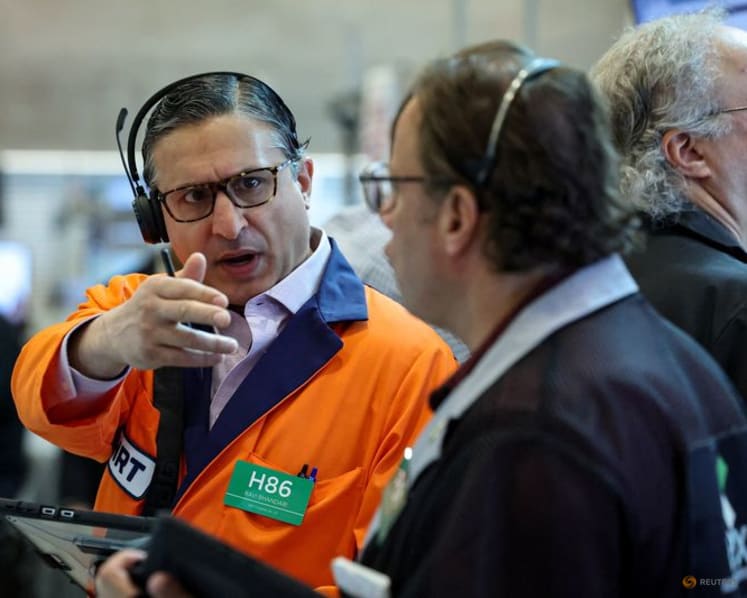
FILE PHOTO: Futures-options traders work on the floor at the New York Stock Exchange's NYSE American (AMEX) in New York City, U.S. June 8, 2026. REUTERS/Brendan McDermid/File Photo
NEW YORK/LONDON, June 11 : MSCI's global equities index rallied on Thursday while the dollar and bond yields fell, along with oil futures, on renewed hopes for peace in the Middle East after U.S. President Donald Trump said he had canceled planned strikes against Iran and a peace agreement could soon be signed.
Hours after threatening more bombings and saying he wanted to "take" oil export hub Kharg Island, Trump announced that talks "have been brought to the highest level of Iranian leadership and approved." He also wrote in a post on Truth Social that "discussions and final points" had been approved by the United States, Israel, Saudi Arabia, UAE, Qatar, Turkey, Pakistan, Bahrain, Kuwait, Jordan, Egypt, and others .
The U.S. president said that the United States and Iran could sign a peace deal as soon as this weekend that would reopen shipping traffic through the Strait of Hormuz, a key energy conduit where oil transportation has been disrupted since the start of the war in late February.
Iranian Foreign Ministry spokesperson Esmaeil Baghaei said the country had not yet made a final decision and would not compromise on its "red lines" in negotiations, according to Iran's IRNA news agency.
In energy markets, oil prices quickly turned lower after Trump's announcement but ended above their lows for the session. U.S. crude settled down 2.58 per cent, or $2.32, at $87.71 a barrel while Brent settled at $90.38 per barrel, down 2.92 per cent, or $2.72.
On Wall Street, equities added to gains after Trump's announcement and registered their biggest one-day percentage rise since April 8, the day the U.S. and Iran announced their ceasefire.
But after many twists and turns in the peace process since then, investors were anxious for more details.
"It's another day when the war is about to end, according to the administration. That drove the market up. Is it one more false lead or is it really coming to an end?" said Rick Meckler, partner at Cherry Lane Investments, a family investment office in New Vernon, New Jersey.
"The biggest weight on the market remains the war and its impact on inflation, particularly energy. And if it was to end, it obviously is a real positive," Meckler added.
Earlier in the day, data showed that U.S. producer prices increased more than expected in May, leading to the largest annual gain in 3-1/2 years as the Middle East conflict drove up energy prices. On the labor market side, the number of Americans filing claims for unemployment benefits increased marginally last week, pointing to continued labor market resilience in early June.
In stocks, the Dow Jones Industrial Average rose 929.97 points, or 1.86 per cent, to 50,848.75, the S&P 500 rose 127.31 points, or 1.75 per cent, to 7,394.30 and the Nasdaq Composite rose 640.16 points, or 2.54 per cent, to 25,809.66.
MSCI's gauge of stocks across the globe rose 12.57 points, or 1.16 per cent, to 1,099.55.
Earlier, the pan-European STOXX 600 index rose 0.54 per cent after the European Central Bank delivered its first interest rate hike in nearly three years, as expected.
In fixed income markets, yields sank on hopes for a peace agreement.
Still, Molly Brooks, U.S. rates strategist at TD Securities, said investors were likely to remain cautious until it looks clear that an agreement is finalized, while noting that the normalization of oil markets could take several months.
“Oil futures will come down, but the actual price of oil might still be elevated. So you might still see this pass through to inflation for the next few months,” Brooks said.
The yield on benchmark U.S. 10-year notes fell 8.1 basis points to 4.457 per cent, from 4.54 per cent late on Wednesday, while the 30-year bond yield fell 7.2 basis points to 4.9534 per cent.
The 2-year note yield, which typically moves in step with interest rate expectations for the Federal Reserve, fell 6.5 basis points to 4.062 per cent, from 4.127 per cent late on Wednesday.
In currency markets, with demand for safe-haven assets dropping on peace hopes, the dollar lost ground.
The dollar index, which measures the greenback against a basket of currencies including the yen and the euro, fell 0.36 per cent to 99.69, with the euro up 0.37 per cent at $1.1579.
Against the Japanese yen, the dollar weakened 0.37 per cent to 159.94.
In precious metals, spot gold rose 3.41 per cent to $4,212.21 an ounce while spot silver rose 5.51 per cent to $67.20 an ounce.





