







Commentary: The British are cursed by their exaggerated self-importance
A decade after Brexit, the liberty Britain voted for has come at a cost, says Max Hastings for Bloomberg Opinion.
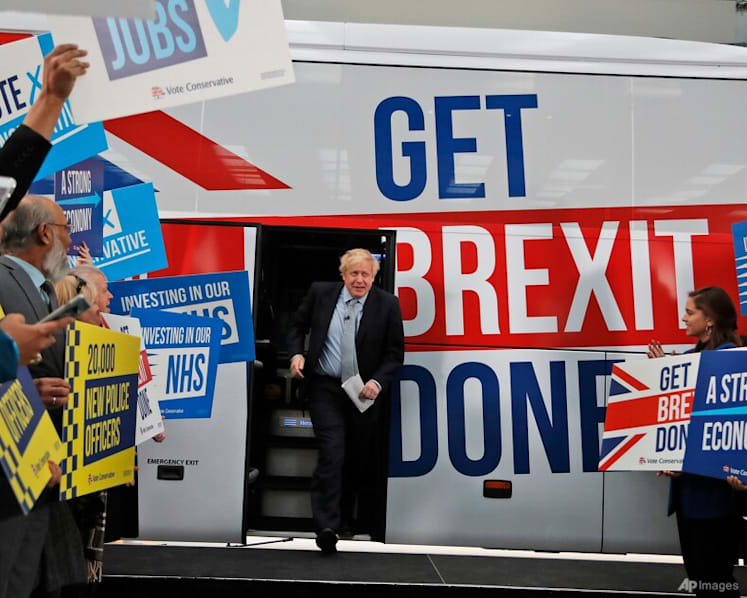
Britain's Prime Minister Boris Johnson addresses his supporters prior to boarding his general election campaign trail bus in Manchester, England on Nov 15, 2019. (Photo: AP/Frank Augstein)
LONDON: On Jun 24, 2016, following the narrow triumph of the Brexiters in the British national referendum on membership of the European Union, their standard-bearer Nigel Farage proclaimed “Independence Day… A victory for normal people.” Boris Johnson became prime minister in 2019 with the slogan “Get Brexit Done!”
And so he did. A decade on from the vote, Britain is enjoying freedom as defined by the Brexiters, having cast off the bonds of EU membership. Yet liberty has come at a cost, a heavy one. It feels pretty lonely out here.
If, as expected, the victor of Thursday’s (Jun 18) Makerfield by-election Andy Burnham becomes Britain’s prime minister, he will face the same intractable agenda: Britain languishes economically. We are living way beyond our means. Brexit has made a big contribution to our troubles, even if only the centrist Liberal Democrats, of the major political parties, fully admit this.
Some economic analysts reckon Britain’s gross domestic product is 6 to 8 per cent below what it would have been had we stayed in Europe. Econofact estimates business investment at 12 per cent below its inside-the-EU potential, employment 3.5 per cent lower.





Johnson and Michael Gove, co-leaders of the 2016 Leave campaign, made a headline claim that leaving the EU would save £350 million (US$462 million) a week, which once we escaped could be spent on the National Health Service.
This fantasy was no less preposterous than those of Donald Trump. And, like the US president’s lies, Johnson’s and Gove’s worked.
A cynical friend of mine said at the time, as I fumed, “Max, when will you understand that we are now living in the post-truth age?”
EUROPEAN DEMANDS
Three years earlier David Cameron, as Conservative prime minister, rashly promised in a speech at Bloomberg’s London headquarters that he would call a referendum on EU membership by 2017. A week on, I had lunch with the then-governor of the Bank of England.
Mervyn King, who later astonished everybody by emerging as a Brexiter, said several things which today seem pertinent. First, he suggested it was foolish of Cameron - for tactical reasons to quell right-wing dissent within his own party - to promise a referendum by 2017, “because by that date I do not believe we shall know what sort of Europe we are being asked to stay in, or to leave.”
King did not believe that the northern and southern European nations could indefinitely remain within the euro, because of the absence of economic convergence. But a breach could be delayed a long time, he argued, certainly beyond 2017. Then he made a remark about our EU partners which has proved spot on: “If we are the ones to break up the party, they will punish us.”
So they have. At every turn since 2016, the Europeans have demanded brutal terms for any concession to British attempts to reclaim bits of EU membership that suit our interests. Who can blame them? By leaving, we inflicted the gravest blow that the bloc’s ambitions have suffered since its inception.
Cameron was foolish, in the three-year interval between promising a referendum and holding it, not to pursue a hearts-and-minds campaign both with the British people and the Europeans. My compatriots had to be warned again and again that it was suicidal for a medium-sized nation such as ours to turn away from integration, to raise trade barriers.
Even more important, our partners needed to be told what we wanted, in order to stay. A senior Foreign Office official told me in 2015: “Every European government wants Britain in, and is waiting to hear our terms for remaining. But all they get from London is silence.”
Cameron and his Foreign Secretary William Hague pursued a policy of omerta, seeking to suppress a Tory civil war by saying nothing significant to or about Europe.

THE CONSEQUENCE
The consequence was that when, just before the referendum, the two men sought to scrabble together a deal for continued British membership, nothing convincing could be done.
Four people were principally responsible for Brexit: Cameron, by his hubris; the editor of the Daily Mail, Paul Dacre, an extreme anti-Europe propagandist; Johnson, a brilliant and morally bankrupt populist; and EU President Jean-Claude Juncker, who heaped ruderies on the British people when emollience might have averted break-up.
All this is now history, however, and what matters is the future. I do not believe Britain will reenter the EU within, say, the next 20 years. Brussels will set the bar so high that no Westminster government, including one led by Andy Burnham, would feel able to leap it.
Through five decades of British membership we were never committed partners; always the awkward squad. The British are cursed by an exaggerated sense of self-importance. I recently asked a farmer, whose fortunes since leaving the EU have declined dramatically, why he and most of his industry voted like turkeys for Brexit when the cost to them was widely predicted: “Heart over head, old boy,” he shrugged.
Many of our people will not accept that even America and China pay a price for going it alone; that for smaller nations such as Britain, membership of a trading bloc is vital. There was an absurd fantasy among Brexiters that, once we had dumped the EU, an alternative economic intimacy with the US would be attainable. This is now exploded, of course.


BRITISH XENOPHOBIA
We must recognise British xenophobia, especially toward Europeans. Many of our people like to holiday on the continent and to drive BMWs, but they cherish a historic disdain for “Johnny foreigner”. This has been intensified by a huge influx of immigrants, which we choose to blame on French failure to stop asylum seekers crossing the Channel.
Some of us warned in 2016 that leaving the EU would do nothing to stem migration from the Southern Hemisphere, but the Leavers insisted that it would. Despite a downward blip in 2025, net inward migration since the referendum has averaged 340,000 a year, and it has become much harder to secure European cooperation to check it.
People like me are mocked as “Remoaners”. The charge is correct, that we still proclaim Brexit the historic disaster of which we warned. My side voted to remain because we wanted to live in a country with a future and not only a past. Most British people tell pollsters that Brexit was a mistake. But I fear that the nationalist minority will continue to dominate our politics, because of the impassioned obduracy of its true believers.
Farage, leader of the arch-Brexit Reform UK party, suffered a setback in Thursday’s Makerfield by-election when his weak candidate lost heavily to Burnham, despite the deep national unpopularity of the latter’s Labour Party. But Reform might yet win the next general election.
This would be less disastrous for the world than is Trump, because ours is a much less important nation. But it will be a tragedy for Britain, supported - like MAGA in the US - by senior politicians and newspaper editors who still cannot bring themselves to admit they are wrong in supposing flag-waving nationalism an answer to anything, except maybe football.




