Commentary: China’s AI lobster craze comes with claws
Fervour for AI agent OpenClaw has consumed China in recent weeks but underneath the excitement, there are concerns, says Catherine Thorbecke for Bloomberg Opinion.
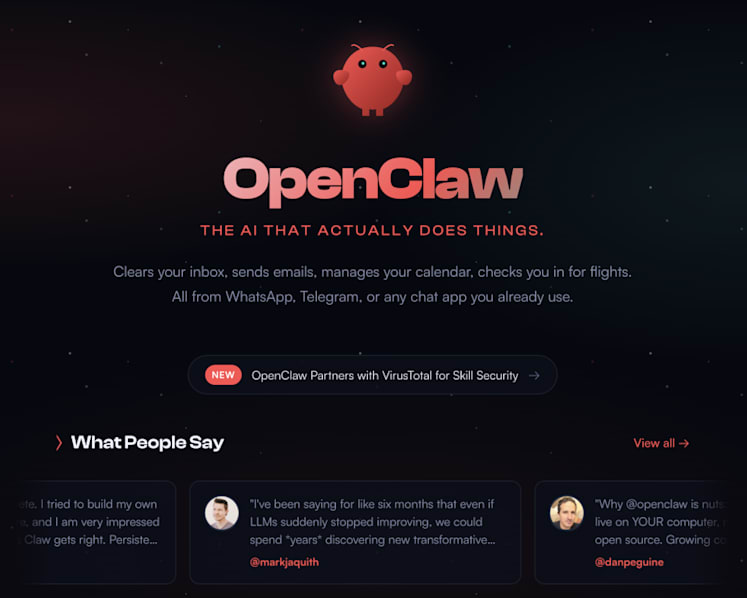
A screenshot of the website for OpenClaw, an open-source AI agent designed to carry out tasks rather than simply answer questions. (Image: OpenClaw)
TOKYO: Over the past week, Chinese social media has been gripped by a single obsession - how to raise a lobster. Not in a tank, but on your laptop.
Fervour for OpenClaw, the AI agent created by Austrian developer Peter Steinberger, has consumed China in recent weeks, emerging from a niche, nerdy tool sporting a crustacean logo to a national obsession. The programme sits on top of a large language model and does more than just chat - it takes action.
Users can ask it to comb through emails, book travel, text your significant other “good morning” - or even trade crypto, depending on how much access you grant it. Hundreds of people, from school children to retirees, lined up outside of Tencent’s Shenzhen headquarters last Friday for a free OpenClaw installation event, a sign of how quickly domestic tech companies are pulling the foreign programme into their orbit.
A retired aviation engineer said he was just there to “keep up with the times”. A fourth-grader said he hoped to use it to help with his homework and to play games, according to videos shared by the tech giant. Elsewhere, entrepreneurs have been tinkering with the tool to create new apps, AI influencer businesses or just automate more parts of their life in a push for productivity.
JUMPING ON THE BANDWAGON





Companies are capitalising on the mania - and investors are rewarding them.
Tencent launched WorkBuddy, its own agent that’s fully compatible with OpenClaw, sending its Hong Kong-listed shares surging. Other firms, including Zhipu and MiniMax Group, also released their own compatible tools.
Domestic firms see this as an opportunity to lock more consumers into their ecosystems. And because AI agents burn far more computing resources than chatbots, the bet is that more users will eventually translate into profits.
Even local governments have joined in. Shenzhen’s Longgang district released draft guidelines offering subsidies and support for “one-person companies” built around AI agents. Other jurisdictions including Wuxi, Hefei and Suzhou followed suit with similar draft measures, eager to brand themselves as OpenClaw hubs.


A HIT ON JOBS?
It’s a vivid portrait of modern China, where tech trends spread at breakneck speed, and AI exuberance is among some of the highest in the world, all buoyed by state and private sector support. But this rush to turn the nation into the world’s largest agentic AI lab also exposes fragility. Beneath the fear-of-missing-out sprint is a workforce bracing for displacement.
That’s the dark side tech leaders try to blur. For more than a year, global executives have hyped up AI agents. And no matter how many panels I attend where they say the aim is to empower workers, I still don’t buy that the goal isn’t to replace them. The push for “one-person companies” only reinforces the fear that agents will shrink jobs, not create them.
This especially matters for policymakers in China, where youth unemployment has remained persistently high and the number of university graduates poised to enter the labor market this year is more than the population of Belgium. The pain this automation push inflicts on these recent graduates, and the parents who financed their degrees, will test the legitimacy of President Xi Jinping’s AI bet.
As one China tech analyst wrote: “What looks like grassroots adoption is actually grassroots career panic, turbocharged by companies with something to sell.”

SECURITY FEARS
Then there’s the issue of security that’s been snagging AI agents’ broader global adoption. When a software can read your email, message your loved ones and even execute financial transactions, the risks don’t just add up, they compound.
As some researchers have noted, OpenClaw checks all the boxes for the “lethal trifecta” of cyber-risk: access to sensitive data, the ability to communicate externally, and exposure to untrusted content. Grant it access to your emails, documents, chat apps and payment tools, along with permission to take action autonomously, and things can go wrong fast.
And who is liable then? The rush for agents is happening faster than we can figure out the guardrails. Chinese authorities are now scrambling to respond, moving to restrict state-run enterprises and government agencies from running OpenClaw on office computers (or notify superiors if they already have). Making it secure enough for businesses to use is a major challenge that will take time.
COUNTING THE UPSIDES
But the scale of adoption in China does have upsides.
OpenClaw’s open-source nature means thousands - if not hundreds of thousands - of tinkerers can improve it in parallel. In theory, that brings more scrutiny, faster bug discovery, and quicker iteration. It also helps explain why the tool has taken off in a country where open-source software is seen as a collective counterweight to AI platform gatekeepers.
This oversight could genuinely harden OpenClaw over time. But it isn’t a magic spell. In a hype cycle, security is often added after the first scandal. More eyeballs can help fix lurking safety issues, but only if developers aren’t pressured to ship new apps as fast as possible.
China is now running the world’s biggest real-world trial of AI agents, with ordinary people as the beta testers and their money and livelihoods on the line. The rest of the world should pay attention. Because in the rush to automate everything, China will be the first to show where this experiment snaps.