Commentary: DAP’s wipeout cannot be explained by ‘Sabah for Sabahans’ sentiment alone
The real turning point of the Sabah state election is that, for the first time in more than a decade, it has become almost impossible to predict how Malaysian Chinese would vote, says political analyst James Chai.
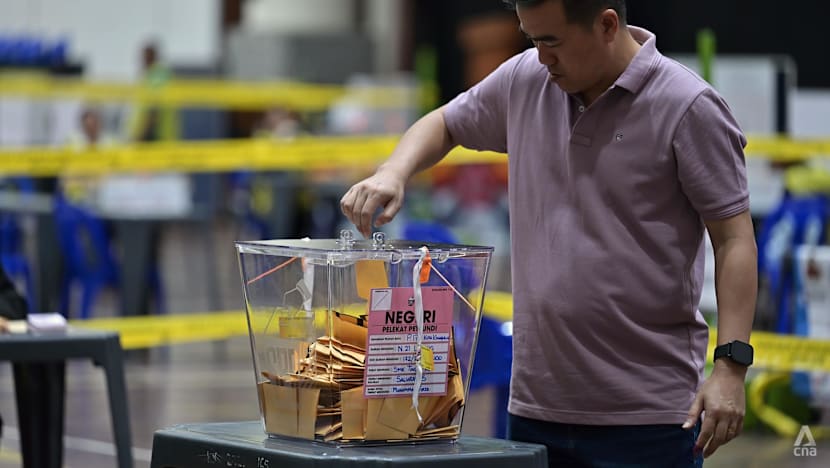
A voter casts his ballot at a polling station at Kota Kinabalu High School during the 17th Sabah state election on Nov 29, 2025. (Photo: CNA/Zamzahuri Abas)

This audio is generated by an AI tool.


KUALA LUMPUR: The truth is that no matter how hard its local state representatives worked, the Democratic Action Party (DAP) could not have averted the total wipeout in the recent Sabah state election.
Most analysts have pointed to a “Sabah for Sabahans” sentiment to explain why the East Malaysia state resoundingly voted for local parties. But this does not completely explain what happened to mostly Chinese, mostly urban seats that DAP held: Such sentiments have long existed, but have not stopped voters from choosing DAP in the past few elections.
Chinese voters in urban areas have voted rather uniformly in the past (at both federal and state level) with little geographic variations, suggesting primarily national issues that influence voting behaviours. Similarly, local issues alone are unlikely to deliver such a massive swing across all six of DAP’s seats, many of which are strongholds.
In the last 2020 Sabah state elections, the average vote share of DAP in the six seats it won was 78.7 per cent. In 2025, this dropped to 27.6 per cent, indicating a dramatic 51.1 per cent swing. This included seats held with supermajorities, such as Luyang (90.6 per cent), Likas (86.3 per cent), and Kapayan (77.4 per cent), that were contested by its party state chairman Phoong Jin Zhe and veteran Jannie Lasimbang. These local candidates were also not uniformly bad that they deserved an across-the-board rebuke.
It seems reasonable to conclude that only significant changes in national sentiment among Chinese voters could have delivered such a decisive outcome.
The biggest difference since is that DAP, as a component party of the Pakatan Harapan (PH) coalition, has been part of Prime Minister Anwar Ibrahim’s unity government for nearly three years. And it is perhaps inevitable in Malaysia that parties with a majority Chinese base will end up seen as a compliant supporting party to the dominant Malay party.
However, I argue that the Sabah elections reveal a more unique phenomenon: the “three-body problem” of the Chinese voters.
NOT A MONOLITHIC VOTER BLOC
It is tempting to view Chinese voters through a monolithic lens, given their immense support for DAP and, by extension, PH in the past few elections. The standard assumption is that they will do anything to avoid being governed by religious conservative party Parti Islam Se-Malaysia (PAS).
However, this assumption is no longer useful for DAP and PH. The Sabah and the past few state- and by-elections have shown that the Chinese could also vote for an alternative party or not turn out altogether.


How to understand the Chinese voters then? Consider the three-body problem, a classic physics problem that originated from Isaac Newton in the 17th century: One cannot optimise for a stable orbit around all three bodies simultaneously and motion becomes unpredictable.
In Malaysia’s context, the first body is the Vernacularist that mainly cares for preservation: of language, culture and the Chinese way of life.
This includes the highly contentious issues of Unified Examination Certification recognition and vernacular school education. But it also entails alcohol restrictions (at government events, in different states), gambling restrictions, concert restrictions, and worship sites. Controversies like the KK Super Mart’s sale of socks featuring a religious word and a kill-switch to cut short concerts that break guidelines feed into culture wars.
The second body is the Mercantilist that mainly cares for ease of doing business.
It wants lower costs and higher profits, and so concerns itself with wages, raw materials, land and other costs of production, as well as industrial policies (for example in semiconductors, energy transition, data centres), grants and investments. Generally, policies that affect how much people are willing to spend – such as the removal of fuel subsidies, sales and service tax increases, and increase of the minimum wage – will be of importance.
The third body is the Reformist that mainly cares about keeping promises about institutional reforms and eliminating corruption.
This concerns core institutions (parliament, anti-corruption commission, judiciary, oppressive legislations, police) and core principles (separation of powers, fairness, justice). High-profile scandals (Deputy Prime Minister Ahmad Zahid Hamidi’s legal cases, Chief Justice appointment controversy) and lack of reforms that were manifesto promises will drive them away.
WHEN A THREE-BODY SYSTEM DESTABILISES
None of this is to suggest that the Chinese voters are right in wanting all these; neither is it realistic to fulfil them without affecting other groups. The point of government is compromise.
In fact, the reason why this is a three-body problem is precisely because it is impossible to satisfy all three at once.
But the Sabah state election results illustrate what happens when this system destabilises. DAP may have assumed that some economic progress under the unity government would maintain voter loyalty.
But if Vernacularists felt their cultural anxieties were not addressed, or the Mercantilists felt squeezed by compliance costs, or the Reformists have given up waiting for the next institutional reform, then the gravitational pull toward DAP would weaken.
Unlike a two-body system in which losing on one axis simply pushes voters towards the other, a three-body problem means voters could spiral unpredictably.


SMALL TRIGGERS, BIG PROBLEMS
Finally, there is the chaos theory dimension. A small disturbance could produce wildly disproportionate effects. A single policy misstep on any of these axes, however small, may trigger an outsized voter reaction precisely because the system is already unstable.
In Sabah’s case, the trigger could have been the court decision on the state’s 40 per cent entitlement of federal revenue and, more crucially weeks before the election, the government’s decision to appeal “defects” in the grounds of the judgment. A bribery scandal involving the prime minister’s former senior political secretary and mining projects in Sabah just days before could have also swayed voters.
These events may not appear big compared to others, but they might have been sufficient to throw everything into cascade.
There is no single policy that could satisfy all three axes. But there is a constant need to attend to the three so that parties could increase their chances of satisfying the demands of the Chinese voters.
The real turning point of the Sabah state election is that, for the first time in more than a decade, it has become almost impossible to predict how the Chinese would vote.
James Chai is a political analyst, columnist and the author of Sang Kancil (Penguin Random House). He writes a monthly column for CNA, published every second Friday.