







Commentary: The political weaponisation of sleep
Tireless dynamism has been fetishised by the likes of US President Donald Trump and Japan Prime Minister Sanae Takaichi, says Leo Lewis for the Financial Times.
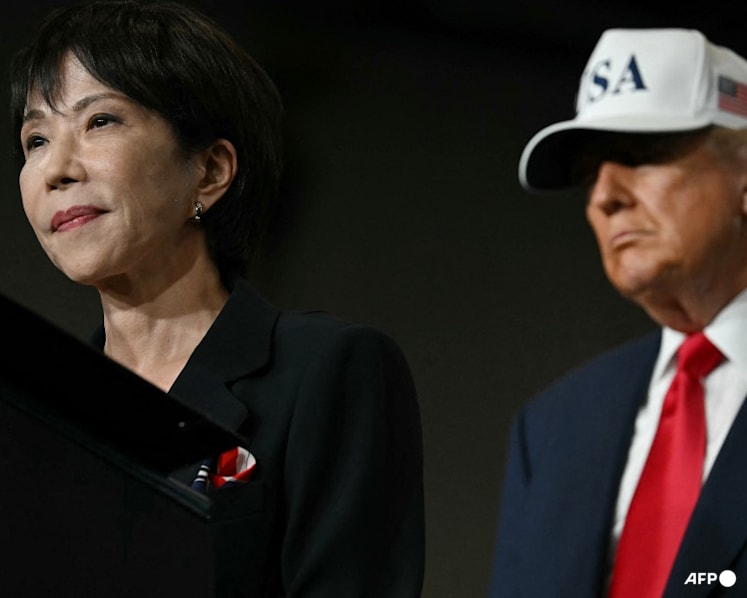
US President Donald Trump looks on as Japan's Prime Minister Sanae Takaichi speaks in front of US Navy personnel on board the US Navy's USS George Washington aircraft carrier at the US naval base in Yokosuka, Japan on Oct 28, 2025. (File photo: AFP/Andrew Caballero-Reynolds)
TOKYO: It is nearly 30 years since the Guinness authorities officially ceased monitoring feats of extreme sleeplessness. So Robert McDonald’s record 18-day, 21-hour and 40-minute stretch of self-imposed insomnia will forever remain unbreakable.
The reasoning behind this move was a combination of technical (it is tricky to screen accurately for momentary “microsleep” lapses during a record attempt), moral (there is a rare genetic disorder that causes potentially record-breaking insomnia, but also death) and blindingly obvious (sleep deprivation, like dehydration, becomes very dangerous very quickly, so perhaps best not to incentivise).
And yet, for all the sanity and decency of that Guinness World Records decision back in 1997, we seem comfortable, day-to-day, with the casual weaponisation of sleep.
The political exploitation of such a basic human need feels particularly retrograde. Especially as governments everywhere must properly start contemplating a time when ever-greater (and whiter-collar) proportions of electorates who do require sleep will be losing jobs to technology that does not.





TWO BLADES OF WEAPONISED SLEEP
There are two blades to weaponised sleep. The first – time-honoured but deployed with modern flair by United States President Donald Trump – is the framing of sleep as incapacity, indulgence or grounds for disqualification. Even before Joe Biden’s decline became unmissable, the former president’s advanced age handed the name-caller-in-chief an easy target.
“Sleepy Joe”, Trump said via sobriquet, was too somnolent for the leadership of a country that makes such a fetish of tireless dynamism. The barb worked, because we are so conditioned to devalue in discourse and habit something that we actually know to be priceless. To the unconscious body, sleep is a magical, restorative panacea without substitute; to the malevolent or just motivated wakeful onlooker, it is weakness.
Which, in turn, gives the second blade such a keen edge. Those who sleep less – by their caffeine- or force-of-will-fuelled definition – are tougher, more vigorous and more devoted to their cause.
Sleeplessness, to its advocates, is passion, perseverance, profit and patriotism. Investment bankers, corporate lawyers and others have been exceptionally deft at branding their preparedness to forgo sleep as the pre-eminent currency of client service. Yawn.
Again, Trump wields this rhetoric with enthusiasm, even as this has proven a high-value hostage to fortune and as evidence mounts of his nodding off in meetings. He has campaigned with the boast that he is “not a big sleeper”. His flurries of small-hours tweeting are a calculated flex.
In November, Trump praised Saudi Arabia’s Crown Prince Mohammed bin Salman with: “He does not sleep much, and I don’t sleep much . . . we’re thinking about our countries.”

“WORK, WORK, WORK, WORK AND WORK”
But Trump has other allies in sleep weaponisation. Moments after she was made prime minister in October, Japan’s Sanae Takaichi declared that she would ditch work-life balance in favour of “work, work, work, work and work”.
In the weeks that followed, Takaichi told parliament that she sleeps only a couple of hours a night, and, according to government officials, has indeed made an exhausting habit of holding meetings in the wee small hours.
Takaichi’s reward was for her "work" phrase to be declared Japan’s buzzword of 2025, and for the country, via her still strong approval ratings, to decide that it will give her workaholism the benefit of the doubt for now.
When accepting the accolade, Takaichi (for whom famously sleep-deficient Margaret Thatcher is a great hero) attempted to clarify that the implied 22-hour working day regimen was more a personal ambition of hers than a prescription for Japan as a whole. She still managed to make it sound like a national order of triple espressos all round.
RISK OF DEHUMANISATION
The immediate risks of this politicisation seem obvious. In Trump’s case, an entire propaganda machine built to condemn dozing and energy deficit in others must now pull multiple all-nighters to construct the fantasy that their guy has not, like everyone else, succumbed to the need to sleep.
Takaichi, in a country that has the shortest average sleep of OECD nations and some pretty baked-in problems to show for it, has created a political obligation to demonstrate that she has something positive to show for all that insomnia bravado.
But the deeper risk in all of this is one of dehumanisation. Messing around, either rhetorically or commercially, with the idea of sleeplessness as strength is an ugly nonsense that casts people as units of endurance.
Having set the sleeplessness record, and convinced Guinness to stop celebrating insomnia, Robert McDonald went on to build what was, at the time, the world’s largest Viking ship constructed from 15 million lollipop sticks. That is why his name should live on. The legacy of nobody, anywhere, should be how little or much they sleep.




