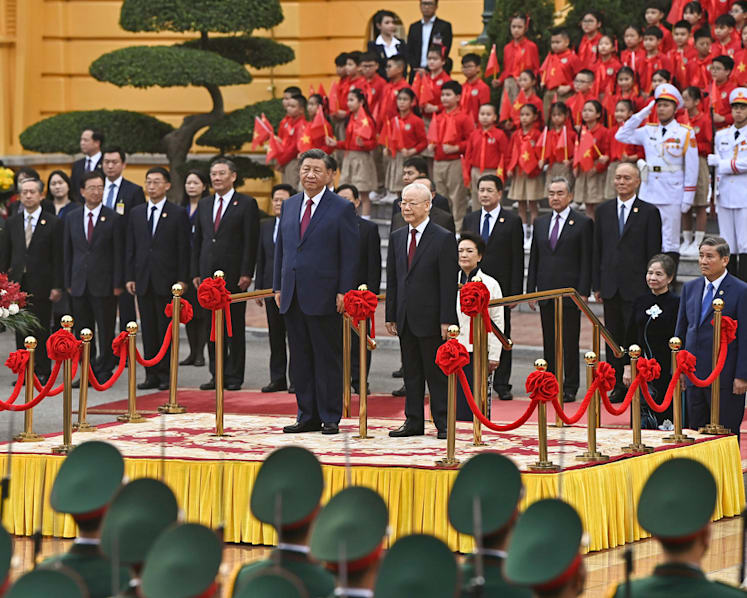
China hosts Thailand’s King Maha Vajiralongkorn on historic visit
Chinese media have depicted the visit - the first by a Thai monarch since bilateral ties were established 50 years ago - as the outcome of friendly coexistence and a signal to other nations that China is a reliable partner.
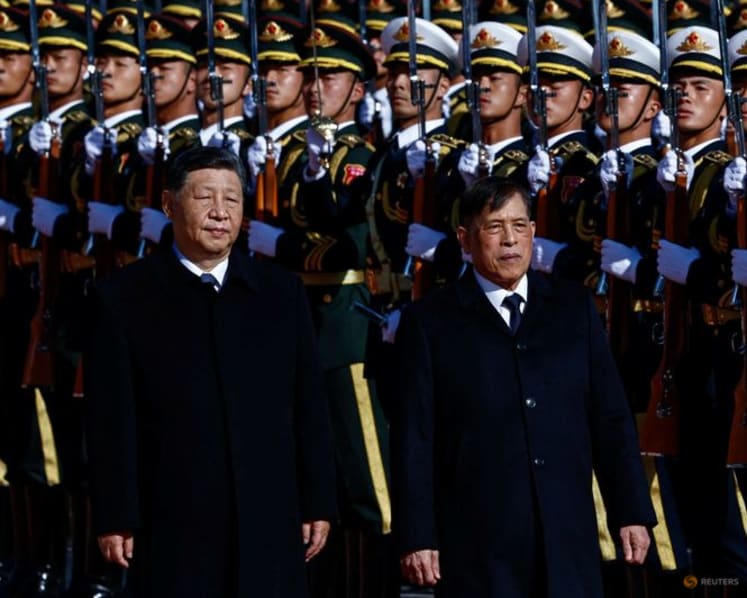
Thailand's King Maha Vajiralongkorn (right) and Chinese President Xi Jinping review the honour guard during a welcome ceremony at the Great Hall of the People, in Beijing, China on Nov 14, 2025. (Photo: Reuters/Tingshu Wang/Pool)
BEIJING: Chinese leader Xi Jinping on Friday (Nov 14) rolled out the red carpet for the first Thai monarch to visit China since ties were established 50 years ago, as Beijing seized the chance to portray itself as a benevolent neighbour and reliable economic partner.
The arrival of Thailand's King Maha Vajiralongkorn and Queen Suthida and a visit earlier this week by Spain's King Felipe VI and Queen Letizia have been depicted by Chinese media as the outcome of friendly coexistence and a signal to other nations that China is a reliable partner, in stark contrast to the economic unease set off by United States President Donald Trump and his sharp tariff hikes this year.
Vajiralongkorn arrived in Beijing on Thursday afternoon, beginning his five-day visit to the country until Nov 17.
He met with Xi and his wife, Peng Liyuan, at the Great Hall of the People in the heart of the Chinese capital on Friday.
STRENGTHENING STRATEGIC COORDINATION





People’s Daily, the newspaper of China’s Communist Party, quoted Xi as saying that Vajiralongkorn’s visit to China reflects the “great importance” the Thai king attaches to bilateral relations.
Xi expressed condolences over the recent death of Thailand's Queen Mother Sirikit, saying that the Thai royal family has deep ties with China and has made important contributions to promoting friendship between the two countries.
The Chinese supremo said China is willing to strengthen strategic coordination with Thailand and steadily promote cooperation on major projects such as the China-Thailand Railway.
China is also willing to expand cooperation in emerging fields such as artificial intelligence, digital economy, and aerospace, Xi said as quoted by People’s Daily.
The Chinese president further said China is willing to actively support the Thai royal family’s public welfare projects and strengthen the exchange of experience in poverty alleviation, and help Thailand improve people's livelihoods.
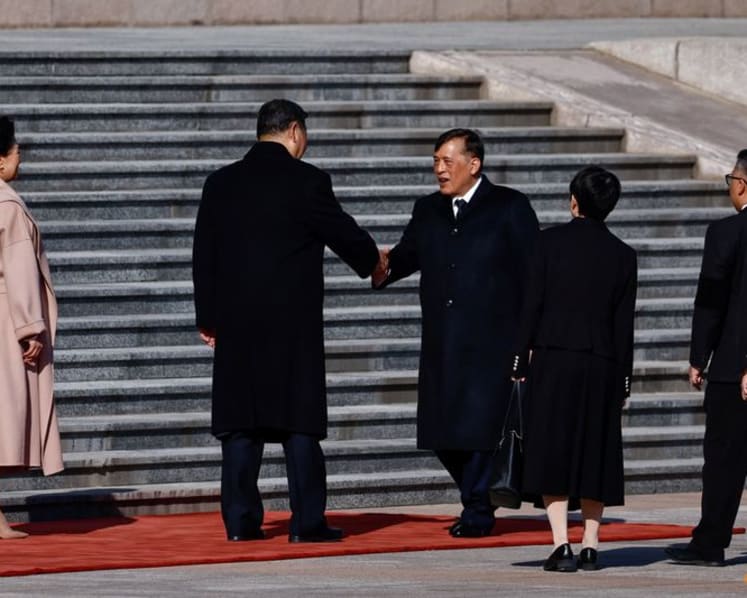
According to the People’s Daily report, Vajiralongkorn said he was pleased to pay a state visit to China and that the country has undergone great changes since his previous visit. He also congratulated China on its major achievements in economic and social development.
The Thai monarch is set to meet Chinese Premier Li Qiang later on Friday, before attending a state banquet in the evening.
During their visit to China, the king and queen will visit cultural and religious sites, including a visit to the Sacred Tooth Relic of the Buddha at Lingguang Temple in Beijing, Thailand’s Ministry of Foreign Affairs said in a statement on Nov 6.
They will also visit institutions highlighting China's development in fields such as science and technology. These include the Beijing Aerospace Control Centre, the Innovation Center of Humanoid Robotics and the Center for Educational Technology and Resource Development.
The royal couple are set to visit a special exhibition celebrating the 50th anniversary of Thai-Chinese diplomatic relations at the Palace Museum in Beijing.
They will also lay a wreath at Tiananmen Square, according to a statement by Thailand’s Bureau of the Royal Household.
Bilateral ties have evolved significantly since Thailand, firmly aligned with the United States against communism during the Cold War, viewed China as a threat. Vajiralongkorn travelled to China once in 1987 as crown prince, sent by his father, who never visited despite invitations from Beijing.
Since the post-Cold War years, the relationship between the two countries has strengthened, anchored by deep trade and investment links.
China is now a top source of visitors for Thailand's vital tourism sector and a major investor in industries such as automobiles. From China, Thailand bought US$80 billion of goods last year.
"The visit gives China a chance not only to reaffirm its closeness with the (Thai) Kingdom, but also to signal its continued regional relevance at a time when US influence is visibly receding," said Juliette Loesch, a researcher at Paris-based Inalco.
"It comes just two weeks after Donald Trump's brief stop at the ASEAN (Association of Southeast Asian Nations) Summit, where his visit's only visible outcome was his role in overseeing the signing of the short-lived peace declaration between Thailand and Cambodia. By contrast, China announced the deepening of its free-trade agreement with ASEAN."
In an editorial, China's official Xinhua news agency portrayed historical trade and exchanges with Thailand from thousands of years ago as a basis on which future bilateral ties should be built.
"Before the large-scale entry of Western colonists, most of Thailand's foreign trade was sold to China," Xinhua said on Thursday, listing Thai rice, spices and tin ore traded for Chinese porcelain, silk, tea and ironware.
A few years before diplomatic ties were formed, Thailand had also sent table tennis players for a championship in China and Beijing provided cheaper crude oil in 1974 to help Bangkok tide over economic difficulties, Xinhua said.