Growing fruits on desert lands? Inside China’s decades-long fight against desertification
For more than four decades, China has been working to halt the spread of desertification through the Three-North Shelterbelt programme, colloquially known as the Great Green Wall.
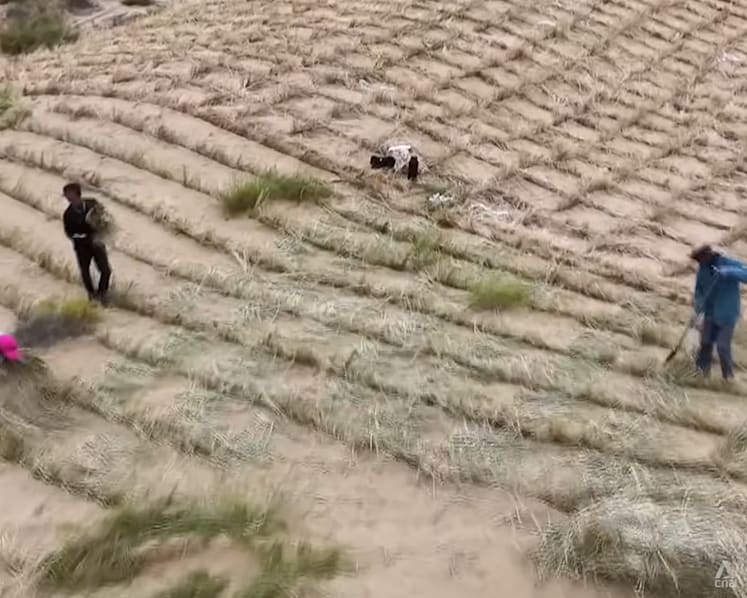
Labourers working in the Maowusu Desert, Inner Mongolia, China.

This audio is generated by an AI tool.




INNER MONGOLIA: At first glance, the Engebei Ecological Demonstration Zone looks out of place.
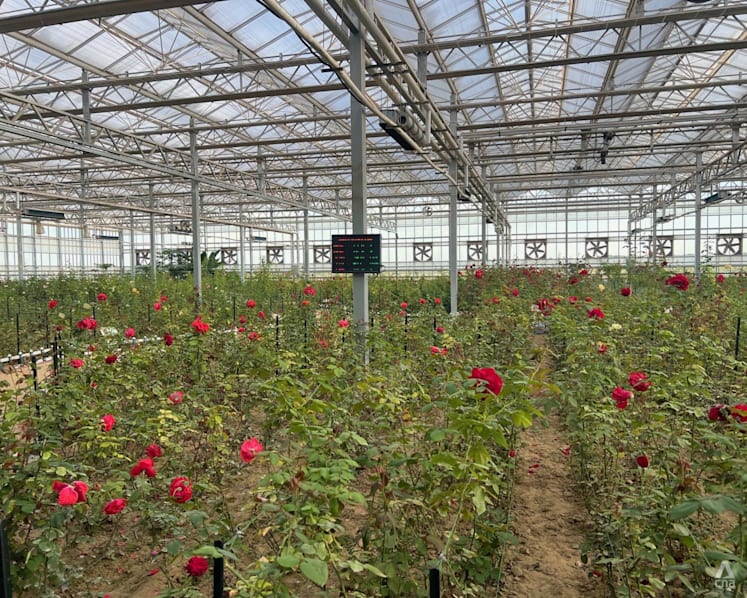
Banana trees, papayas and dragon fruit thrive under the winter sun inside greenhouses on the edge of the Kubuqi Desert in northern China’s Inner Mongolia.
Just decades ago, this land was dominated by shifting sand dunes. Today, more than 300 varieties of fruits and vegetables – including many subtropical crops – are grown in the demonstration zone.
The produce is sold as far south as Shenzhen and Hong Kong – a striking outcome in a region once synonymous with desertification.
“We wanted to test whether tropical plants could survive the harsh winters of northwest China where temperatures can drop below -30°C, using only sunlight, plastic coverings and thermal insulation quilts. The results have been very good,” said Liu Xueqin, an agriculture technician at Engebei.
While she first took this job merely to earn a living, she said she has since developed a “deep emotional connection” with the plants, akin to raising children.
“Watching them grow from seeds to fruit, and then hearing consumers say, ‘These fruits grown in the desert are delicious’ – that sense of achievement is incredibly meaningful,” she told CNA.





The Engebei project is part of a much larger national effort that Chinese authorities say has transformed vast areas of the country’s arid north.
For more than four decades, China has been working to halt the spread of desertification through the Three-North Shelterbelt programme, colloquially known as the Great Green Wall – one of the world’s largest and longest-running ecological restoration initiatives.
China says it is the first country in the world to achieve zero net growth in land degradation.
Authorities also claim that more than 53 per cent of the country’s treatable desertified land has been restored – figures that underscore both the scale and complexity of the campaign.
NATIONAL CAMPAIGN
Desertification, defined as land degradation in dry regions driven by climate change and human activity, affects an estimated 250 million people worldwide, according to the United Nations.
It has been a serious issue in China since the 1950s, contributing to dust storms, farmland loss and buried infrastructure.
Inner Mongolia, which borders Mongolia and Russia, lies at the centre of this challenge.
Known for its grasslands and rich traditions, the autonomous region has become a frontline in China’s fight to stop deserts from expanding further south and east.
One of the most affected areas is Ordos, a coal-rich city in southwestern Inner Mongolia bounded by the Yellow River on three sides.
It is home to two major deserts – Maowusu and Kubuqi. The latter alone spans more than 14,000sqkm, or roughly 2 million football fields, making it China’s seventh largest.
Once called the “sea of death”, the Kubuqi Desert was plunged into desertification when centuries of grazing stripped the land of all vegetation.
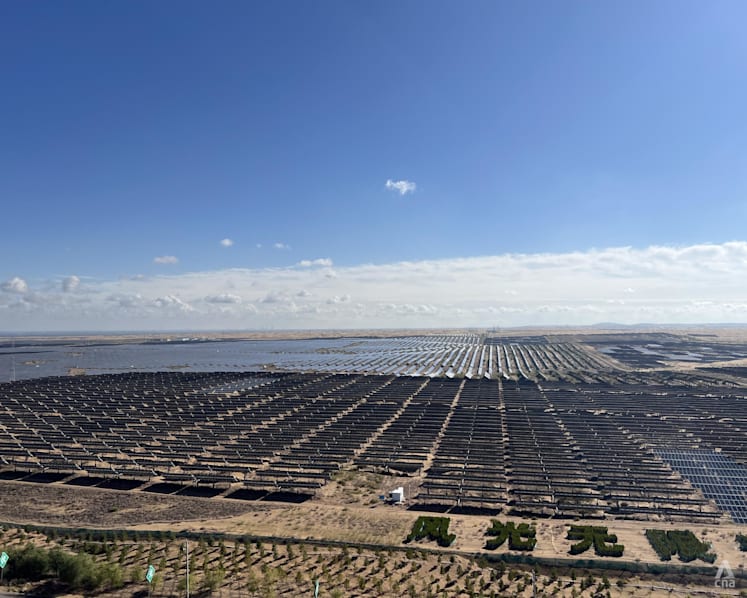
Large photovoltaic bases now stretch across 400km of sand dunes there, in a project dubbed by locals as the Solar Great Wall.
When construction is complete in 2030, it is expected to supply clean electricity to Beijing and its surrounding regions, generating around 2 billion kwh a year – enough to meet the needs of about 400,000 people while cutting reliance on coal.
THREE-NORTH SHELTERBELT PROGRAMME
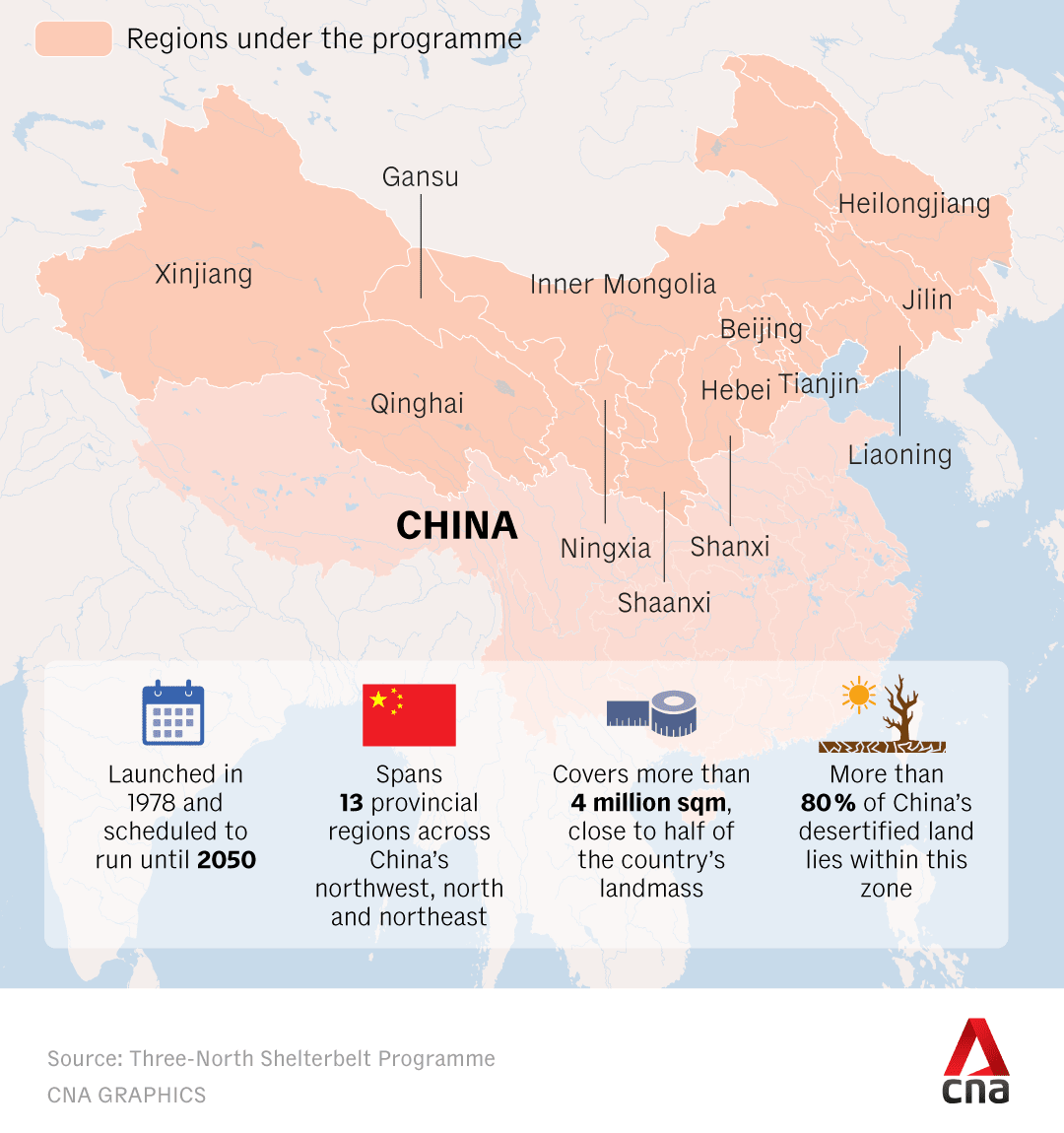
The Three-North Shelterbelt programme, which was launched in 1978 and is scheduled to run until 2050, spans 13 provincial regions across China’s northwest, north and northeast.
It covers more than 4 million sqm – close to half of the country’s landmass. More than 80 per cent of China’s desertified land lies within this zone.
“Over the past 47 years of implementation, the project has achieved remarkable results,” said Liu Guohong, director of the National Forestry and Grassland Administration, in a briefing last September.
The objective is not to eliminate deserts entirely but stabilise them, say forestry officials.
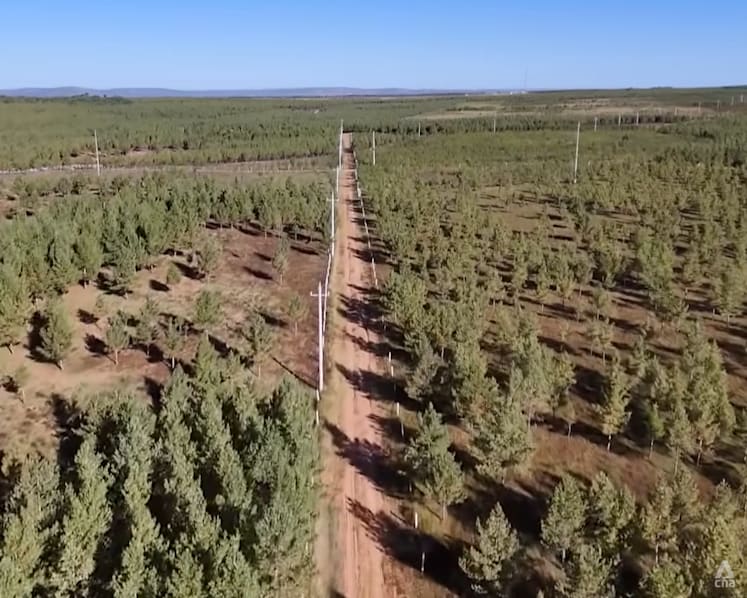
In Ordos, this has involved extensive road construction through desert terrain. More than 500km of roads now divide the dunes into smaller grids, allowing restoration teams to work systematically and transport materials into previously inaccessible areas.
Through sand barriers, shrub planting and grass seeding to stabilise the dunes, these highways have now become green arteries for ecological restoration.
Cao Jun, an engineer with the Dalad Banner Forestry and Grassland Bureau, said the difference is visible.
“The biggest change is the environment. Thirty years ago, this area was dominated by rolling sand dunes. Today, when you look around, you see green vegetation everywhere,” he added.
After roads are built, forestry teams extend the restoration work by another 50m on each side. Gravel layers are laid, followed by mixed planting trials using different grass and shrub species.
Both hydroseeding and manual sowing are used to determine which plants perform best under local conditions.
LABOURERS AT THE FOREFRONT
Much of the physical work is carried out by migrant labourers operating under government contracts.
One of them is 32-year-old Zhao Xinian, who leads teams working in the Maowusu Desert. He arrived from nearby Gansu province in 2013 at the age of 19, in search of a job.
Part of the work involves laying out straw grids by hand, which is the first step in preventing dunes from shifting. Once the sand is stabilised, workers plant hundreds of shrubs, grasses and native vegetation selected to anchor soil and slow wind erosion.
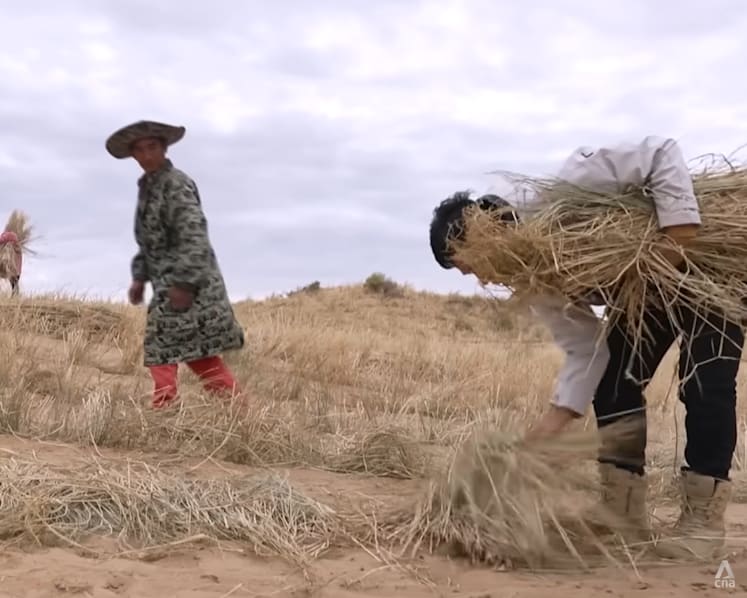
“Only people who are extremely resilient can do this kind of work,” Zhao said.
“Every spring, we face strong winds and frequent sandstorms. Sometimes we have to live deep in the desert, with no electricity or water. We have to truck water in ourselves.”
Many workers left after a short time, but Zhao stayed. He later brought his parents to join him and began recruiting labourers from his hometown, as well as from Yunnan and Sichuan.
“The locals wouldn’t do it as they make a living from herding, so I saw an opportunity and brought over more than a dozen people,” he said.
Zhao is now a contractor bidding on shelterbelt projects. At peak periods, he supervises teams of up to 1,000 workers, with daily wages ranging from about US$30 to US$60 depending on output.
He also documents his work on the popular Chinese short-video sharing platform Douyin, where encouragement from viewers has helped sustain his motivation.
“Planting trees is a self-healing process. You plant something and watch it grow … In recent years, that kind of (desert) weather has almost disappeared. The environment is clearly improving,” Zhao pointed out.
SCIENCE BEHIND SURVIVAL
In the early years of the Shelterbelt programme, large-scale planting was carried out rapidly, but survival rates were low. In some areas, only 30 per cent of saplings survived the harsh and arid conditions.
Scientific research proved critical to improving outcomes.
Wang Haibing, an assistant professor at Inner Mongolia Agricultural University, said early failures highlighted the destructive impact of wind erosion.
“After spring plowing, when the crops have grown to this height, if a sandstorm hits – just a single one – at least a third of the farmland will have its seedlings completely destroyed, beaten into mud and sand,” he noted.
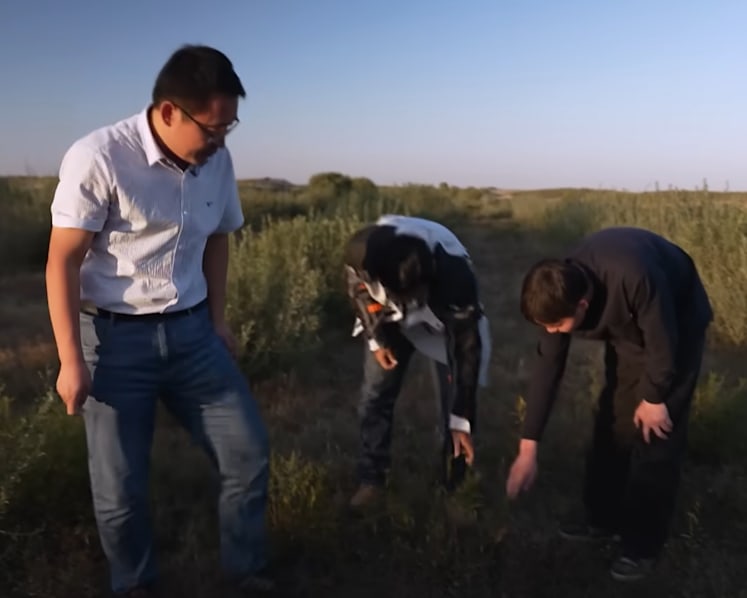
To address this, researchers developed techniques such as deep planting using water-injection tools that deliver water directly to seedlings during planting.
“So although planting shrubs like Salix today may look easy, low-cost and fast, the research behind it has been a long and difficult process,” Wang added.
“It has taken at least 40 to 50 years of accumulated experience and technical refinement.”
With better techniques and species selection, survival rates in some areas have risen to around 85 per cent.
Researchers are now focused on how to translate this success into economic benefits. Wang pointed out that desert control in farming and pastoral areas involves planting grass and medicinal plants, which in turn can provide a livelihood.
BALANCING RESTORATION AND LIVELIHOODS
But conservation efforts have not been without trade-offs.
Traditional activities like grazing and farming were restricted, prompting Beijing to introduce ecological compensation schemes.
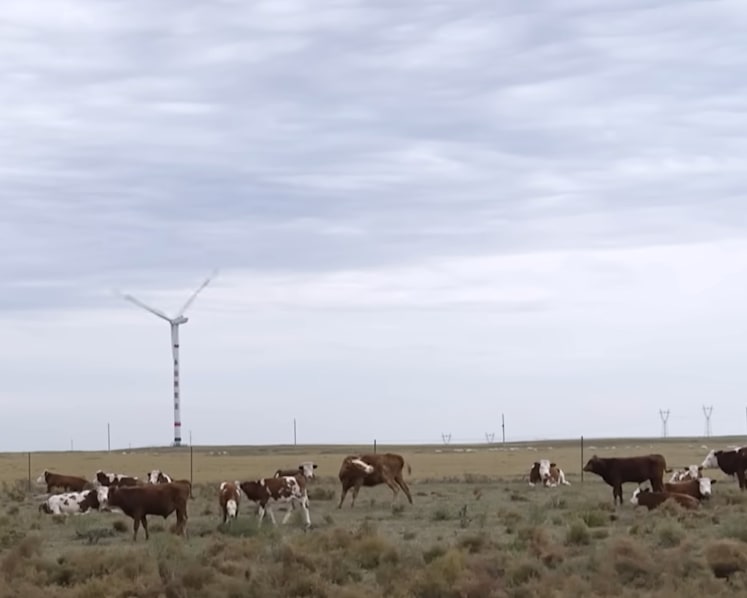
Since 2011, more than 150 billion yuan (US$21 billion) has been allocated for such programmes.
Experts warn, however, that subsidies alone are not sufficient.
“Maybe at the beginning, the fiscal support to those communities could be good enough, but later on … only relying on this kind of fiscal support definitely is not enough,” said Hu Min, director and co-founder of the Institute for Global Decarbonization Progress.
“We have heard all these voices too when we do our investigation. This is a huge challenge now.”
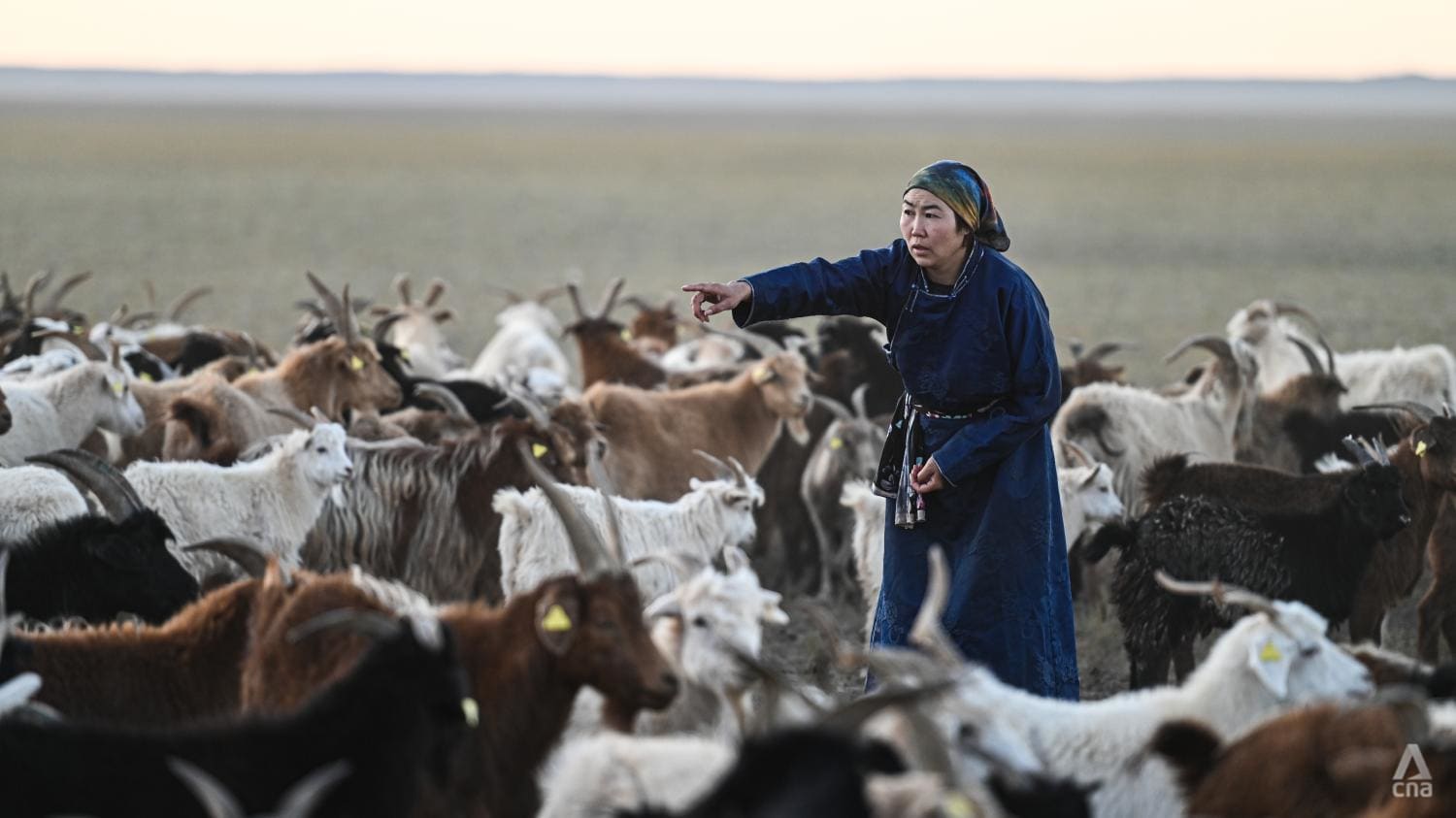
LONG ROAD AHEAD
Four decades on, China’s fight against desertification has delivered visible changes across large parts of its northern regions.
Forest coverage has increased to 14 per cent today – up from 5 per cent in the 1970s. Trees also act as protective belts to ensure that sands do not encroach into rivers, especially China’s second-longest river – the Yellow River.
Degraded grassland has declined as well, and severe dust storms have become less frequent in some areas.
But officials and experts alike stress that the work is far from complete.
With the Three-North Shelterbelt programme set to continue until 2050, they said sustaining gains will require continued investment, scientific research and local innovation.
When asked if he would support his children doing the same work, Zhao said: “If there’s still desert left when they grow up, yes.
“But I believe we’d have already restored much of it by then.”