China suspends some agricultural tariffs on Canada after Carney visit
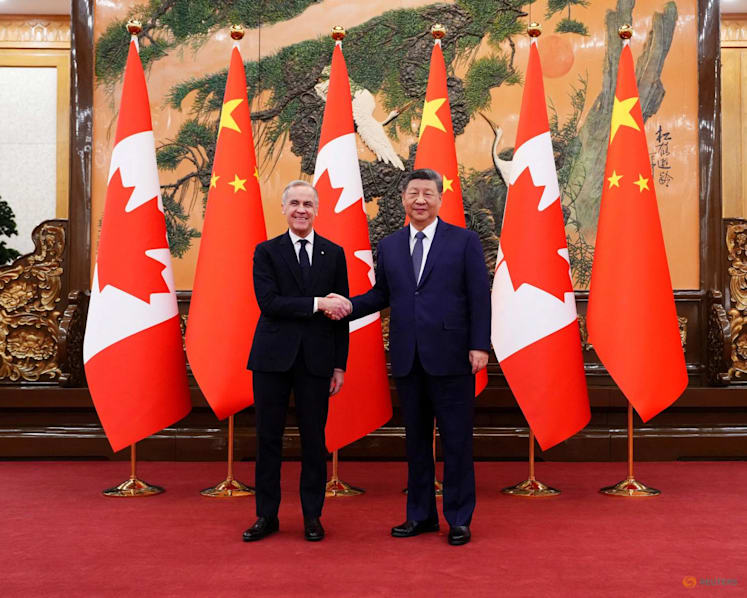
Canadian Prime Minister Mark Carney meets with President of China Xi Jinping at the Great Hall of the People in Beijing, China on Jan 16, 2026. (File photo: Reuters: Sean Kilpatrick)
BEIJING: China said on Friday (Feb 27) it would suspend some tariffs on Canadian agricultural products imposed during a trade spat between Beijing and Ottawa, after Canadian Prime Minister Mark Carney struck an initial deal with Beijing during a visit in January.
China will suspend 100 per cent tariffs on Canadian canola meal and pea imports and will halt 25 per cent tariffs on lobster and crab imports from Mar 1 through the end of 2026, the finance ministry said in a statement.
The outcome broadly aligns with Carney's expectations. But the Chinese announcement made no mention of canola seed tariffs, which Carney had previously said would be lowered by Mar 1.
Ottawa expected Beijing to lower canola seed tariffs to a combined rate of about 15 per cent from the current 84 per cent. A probe into Canadian canola is set to conclude on Mar 9, the Chinese commerce ministry has said.





"One thing we do know is that Chinese buyers have been booking Canadian canola cargoes for March already. That gives me a pretty high degree of confidence that they're going to follow through on the reduced tariff rate," said Even Rogers Pay, director at Beijing-based consultancy Trivium China.
Canola oil and pork were also not mentioned in the statement. But Beijing could still announce further adjustments by the Mar 1 deadline previewed by Carney.
China was Canada's second-largest market for canola in 2024.
The suspensions come amid a wave of visits to Beijing by Western leaders as US President Donald Trump's trade policies have strained Washington's traditional alliances. China has sought to present itself as a more stable and reliable economic partner in contrast.
Carney went further than his European counterparts by securing a deal with China and signalling Canada's ambition to play a leading role in a new global trade order aimed at reducing dependence on the United States.
During his China trip, Carney pledged to allow into Canada up to 49,000 Chinese electric vehicles at a tariff of 6.1 per cent on most-favoured-nation terms.