Beijing revives dialogue with Taiwan opposition, but impact on policy and tensions limited
Beijing has avoided engaging Taiwan’s ruling Democratic Progressive Party, which it sees as promoting independence, maintaining ties instead with the more China-friendly Kuomintang.
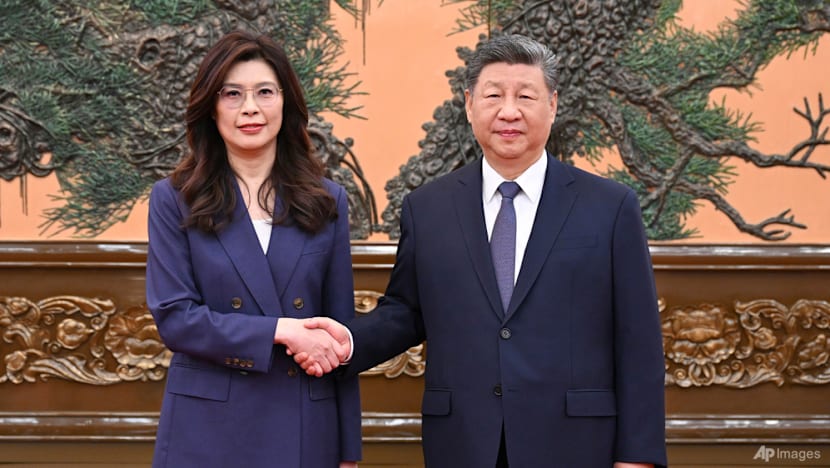
In this photo released by Xinhua News Agency, Chinese President Xi Jinping (right) shakes hands with Kuomintang (KMT) party leader Cheng Li-wun in Beijing on Apr 10, 2026. (Photo: Xinhua via AP/Xie Huanchi)

This audio is generated by an AI tool.




A rare meeting between Chinese President Xi Jinping and Taiwan’s main opposition leader has revived long-frozen ties across the Taiwan Strait, but whether it meaningfully eases tensions remains far from clear.
The talks last month brought together Xi and Cheng Li-wun, chairwoman of Taiwan’s Kuomintang (KMT), during a six-day visit to China that marked the highest-level engagement between the two parties in a decade.
Cheng led a 13-member delegation that included senior party figures. The group paid tribute at the mausoleum of Sun Yat-sen – revered on both sides as the “Father of Modern China” – and visited Chinese companies, including tech giant Xiaomi.
RENEWED ENGAGEMENT
But it was Cheng’s meeting with Xi that drew the most attention.
Beijing has avoided engaging Taiwan’s ruling Democratic Progressive Party (DPP), which it sees as promoting independence from China.
Instead, it has maintained channels with the KMT, which is seen as more Beijing-friendly.
The Xi-Cheng meeting therefore marked a revival of party-to-party dialogue between the Chinese Communist Party and the KMT – a priority Cheng has pursued since taking office last November.
Speaking on the significance after the meeting, Cheng said: “As long as our starting point is right, peaceful development across the strait is full of optimistic possibilities. Today, we’ve successfully taken that first step.”
Cheng returned to Taiwan to a show of support from within her party, with 19 KMT lawmakers welcoming her at the airport and backing her efforts to position the party as a bridge for cross-strait stability.
The ruling DPP, however, criticised the visit, pointing to continued Chinese military activity around the island during the trip.
Alongside the meeting, Beijing announced 10 policy measures targeting Taiwan, including plans to resume individual travel from Shanghai and Fujian, and to expand opportunities for Taiwanese businesses operating in China.
However, analysts say many of these measures are limited in scope and depend heavily on Beijing’s unilateral decisions.
“Seven or eight of the 10 measures are essentially unilateral policies by China,” said Wang Chih-sheng, secretary-general of Taipei-based think-tank Cross-Strait Policy Association.
“For many people in Taiwan, the attraction and how they feel about it is reduced, compared to before.”

PUBLIC OPINION SPLIT
Public opinion in Taiwan appears divided over the significance of the meeting.
A poll by broadcaster TVBS found that 43 per cent of respondents said the Xi-Cheng talks would help cross-strait peace, compared with 39 per cent who said they would not.
A separate survey by Taiwanese polling firm Formosa was more sceptical, with 51.1 per cent saying the meeting would not help prevent conflict or safeguard Taiwan’s interests, versus 37.6 per cent who said it would.
Still, both polls indicated broader support for renewed dialogue with China, even as views on Cheng’s visit remain mixed.
“Both the Taiwanese public and the government hope to see cross-strait dialogue resume. It’s whether it can happen without preconditions,” said Wang.
“Peace and communication across the strait can be achieved more effectively without preconditions and predetermined positions.”
Despite the renewed contact, the KMT is not Taiwan’s governing party, limiting the extent to which the meeting can translate into concrete policy shifts or reduce tensions.
Even so, the visit may carry domestic political benefits for Cheng.
Polls show her trust rating has risen by more than 7 percentage points since the trip – its highest level since January – suggesting she may be regaining support within the KMT base.
That momentum could be tested in upcoming local elections in November.
Observers say a strong KMT showing could bolster Cheng’s leadership and potentially position her for a presidential run in 2028.