Japan snap election: Can PM Takaichi turn popularity into a decisive victory?
Sanae Takaichi is gambling on her popularity to secure a stronger mandate, but shifting alliances and snow-hit regions could still change the outcome.
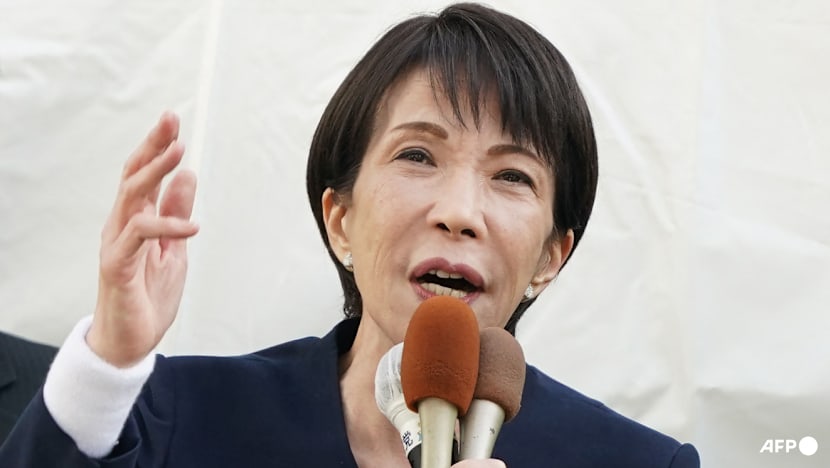
Japan's Prime Minister Sanae Takaichi delivers her campaign speech ahead of a snap election in Tokyo, Jan 27, 2026. (Photo: AFP/Kazuhiro Nogi)
New: You can now listen to articles.

This audio is generated by an AI tool.




06 Feb 2026 07:34PM
(Updated: 06 Feb 2026 09:49PM)
TOKYO: Japanese Prime Minister Sanae Takaichi's ruling coalition is poised for a landslide victory in Sunday’s (Feb 8) snap election, according to observers and local media surveys, despite a fragmented political landscape.
Her Liberal Democratic Party (LDP) is contesting the polls alongside the Japan Innovation Party, or Ishin, in a fledgling coalition formed last October.
They face a newly forged opposition bloc: the Centrist Reform Alliance, which brings together former long-time LDP partner Komeito and the main opposition Constitutional Democratic Party.
The alliance was formed in January after Komeito withdrew from the ruling coalition soon after Takaichi became LDP president, citing concerns over the LDP’s slush fund scandal, widely blamed for a string of recent electoral defeats.
“(Komeito) was worried that if it got stuck with the LDP, which is scandal-ridden, it would lose (support) and become tainted by association,” said Koichi Nakano, a liberal arts professor at Tokyo’s Sophia University.
He added that Komeito may also have been put off by Takaichi’s strong anti-China stance, given its traditionally more conciliatory approach towards Beijing.
TAKAICHI RIDES WAVE OF POPULARITY
Despite the reshuffled alliances, recent polls show the opposition trailing well behind the LDP-led coalition.
While approval ratings for Takaichi’s cabinet have slipped from earlier highs, they remain at around 60 per cent – still stronger than many of her predecessors.
Observers say Takaichi – Japan’s first female prime minister – is betting that her personal popularity, particularly among younger voters, will translate into a stronger mandate and secure her a full term.
Before parliament was dissolved last month, she was governing with a razor-thin lower house majority.
“Despite her image as a very strong woman leader, she is among Japan’s weakest prime ministers ever in terms of parliamentary support,” said Nakano. “When it comes to passing the budget, or bills that are controversial, she does not have the numbers."
That may soon change. One projection suggests the ruling coalition could secure more than 300 of the 465 seats up for grabs, comfortably above the 233 needed for a lower house majority.
“Takaichi’s scramble may be paying off. This could be a big win for her. Her strategy is to turn her personal popularity into stronger support for the LDP,” said Seijiro Takeshita, professor of management and information at the University of Shizuoka.
WHY THE WEATHER COULD BE A PROBLEM
Still, harsh winter weather could yet complicate Takaichi’s gamble. In northern parts of the country, heavy snowfall could make it dangerous or impossible for voters to reach polling stations.
The impact is already being felt, with early voting turnout down by more than 20 per cent in some snow-hit prefectures.
“Historically, lower voter turnout has favoured the LDP, but that was when it was partnering with Komeito, which reliably mobilised voters, regardless of the weather or timing,” Takeshita told CNA’s East Asia Tonight.
“This time, the picture is less clear. Lower turnout could work against the LDP if voters decide not to brave the weather conditions.”
Takaichi initially faced criticism for calling the snap election, with the timing seen as unexpected – in the middle of winter and just ahead of deliberations on the national budget.
Analysts, however, say a strong mandate would give her greater leverage at the upcoming budget.
“If she succeeds (at the polls), it would give her room to push ahead with key policies, including a stronger defence stance and aggressive fiscal spending,” said Takeshita.
The LDP is also seeking to claw back votes lost to the ultraconservative Sanseito party, which made gains in last summer’s upper house election – a move that could see the ruling party harden its stance on immigration to appeal to right-leaning voters.
FOREIGN POLICY IN FOCUS
Analysts say a decisive victory would send a strong signal overseas, particularly to China, that pressure from Beijing has not weakened domestic support for Takaichi, despite Chinese anger over her comments on Taiwan.
Instead, it seemed to have boosted her standing, especially among conservative voters.
“While Japan has no interest in a confrontation with China, (Japanese voters do want a government) that stands up to China in coordination with the United States,” said Phillip Lipscy, chair of Japanese politics at the University of Toronto’s Munk School of Global Affairs & Public Policy.
Like her mentor, the late former Prime Minister Shinzo Abe, Takaichi has cultivated a close relationship with US President Donald Trump.

The two displayed strong personal chemistry during Trump’s visit to Tokyo last October, and on Thursday (Feb 5), Trump publicly endorsed Takaichi and announced plans to meet her in Washington next month.
Lipscy said close ties with the US leader are widely viewed as an asset in Japan, though he noted the endorsement is unlikely to directly sway the election outcome.
“(It shows) she's able to manage that relationship and keep Trump on (Japan’s) side in a way that other countries have found somewhat challenging,” he added.
COST OF LIVING LOOMS LARGE
Whether Takaichi’s personal popularity will translate into votes for the LDP remains a central question.
“I want to vote for her clarity, and for a person who does not have double standards,” said a 23-year-old in Tokyo.
Another voter, 59, said: “There has been enough deliberation (about issues). Next, I wish to see it put into action. I have strong hope.”
Takaichi has pledged expansionary fiscal policies to spur growth, including a two-year suspension of the 8 per cent sales tax on food – a proposal echoed across party lines amid rising living costs.
Critics, however, have questioned the long-term sustainability of such measures and their impact on tax-funded social welfare.
Takaichi has vowed to resign if her coalition fails to secure a majority. Should that happen, the LDP would be forced into a leadership contest, and both Houses of Parliament would have to elect a new prime minister – potentially plunging Japan into renewed political uncertainty.


Source: CNA/dn(lt)