Macron urges Xi to help correct 'unsustainable' global trade imbalances
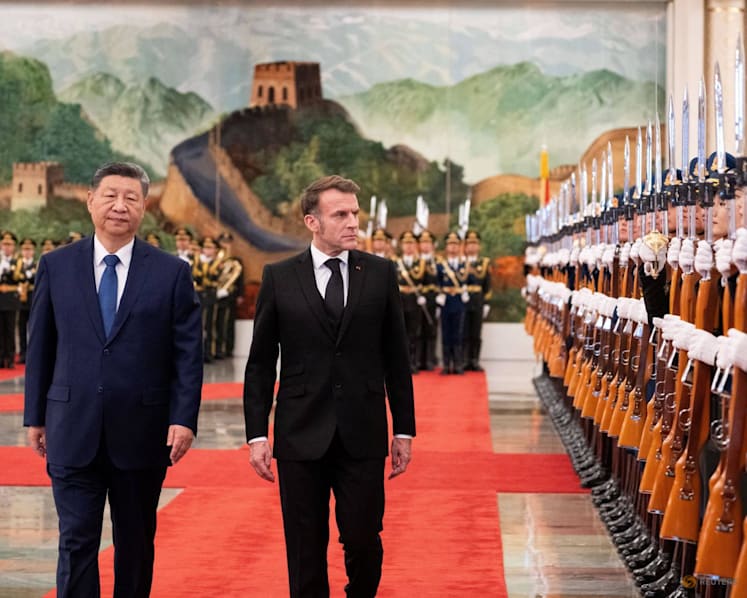
The official welcoming ceremony for the French President Emmanuel Macron and his wife, Brigitte Macron, by China's President Xi Jinping and his wife, in the Great Hall of the People, Beijing, China, on Dec 4, 2025. (Photo: Pool via Reuters)
BEIJING: French President Emmanuel Macron urged Chinese leader Xi Jinping to boost cooperation on geopolitics, trade and the environment, as the European Union seeks China's help in ending the war in Ukraine and Beijing looks for economic wins from United States tariffs.
On his fourth state visit, Macron is walking a delicate tightrope, trying to reduce France's massive trade deficit with China and secure industrial jobs at home to bolster his legacy, without antagonising the world's second-largest economy.
China, for its part, wants to ease trade frictions with the 27-strong EU over its heavily subsidised electric vehicle industry, while presenting itself as a more reliable market to the US for economies hit by President Donald Trump's tariffs.
"The imbalances we see accumulating today are not sustainable, they carry the risk of triggering a financial crisis and threaten our ability to grow together," Macron told his host during their Thursday (Dec 4) meeting at Beijing's Great Hall of the People.





"There are solutions," he said, calling for rules that were fairer and stronger, rather than based on "survival of the fittest".
Xi told Macron their countries should follow their own geopolitical paths.
"No matter how the external environment changes, our two countries should always demonstrate the independence and strategic vision of major powers," he said.
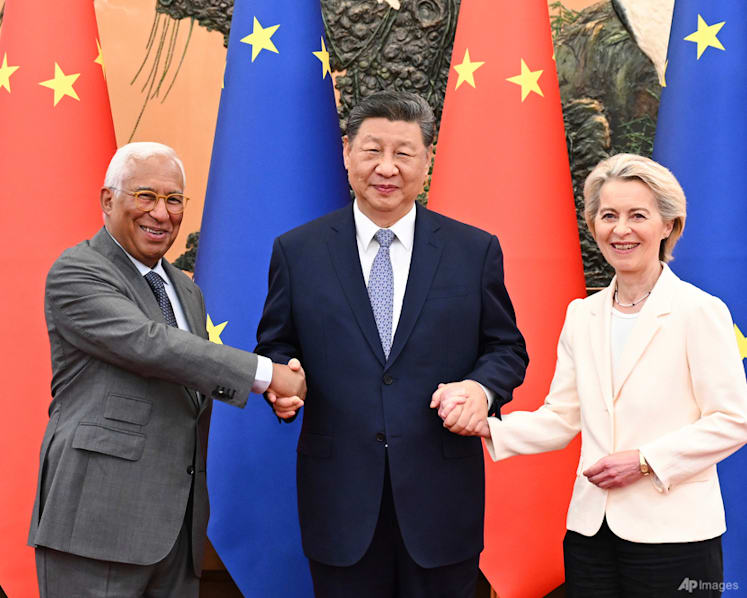
However, no major business deals were signed at a ceremony between Xi and Macron, who was travelling with a big business delegation. Nothing was said of a package of Airbus orders that the group has discussed with Beijing for months and is often tied to diplomatic visits.
The Chinese leader was not expected to approve the long-anticipated 500-jet Airbus order, as that would weaken Beijing's leverage during trade talks with the US, which is pressing for new Boeing purchase commitments.
Top executives from Airbus, France's largest bank BNP Paribas, electrical giant Schneider and train maker Alstom, along with leaders of the French dairy and poultry industry groups, have joined Macron in China.
WIDER POWER DYNAMICS AT PLAY
Macron, who like other European leaders has been pleading in vain with Beijing to lean on Moscow to end the war in Ukraine, repeated his call on Thursday.
"I hope China will join our call and our efforts to at least reach a ceasefire as soon as possible and a moratorium on strikes targeting critical infrastructure," he said. "It's key as winter is coming."
Earlier this month, China offered its assurances to Russia of its continued support. Xi said China remained committed to peace in Ukraine.
Xi will accompany Macron to southwestern China's Sichuan province on Friday, lavish treatment considering Xi seldom joins visiting world leaders once they leave Beijing. Macron has also treated Xi to provincial outings when he came to France.
But despite the apparent bonhomie between the two men, analysts say wider power dynamics between Europe and China were at play.
Xi is unlikely to lift the minimum prices required for most French brandy sales in China, given that the anti-dumping probe that led to the price rule was launched in response to the wider EU's decision to impose import tariffs on Chinese EVs.
An easing of Chinese duties on EU pork shipments is also not expected, as Beijing seeks to pressure Brussels into agreeing to a minimum price plan for its EVs.
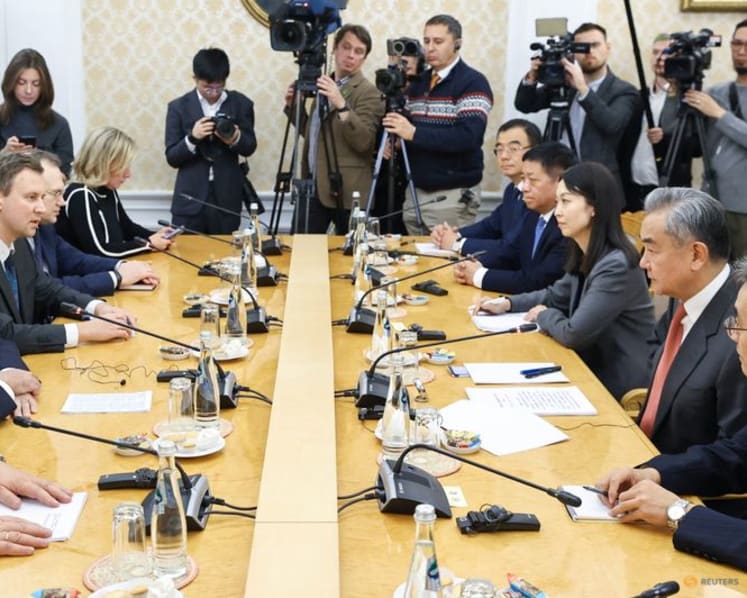
Xi reiterated China's support for peace in Gaza and announced a further US$100 million in aid to the Palestinians for reconstruction, although far below the 1.6 billion euros (US$1.87 billion) the EU pledged in April for the next three years.
China's top leader also encouraged Macron to deepen cooperation in aerospace and nuclear energy, as well as in artificial intelligence, the green economy and biopharmaceuticals.
The two leaders signed 12 cooperation agreements following their talks, covering population ageing, nuclear energy, and panda conservation, but without specifying their monetary total.
BIG BUSINESS
Macron in the past has sought to project a robust European front in dealing with China, pushing Brussels to deploy protectionist counter-measures to slow the flood of subsidised Chinese goods hammering European industry.
The EU's goods trade deficit with China has ballooned by nearly 60 per cent since 2019, while France's trade balance with the US$19 trillion economy continues to widen.
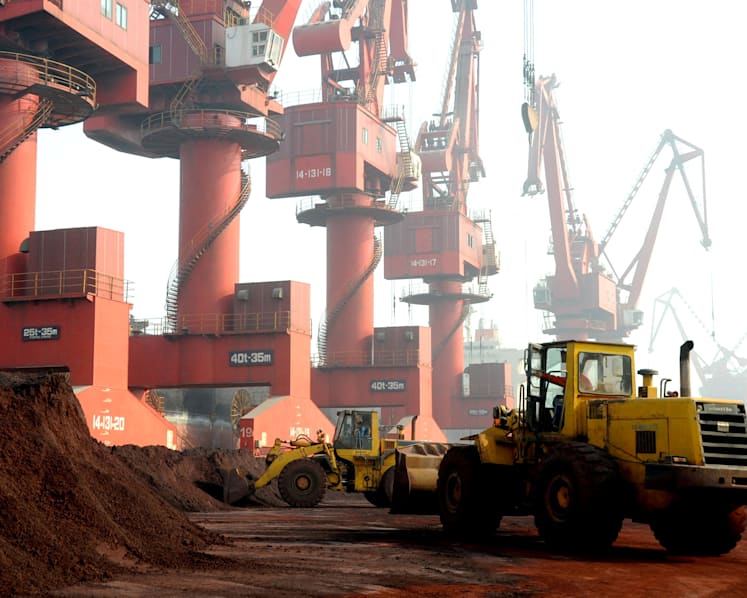
Macron also raised European concerns with China's move to restrict exports of critical minerals.
Beijing's threat of new curbs on rare-earth exports to the West in October, on top of restrictions announced in April, has caused fresh panic in European car, clean energy and semiconductor sectors, all heavily dependent on them.
"It is essential to create an environment of trust and to deal with every instability risk in supply chains," Macron said.
China is France's seventh-largest trading partner, buying around US$35 billion in goods each year, according to Chinese customs data. About 10 per cent of those products are cosmetics, with aircraft parts and alcoholic spirits among other key exports.
For its part, France takes some US$45 billion worth of Chinese products, mostly low-value parcels through online platforms like Shein selling cheap clothes, accessories and gadgets direct from Chinese factories, thanks to an EU customs waiver on purchases below 150 euros.