From virtual K-pop stars to storytelling apps, AI reshapes life in South Korea
But as artificial intelligence tools become more sophisticated and widespread, experts warn of potential risks like deepfakes.

Members of Iiterniti, a virtual K-pop girl group created with AI, in their music video for "Ice Cream Heaven". (Screenshot: Youtube/IITERNITI)

This audio is generated by an AI tool.



SEOUL: South Korea is known for moving fast. But now, artificial intelligence is moving even faster.
Technology is rapidly reshaping how people work, play and connect in the East Asian nation, which has long prided itself on being at the forefront of technological change.
In the capital Seoul, AI is no longer a distant concept – it is becoming part of everyday life and culture.
One of the most striking examples is Iiterniti, a virtual K-pop girl group created using AI.
Unlike human celebrities, these idols do not age, get tired or become embroiled in scandals. They are entirely AI-generated and designed to exist in a polished, idealised form indefinitely.
“In the traditional K-pop industry, stars are typically very young – often in their teens or early 20s,” noted Park Ji-eun, CEO of tech firm Pulse9 which created Iiterniti.
“They are attractive, but also, in a sense, possess an incomplete or still developing identity. Through our project, Iiterniti, we are experimenting with whether a girl group can remain in a more eternal and idealised form,” she added.





The virtual artists are capable of much more than simply performing – they can express their own thoughts and sense of self to fans, as well as compose songs, recommend content and perform “relatively simple creative tasks”, said Park.
“What we are striving for next is real-time interaction with fans, delivered with the visual quality and psychological satisfaction that makes it feel as though you are speaking to a real person.”
In the highly competitive K-pop industry, connecting with fans is crucial.
Developers are now working to ensure AI idols can build those emotional connections without the limitations faced by human performers.

AI-POWERED INTERACTIVE STORIES
Virtual pop stars are just one part of South Korea’s wider AI transformation.
Local startup Wrtn has developed a storytelling app called Crack, which places users inside an AI-generated world.
“What AI does is rewrite the story or start it on the spot. There is a predetermined universe with settings and characters, but ultimately, the main character is you. As you make choices, the story unfolds just for you,” said Lee Dong-jae, Wrtn’s co-founder and chief product officer.
Currently text-based, the platform could soon evolve into something more, he added.
“When latency, cost and quality issues are solved, then 3D models (can be created), making fully immersive interactive stories,” he said.
GROWING CONCERNS
But as AI tools become more sophisticated and widespread, experts warn of potential risks.
Professor Kim Hyung-jong, an information security expert at Seoul Women’s University, said deepfakes are among the biggest concerns.
“If an AI character reminds people of a real individual, it could invade privacy and damage reputations. Teenagers interacting with these characters could develop distorted patterns of social interaction. These are legitimate concerns.”
South Korea has introduced an AI Basic Act – a governance framework requiring transparency for AI-generated content to prevent potential risks.
However, Kim cautioned that legislation alone may not be sufficient.
“In Formula 1 racing, cars go faster and faster, but you need strong brakes to stay in control. Similarly, privacy protection, information security and governance must develop alongside AI. Otherwise, we risk losing control,” he added.
For many South Koreans, the impact of AI is already visible, for good or bad.
“I was bored so I tried making a friend with AI. I created a lively personality, and chatting felt very human – comforting even. That’s why I kept using it,” a Seoul resident in his 20s told CNA.
“Talking to the AI brings enjoyment and emotional relief.”
Another young Seoul resident said he wonders when AI will take over daily life, to the point where machines can perform part-time work.
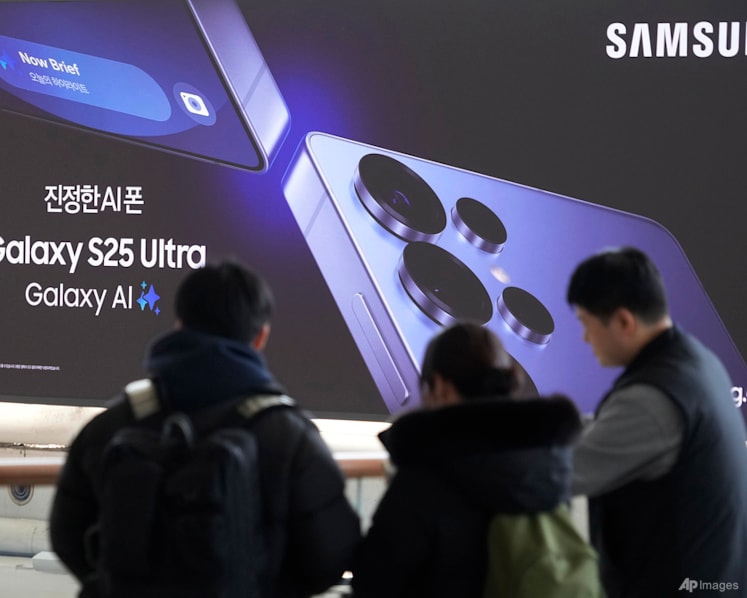
On the streets of Seoul, the rapid pace of AI adoption is visible everywhere from entertainment to education and beyond.
But as AI accelerates innovation at unprecedented speed, keeping pace with its implications may prove to be the country’s biggest challenge yet.