‘Democracy is working’: Analysts say Yoon conviction proves strength of South Korea’s institutions
A Seoul court that sentenced Yoon to life behind bars said the former president damaged South Korea’s democracy, but analysts say the landmark ruling proves the nation’s institutions are resilient, even as political divisions persist.
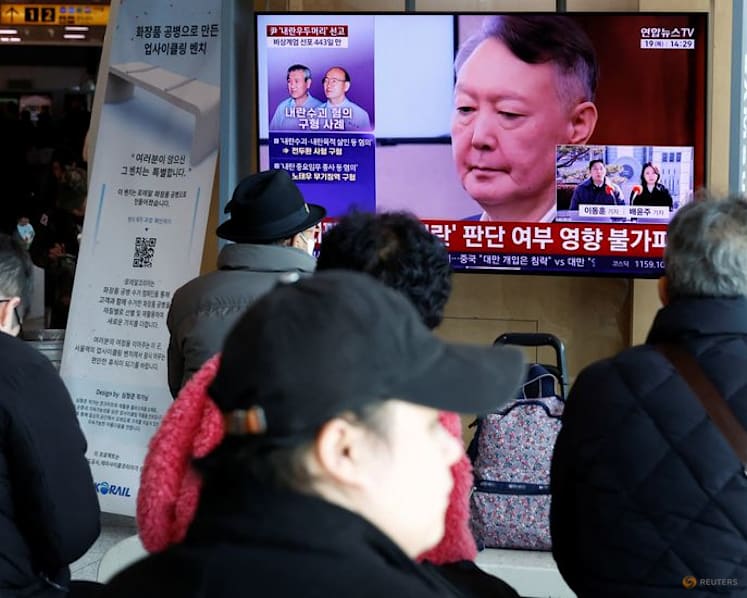
People watch a news report on the sentencing trial of South Korean former president Yoon Suk Yeol's insurrection case, stemming from his short-lived declaration of martial law in December 2024, in Seoul, South Korea, on Feb 19, 2026. (Photo: Reuters/Kim Soo-hyeon)

This audio is generated by an AI tool.


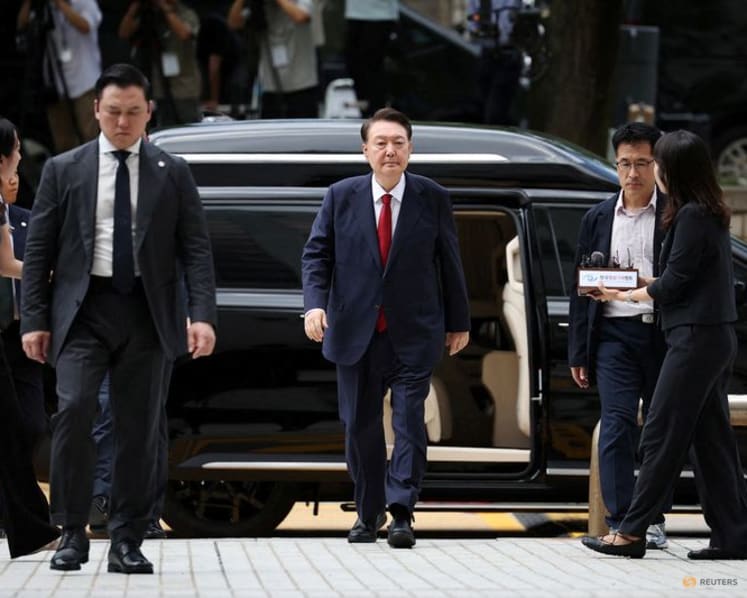
Former South Korean President Yoon Suk Yeol was sentenced to life imprisonment on Thursday (Feb 19) after a Seoul court found him guilty of masterminding an insurrection over his botched attempt to impose martial law in December 2024.
The ruling marks one of the most dramatic moments in the country’s modern political history. But beyond Yoon’s personal fate, analysts say the verdict ultimately underscores the resilience of South Korea’s democratic institutions.
Yoon’s declaration of martial law – the first since the country’s transition to democracy in 1987 – triggered a national political crisis.
But it was swiftly overturned by the National Assembly, with some lawmakers scaling barricades to get into the voter chamber amid heavy police presence.





Yoon was later impeached by parliament, arrested and charged with multiple offences. Analysts said the subsequent prosecution followed established legal procedures, demonstrating South Korea’s democratic resilience.
“This incident … actually highlights that democracy is working,” said Edward Howell, international relations lecturer at the University of Oxford.
“Obviously essential to any democracy is that leaders are accountable for their actions. Yoon declared martial law. It was voted down by the National Assembly. Due process was followed,” he added.
“We should not be naive in saying that democracy in South Korea is fragile. No, it's resilient; it's vibrant.”
Jong Eun Lee, assistant professor of political science at North Greenville University, said the harsh judgment is likely to have a deterrent effect.
“Probably the most immediate consequence of this verdict would be that future South Korean presidents would think very carefully before declaring another martial law,” he told CNA938.
WAS THE RULING JUSTIFIED?
Delivering the judgment to a packed courtroom, presiding judge Jee Kui-youn said Yoon’s actions fundamentally damaged South Korea's democracy and deserve a harsh punishment.
The court ruled the former president subverted the constitutional order by deploying troops to the National Assembly in a bid to paralyse its functions.
“When (Yoon) sent military units to surround the National Assembly and stop (lawmakers) from entering, he was abusing (his) powers,” said Jong, adding that Yoon interfered with the responsibilities of the legislative branch.
Mason Richey, associate professor of international politics at the Hankuk University of Foreign Studies in Seoul, described the court’s handling of the case as “thorough and meticulous”, pointing to the lengthy and detailed reasoning behind the verdict.
“That inductive reasoning process came across as extremely balanced and well-reasoned. The sentence came across as reasonable for the verdict,” he said.
While prosecutors sought the death penalty, Richey said several mitigating factors likely prevented the court from imposing the harshest possible punishment.
No excessive violence was ultimately used during the short-lived martial law, and no one was seriously injured. The plan itself also appeared poorly conceived and executed – the court found there was insufficient evidence that Yoon had planned the imposition of martial law a year in advance.
Richey added that the court may have taken into account Yoon’s long record of public service and the absence of prior criminal record.
However, the court also noted that Yoon had shown no remorse and had never admitted to criminal wrongdoing – factors that likely weighed against him in sentencing.
Yoon’s defence team has said it will discuss with him whether to appeal the ruling.
POSSIBLE APPEALS?
Meanwhile, history suggests the legal battle may not be over.
South Korea has a precedent of former presidents receiving heavy sentences only for them to be reduced or pardoned later.
Former military ruler Chun Doo-hwan was sentenced to death in 1996 for his role in the 1979 coup and the violent suppression of pro-democracy protests. His successor Roh Tae-woo also received a lengthy prison term.
Both sentences were later reduced on appeal, and the two men were pardoned in 1997 in what was described at the time as a move for national unity.
More recently, former President Park Geun-hye was released early in 2021 from a 20-year prison term for corruption and other crimes, and later pardoned. Her predecessor Lee Myung-bak, also jailed for corruption, was pardoned by Yoon in 2022.
“So, it’s not unlikely that Yoon, further down the line, seeks to appeal (his sentence) and faces a similar outcome,” said Howell.
However, he added that any reduction or pardon may not come soon. Current President Lee Jae Myung, who was defeated by Yoon in the 2022 presidential election, has vowed “strict accountability” for perpetrators of the martial law.
STABILITY REMAINS UNCERTAIN
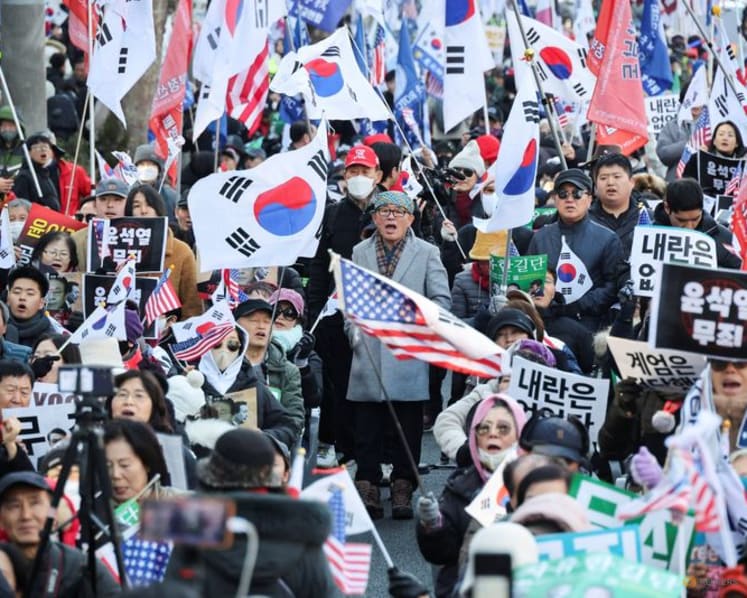
Still, for many South Koreans hoping the verdict would close yet another turbulent chapter in the nation’s politics – one that has again seen a leader end up behind bars – experts caution that political stability may still be elusive.
Howell warned that deep political polarisation in the nation is unlikely to fade quickly.
“Even within the current South Korean government, the ruling left-wing Democratic Party, there is factionalism and division,” he noted.
Richey added that the far right movement in South Korea has grown in recent years, and that the opposition conservative People Power Party remains splintered.
“Every democracy needs at least two functional parties that are opposed to each other. It's not great that the right in South Korea is so far off the rails, because that means that they're effectively not a very useful counterweight to the progressive ruling party,” he told CNA’s East Asia Tonight.
"I foresee some very difficult reconciliation … in the coming years, if not even longer," he added.