Analysts uncertain if sharing ministerial roles is the solution
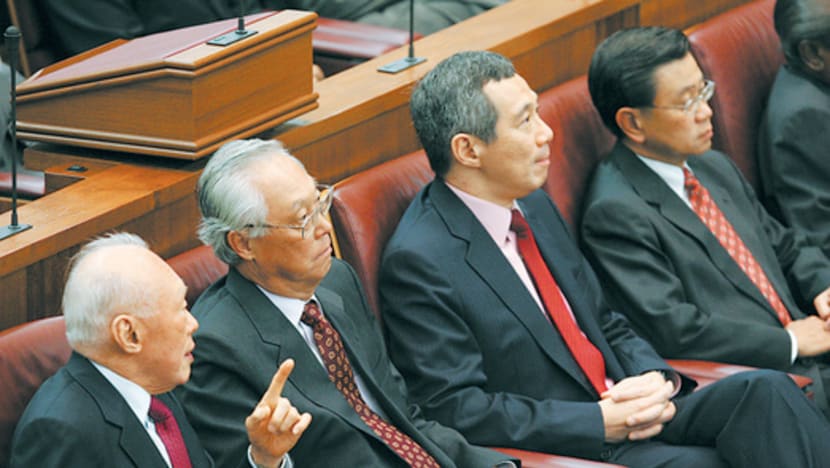
Prime Minister Lee Hsien Loong has said that one role of the new Cabinet is to prepare the team that succeeds him and fellow senior office-holders, the way previous leaders Mr Lee Kuan Yew and Mr Goh Chok Tong had done. TODAY file photo


SINGAPORE — While they agreed that governance is becoming increasingly complex and greater coordination is required across ministries, political analysts said it remains to be seen if having Coordinating Ministers and more than one minister helming the Education and Trade and Industry ministries is the solution.
Drawbacks, said some, include the possibility of more red tape and crossed wires.
Singapore is becoming a less homogenous society and more complex, said National University of Singapore (NUS) Associate Professor Lan Luh Luh. “Singapore is quite unique because if you look at history there is no city-state that actually goes beyond 100 years ... Singapore is determined to move another 100 years, so in that sense it warrants a different structure for Singapore,” she said.
On having three Coordinating Ministers — Mr Tharman Shanmugaratnam, Mr Teo Chee Hean and Mr Khaw Boon Wan — overseeing the economic and social policies, national security and infrastructure, NUS Associate Professor Reuben Wong said oversight of inter-ministerial coordination is necessary.





“When you have many ministers to coordinate issues across ministries, there will always be an issue of who is going to be the head, who has the final say. So, it’s good to have somebody other than the Prime Minister, himself, to play that role,” he said.
Both Assoc Prof Wong and Assoc Prof Lan said that in the past, problems could have risen from a lack of communication between ministries. For example, the foreign worker population was booming, but local infrastructure was not keeping up.
NUS political scientist Bilveer Singh likened the roles of Coordinating Ministers to the statutory boards of the past, addressing and resolving specific problems facing Singapore today. For instance, he saw Mr Khaw’s role as a policy response to the rising challenges involving MRT breakdowns, traffic jams and the inability to manage the car population here.
And, the decision to have two ministers each helming the Education and Trade and Industry Ministries added some “fat” to a usually lean Cabinet, “partly to expose the new faces as quickly as possible, and as many as possible to as many positions as possible”, he said.
However, analysts also had reservations about the strategy. SIM Global Education academic Felix Tan said while the role of Coordinating Ministers could add an extra layer of checks and balances to ensure that a ministry “does not run off tangent”, a drawback could be the additional red tape in the system.
NUS Associate Professor Reuben Wong said that issues such as who is in charge could emerge. “I can see potential problems because who is actually in charge of MOE if you split it this way? Both are completely new and first-time MPs and ministers,” he said.
Institute of Policy Studies Senior Research Fellow Gillian Koh said while specific responsibilities have been marked out, the model of having two ministers helming a ministry would “place a demand for cooperation between the two leaders”.
But, Assoc Prof Singh felt that “two heads are better than one” in complex and difficult ministries where the leaders are handling different areas.
In the case of MOE, which will be led by Acting Ministers Ong Ye Kung and Ng Chee Meng, Assoc Prof Singh said: “This is where the permanent secretary and the entire MOE bureaucracy, which is tried and tested, will be called up to make the difference.” ADDITIONAL REPORTING BY KELLY NG