







Authorities picking up steady trickle of radicals
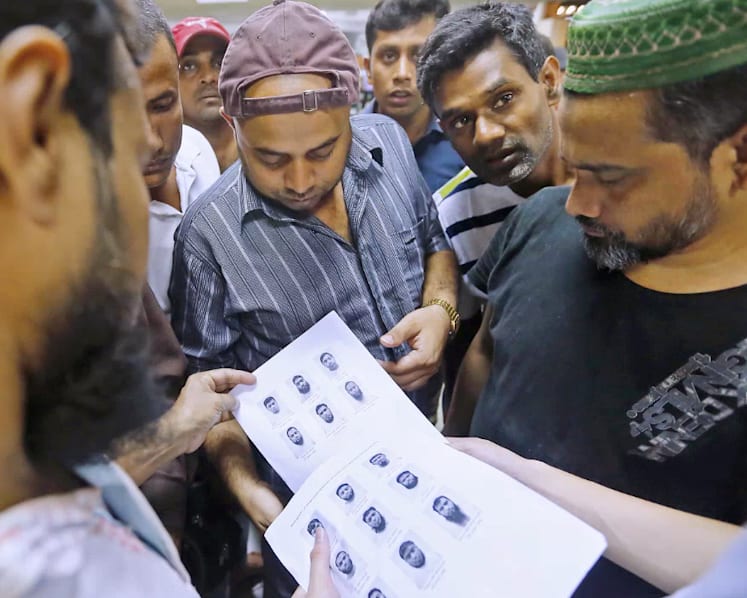
Worshippers at Angullia Mosque in Little India looking at the photos of 27 Bangladeshi construction workers who were arrested here for contemplating armed jihad overseas. Attacks by self-radicalised individuals are almost impossible to completely prevent, said PM Lee. TODAY file photo


SINGAPORE — With the Republic facing a significant external and domestic threat of terrorism, the authorities have continued to pick up a “steady trickle” of radicalised individuals, said Prime Minister Lee Hsien Loong on Sunday (Aug 21).
On average, one or two such persons are picked up each month, he shared during his National Day Rally speech.
These people either tried to join Islamic State in Iraq and Syria (Isis, also known as IS) militants in the Middle East or were prepared to launch attacks here, said Mr Lee, as he alluded to four self-radicalised Singaporeans dealt with under the Internal Security Act for attempting to travel to Syria to join IS.
Most of the Singaporeans who had been arrested for terror-related activities were self-radicalised, such as by surfing jihadist websites or tuning in to extremist radio stations in the region, said Mr Lee.





In the latest cases, made public by the Home Affairs Ministry on Friday, two of the four arrested — Rosli Hamzah, 50, and Omar Mahadi, 33 — had started listening to Radio Hang, a Batam-based religious radio station that sometimes features speakers who preach extreme religious views, in 2009 and 2010.
“(Terrorism) is on our minds now. Almost every day, we read of new attacks somewhere: US, Europe, the Middle East, and closer to home, Indonesia and Malaysia,” said Mr Lee.
Calling for cooperation between the Republic and its neighbours in fighting terror, he cited the recent arrests of five Indonesians in Batam who had purportedly plotted to fire a rocket at Singapore’s Marina Bay Sands.
Allegedly led by Gigih Rahmat Dewa, 31, the five are said to be part of terror cell Katibah GR, which has links to Bahrun Naim, the alleged mastermind of the shopping mall bomb attack in central Jakarta in January.
Urging Singaporeans to take the incident seriously, Mr Lee said: “Speaking as a former artillery man, I will tell you, it is not so easy to fire one rocket and hit a building 20 kilometres away ... But the trouble is, if you fire one rocket at Singapore and you miss Marina Bay Sands, you may hit something else.”
He added: “Furthermore, how do you know this was the only thing (Gigih) was planning? He may have other dark thoughts on how to attack Singapore … And can we be sure that every last terrorist in the group has been arrested?”
He pointed out that the cell which mounted the brazen attack in Jakarta had evaded the Indonesian police’s dragnet, despite the police’s resolve to clean up all terrorist cells.
Some 1,000 Malaysians and Indonesians are fighting alongside IS in the Middle East — a number large enough for the group to form a Bahasa-speaking battalion called Katibah Nusantra, the Prime Minister noted.
IS also produces propaganda videos in Bahasa. One such video, published online in May, showed child fighters from Malaysia and Indonesia firing guns, burning their passports and denouncing their citizenships, while a wanted terrorist delivered a provocative message for regional governments.
An IS-affiliated media agency also publishes Al-Fatihin, a magazine in Bahasa Indonesia, which is banned here.
“Terrorist groups are active all around us in South-east Asia ... Singapore is not uniquely immune to jihadist propaganda,” said Mr Lee.
He noted that attacks by “lone wolves”— or self-radicalised individuals — no longer come as a surprise, but are challenging to prevent.
“Each (attack is) heartbreaking, shocking, yet each time no longer a real surprise. Such attacks are almost impossible to prevent completely,” Mr Lee said, citing the truck rampage in Nice, France, in July, and nightclub shooting in Orlando, Florida, in June.
“They are inspired by Isis ... but there is no group involved (in the) planning and execution.
“So if it is just one (or) two persons, it is much harder for security forces to discover and to prevent these attacks,” Mr Lee added.




