







Budget 2026: Surplus for FY2025 revised up sharply to S$15.1b on higher corporate tax collections, COE premiums
The surplus was previously estimated at around S$6.8 billion.
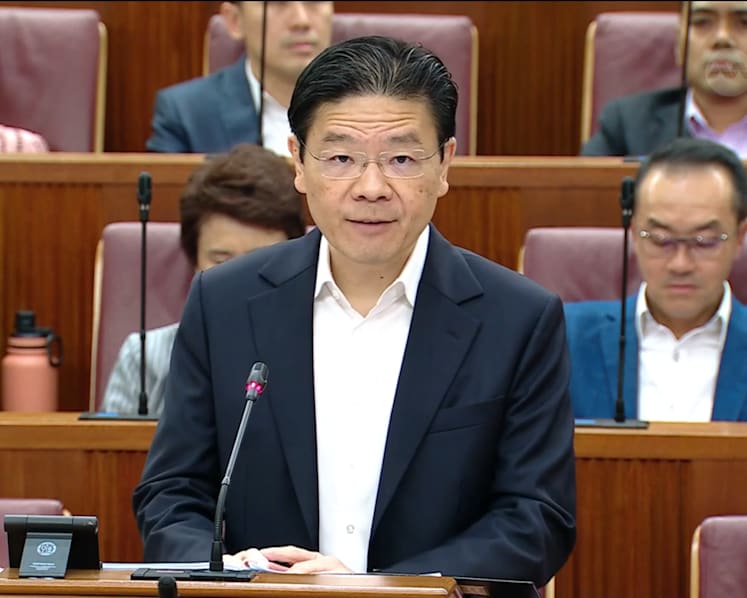
Prime Minister Lawrence Wong delivers the Budget statement in Parliament on Feb 12, 2026.

This audio is generated by an AI tool.


SINGAPORE: Singapore’s budget surplus for the 2025 financial year is now expected to come in at S$15.1 billion (US$12 billion), more than double the earlier estimate of S$6.8 billion.
Prime Minister and Finance Minister Lawrence Wong said in his Budget speech on Thursday (Feb 12) that the stronger position was partly driven by better-than-expected economic performance, highlighting the increase in corporate income tax collections.
The revised operating revenue for the financial year 2025 is S$130.9 billion, about 6.6 per cent higher than previous estimates.
Corporate income tax collections, a key contributor, were revised up to S$35.2 billion, about S$2.6 billion more than initially expected.
“Based on the latest estimates, we expect corporate income tax collections to increase further in (the financial year) 2025,” said Mr Wong. The financial year 2025 ends on Mar 31, 2026.
Asset-related revenue collections were also higher than expected, driven by strong demand for private vehicles and properties, he said.





The government collected S$8.7 billion in Certificate of Entitlement (COE) premiums - around S$2 billion more than anticipated. Stamp duty collections were also revised upwards.
Total expenditure was slightly higher than expected, at S$124.5 billion.
Higher development spending by the Ministry of Transport - mainly for rail development and expansion - contributed to the increase.
Expenditure by the Ministry of Home Affairs also rose, while the Ministry of Health and the Ministry of Trade and Industry (MTI) spent less than expected.
Taking into account ministry expenditure, special transfers and factoring in the impact of the Significant Infrastructure Government Loan Act, the revised size of the Budget for 2025 is S$143.3 billion, or 17.9 per cent of GDP.
FINANCIAL YEAR 2026 IN NUMBERS
For the 2026 financial year, the government expects the size of the Budget to increase to S$154.7 billion, an increase of 8 per cent from the revised figure for 2025.
Ministry expenditure is expected to reach S$137.3 billion, up 10.3 per cent from 2025’s spending.
The largest increase is expected to come from MTI, which will see development expenditure jump S$4.3 billion to hit S$9.2 billion. This is mainly due to initiatives to enhance Singapore’s economic competitiveness in an uncertain global environment.
Operating expenditure for the Ministry of Health is also expected to increase S$1.6 billion to S$20 billion, because of higher grants to public healthcare institutions and enhancements to long-term care subsidies and schemes.
On the revenue side, operating revenue is projected to grow to S$134.8 billion, an increase of 3 per cent from the revised 2025 figure.
The Ministry of Finance said this is due to higher collections expected from corporate income tax, personal income tax, goods and services tax, COE premiums and motor vehicle taxes.
Corporate income tax collections are expected to increase by S$2.5 billion due to strong economic growth last year.
The net investment returns contribution (NIRC) is expected to bring in S$28.5 billion - S$0.95 billion higher than the revised 2025 figure.
Overall, the fiscal position for the financial year 2026 is estimated to be S$8.5 billion, smaller than the surplus reported for 2025.
SPENDING NEEDS SET TO GROW
Looking ahead, Mr Wong said Singapore’s public finances remain sound despite growing needs.
On the revenue side, corporate tax revenues are expected to rise further from FY2027 when Singapore implements the 15 per cent minimum effective tax rate for large multinational enterprises under the global BEPS framework, or Base Erosion and Profit Shifting.
At the same time, expenditure is set to increase across several fronts.
More will be spent on security and external relations, including strengthening overseas partnerships and building capabilities to keep Singapore safe.
Economic spending is likely to remain elevated as the government updates its investment promotion tools to stay competitive.
Social spending will also increase to strengthen support for families, boost social mobility and enhance retirement adequacy.
The government will manage the increase in revenues and expenditure carefully, ensuring that spending is supported by collections, to maintain a balanced budget in the medium term.
“Our sound public finances give us the ability to act decisively and to invest where it matters most,” said Mr Wong.
Many other countries are constrained by debt and deficit pressures, and are forced into difficult trade-offs, but Singapore begins this term of government on a firm fiscal footing, he said.
“We are therefore able to invest meaningfully and responsibly in policies and programmes that benefit all Singaporeans – now and in the years ahead.”




