







Budget 2026: Singapore must adapt and connect differently to create good jobs, says PM Wong
The government will act decisively on recommendations from the Economic Strategy Review committees to secure growth that translates into jobs and rising incomes, says Prime Minister Lawrence Wong.
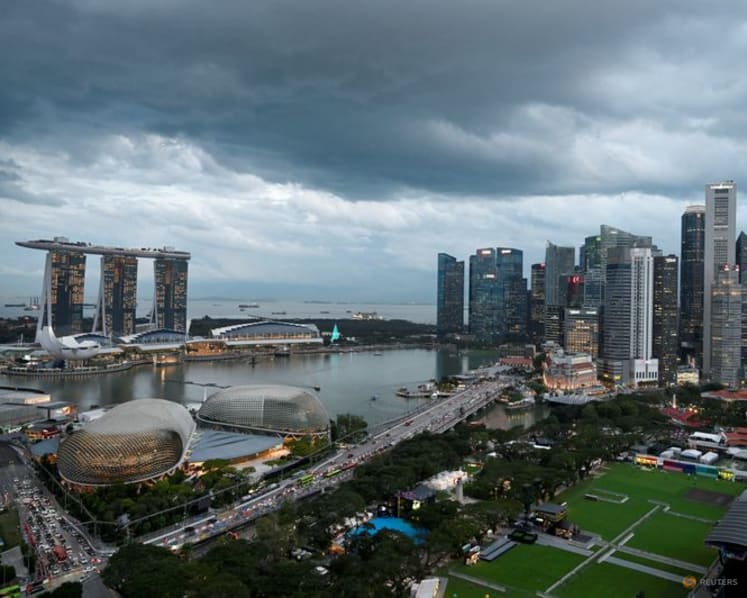
A view of the skyline in Singapore Sep 17, 2024. (File photo: Reuters/Caroline Chia)

This audio is generated by an AI tool.


SINGAPORE: Singapore must adapt to a more fragmented global economy and “connect in smarter, more diversified and more resilient ways” to secure growth that creates good jobs, Prime Minister Lawrence Wong said on Thursday (Feb 12).
Delivering Budget 2026, Mr Wong - who is also the finance minister - said the government will act decisively on key recommendations from the Economic Strategy Review committees to ensure growth translates into rising incomes for Singaporeans.
“Growth will be harder in this changed world,” said Mr Wong. “We must aim higher, move faster and be prepared to take calculated risks.”
While some countries are turning inward, Singapore does not have that option, he added. Economic flows are becoming more selective and partnerships more strategic.
“Singapore must therefore adjust to these new patterns – staying open, but connecting in smarter, more diversified and more resilient ways,” said Mr Wong.
Mr Wong outlined efforts to expand Singapore’s network of partnerships. The country has formed new cooperative arrangements such as the Future of Investment and Trade Partnership, and signed agreements including the EU-Singapore Digital Trade Agreement. It will also sign an Agreement on Trade in Essential Supplies with New Zealand later this year.





Engagement with fast-growing markets in Latin America, Africa and the Middle East will be stepped up, he said.
Within the region, Singapore is working on projects such as the Johor-Singapore Special Economic Zone and the Batam, Bintan and Karimun Free Trade Zones in Indonesia.
“In short, we will redouble our efforts to diversify globally and to integrate regionally,” he said.
TAX REBATES AND SUPPORT FOR BUSINESSES
Acknowledging cost pressures faced by firms, Mr Wong announced a 40 per cent corporate income tax rebate for the Year of Assessment 2026.
Companies that are active and have employed at least one local employee in 2025 will receive a minimum benefit of S$1,500 (US$1,200) in the form of a corporate income tax rebate cash grant. The maximum benefit per company will be capped at S$30,000.
“This will provide short-term relief as we press on with our restructuring and transformation efforts,” he said.
To create more opportunities and jobs, the government will step up support for local companies venturing overseas.
From April 2026, local small‑ and medium‑sized enterprises (SMEs) that apply for the Market Readiness Assistance grant can receive up to 70 per cent of eligible costs, capped at S$100,000 per company per new market – up from the current 50 per cent.
From the second half of 2026, firms will also be able to tap the grant to deepen their presence in overseas markets, with the removal of the “new to target overseas market” criterion.
Support levels for the Business Adaptation Grant and the Global Innovation Alliance schemes will also be enhanced from April 2026. SMEs will receive up to 70 per cent support for eligible costs, while non-SMEs will receive up to 50 per cent. The higher support levels will apply until end-March 2029.
Changes will also be made to the Double Tax Deduction for Internationalisation scheme.
More qualifying activities will be eligible for automatic 200 per cent tax deduction claims, and the cap on claims that may be filed without prior approval will be increased from S$150,000 to S$400,000.
Eligible expenses for overseas market development trips and overseas investment study trips will no longer require prior approval, along with activities such as investment feasibility studies and production of corporate brochures for overseas distribution.
Companies can also access larger trade and fixed asset loans under the enhanced Enterprise Financing Scheme from April this year. Borrower caps of between S$10 million and S$30 million for each loan facility will be lifted, although borrower groups will remain subject to an overall exposure limit of S$50 million.
BUILDING INDUSTRY LEADERS
Beyond connectivity and enterprise support, Singapore must strengthen its position in key growth clusters, said Mr Wong.
For example, the country invested in advanced packaging research and development more than 20 years ago, anchoring major semiconductor companies here today. Similar approaches have supported industries such as aerospace and biomedical sciences.
“Technology is the critical enabler underpinning our strategy to build leadership in these clusters. Singapore must be a place where frontier technologies are developed, tested and commercialised,” said Mr Wong.
To support this, Singapore will invest S$37 billion under the Research, Innovation and Enterprise 2030 plan.
Mr Wong said investments must be disciplined and strategic, as Singapore cannot match the scale of larger economies.
Emerging areas such as decarbonisation solutions and quantum technology have potential, he added, noting that Singapore made an early bet on quantum and is now attracting some of the world’s leading companies and talent in the field.
“These examples show how we can build leadership in key growth areas, and shape where innovation and value creation take place,” said Mr Wong.
“In doing so, we strengthen Singapore’s strategic resilience and relevance, while creating more jobs and better opportunities for Singaporeans.”
CREATING JOBS
Senior economist at DBS Chua Han Teng said that the enhanced internationalisation schemes will support the ambitions of Singapore enterprises to build resilience amid global uncertainty and a limited domestic market.
The measures announced are “strongly aligned” with the execution of the key recommendations in the Economic Strategic Review’s mid-term update, he added, noting the focus on AI adoption.
Mr Yong Jiahao, a partner at KPMG, agreed that the measures align closely with the recommendations, particularly in addressing the need for Singapore to adapt to shifting global economic patterns.
He noted that the measures announced are "well positioned to create quality jobs".
"By focusing on attracting high-growth companies with the potential to become future industry leaders, Singapore is laying the groundwork for new engines of economic growth", said Mr Yong, who focuses on infrastructure, government and healthcare, industrial manufacturing, and tax.
Additionally, the emphasis on nurturing homegrown startups and enabling companies of all sizes to access capital and partnerships ensures that the benefits are distributed across the business landscape, he said.
"By anchoring these businesses in Singapore, the measures also enhance the resilience of the local job market, ensuring that it remains competitive and future-ready in an evolving global economy."





