







Celebrating a remarkable Singapore story
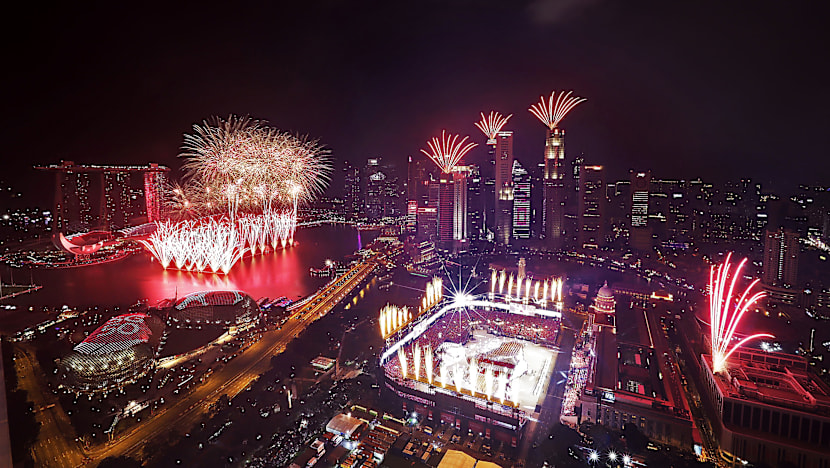
Fireworks during the National Day Parade this year. TODAY file photo


SINGAPORE — The Golden Jubilee celebrations a fortnight ago was not “just a birthday bash” as Singaporeans got together to rejoice over far greater causes: The country’s journey from Third World to First, the people’s resolve to defend the country and to survive over the next five decades, and the way the island’s vulnerability was turned into strength, Prime Minister Lee Hsien Loong said tonight (Aug 23).
Mr Lee noted that the Republic started out in a “rough neighbourhood” with only two infantry battalions. But its pioneers, who were determined to defend the country, built up the Singapore Armed Forces.
Within four years after independence, the National Day Parade (NDP) in 1969 had a Hunter aircraft and an Alouette helicopter flying above the spectators. Eighteen AMX-13 tanks also made their first public appearance as they formed part of the mobile column.
“Singaporeans cheered,” Mr Lee recalled. “Everyone understood what it meant. And it wasn’t just Singaporeans who took note.” At the NDP earlier this month, pioneer servicemen kicked off the SG50 Vintage Parade held at the Padang. “Older, greyer, but their spirit remained undaunted,” he added.
Mr Lee reiterated that Singapore was a Third World country when it separated from Malaysia in 1965.





The Republic had a weak economy and no hinterland. Its workforce was also unskilled and people lived in slums without modern sanitation or utilities. But over the years, Singapore made the world its hinterland, the tripartite partners created the “best workforce” and Housing and Development Board flats were built to give Singaporeans a roof over their heads, he said.
In the early years, nearly all of Singapore’s water supply came from Johor, Mr Lee pointed out. Every now and then, an issue arose with Malaysia and “some crazy politician” would threaten to turn off the tap. “But we didn’t die of thirst,” Mr Lee said. Rivers were cleaned up and dammed to become reservoirs. The whole island became a catchment area, Mr Lee said.
Mr Lee also recalled how Singaporeans were not yet united during independence in 1965, with memories of the race riots a year earlier still “fresh and raw”. Then, the minorities were uncertain of their place in the new country.
“Fifty years on, we celebrate as one united people,” Mr Lee said. “On National Day, when the sirens sounded, we stood and recited the Pledge together. Regardless of race, language, or religion, we sang Majulah Singapura!”




