Singapore's core inflation fell to 1% in January, down from 1.2% in December
Overall inflation rose to 1.4 per cent, mainly due to due to higher accommodation inflation that more than offset lower core and private transport inflation.
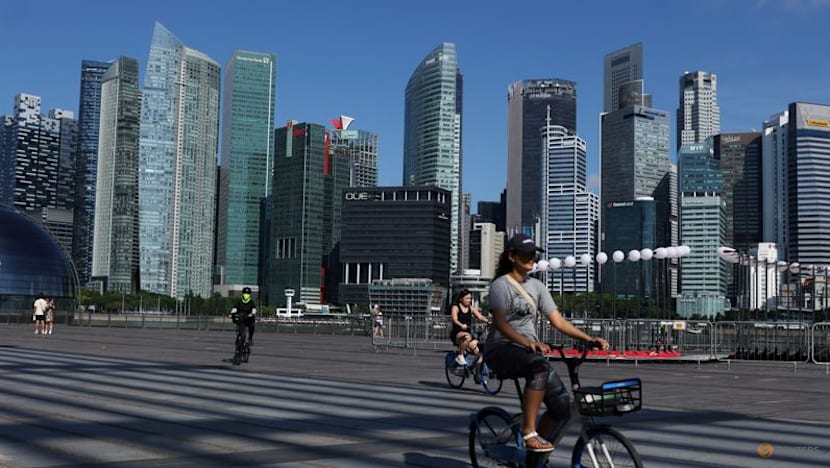
People ride bikes past the skyline of the central business district in Singapore on Jun 13, 2025. (File photo: Reuters/Edgar Su)

This audio is generated by an AI tool.


SINGAPORE: Singapore’s core inflation fell to 1.0 per cent year-on-year in January, down from 1.2 per cent in December, official data showed on Monday (Feb 23).
January's figure was lower than the median forecast of 1.5 per cent in a Reuters poll of economists.
It was largely due to a moderation in services inflation, the Ministry of Trade and Industry (MTI) and the Monetary Authority of Singapore (MAS) said in a joint media release.
On a month-on-month basis, core prices - which exclude accommodation and private transport - fell 0.3 per cent in January.
Overall inflation, as measured by the Consumer Price Index-All Items, rose to 1.4 per cent in January from 1.2 per cent in December, mainly due to higher accommodation inflation that more than offset lower core and private transport inflation.
On a month-on-month basis, overall inflation - which excludes non-consumption expenditures such as purchases of houses, shares and other financial assets and income taxes - fell by 0.5 per cent in January.
SECTORS
The dip in core inflation to 1 per cent was a surprise, said Ms Selena Ling, chief economist and head of OCBC Group Research.
It was attributed to an easing in services inflation, which fell to 1.5 per cent in January from 1.9 per cent the month before due to a larger fall in airfares and a decline in general, vocational and higher education fees.
Electricity and gas inflation remained unchanged at -4.2 per cent in January, as electricity tariffs declined at a similar pace as in December.
Food inflation also stayed unchanged at 1.2 per cent, as the prices of non-cooked food and food services rose at similar rates in January and December.
Retail and other goods inflation rose to 0.5 per cent in January from 0.0 per cent, on account of an increase in the cost of other appliances for personal care.
Private transport inflation eased to 2.7 per cent in January from 3.7 per cent due to a smaller increase in car prices and a steeper decline in petrol prices.
Accommodation inflation went up to 1.9 per cent in January, up from 0.3 per cent, due to a larger increase in the cost of housing maintenance and repairs.
OUTLOOK
MAS and MTI said Singapore’s imported costs should remain contained, as global crude oil prices have risen in recent weeks but are expected to remain lower than levels a year ago.
Regional consumer price inflation should pick up modestly after its weak outturns last year, although broadly subdued producer prices in Asia should cap the extent of inflationary pressures.
“On the domestic front, unit labour cost growth should edge higher in 2026, but the extent of pick-up will be dampened by sustained productivity growth,” said MAS and MTI.
“Meanwhile, private consumption demand is likely to remain steady, underpinned by continued real wage increases.”
Reflecting these factors, MAS and MTI said core and overall inflation are projected to average 1.0-2.0 per cent in 2026.
However, they added that the inflation outlook remains subject to uncertainties, as stronger-than-expected growth could bolster demand-pull inflationary pressures.
“Supply shocks, including those triggered by geopolitical developments, could also lift imported costs,” they said. “Conversely, a large, discrete shock to growth from macroeconomic and financial stressors could dampen inflation.”
Domestic cost pressures are the key determinant of the 2026 inflation outlook, Ms Ling said, given that unit labour costs should edge up due to labour market tightness.
"The policy intention from Budget FY2026 is clear, with announced increases to the Local Qualifying Salary from Jan 1, 2027, and also the EP and S Pass qualifying salaries from Jan 1, 2028, which suggests that higher wage costs could continue to ratchet higher from next year," she added.
"Looking ahead, we expect that MAS will likely remain static at the April MPS (monetary policy statement) to observe a few more months of inflation data before committing to a tightening move down the road."