







Singapore’s core inflation holds steady at 1.4% in May
While there was higher food as well as retail and other goods inflation, these were mostly offset by lower services inflation, said the Monetary Authority of Singapore (MAS) and the Ministry of Trade and Industry (MTI).
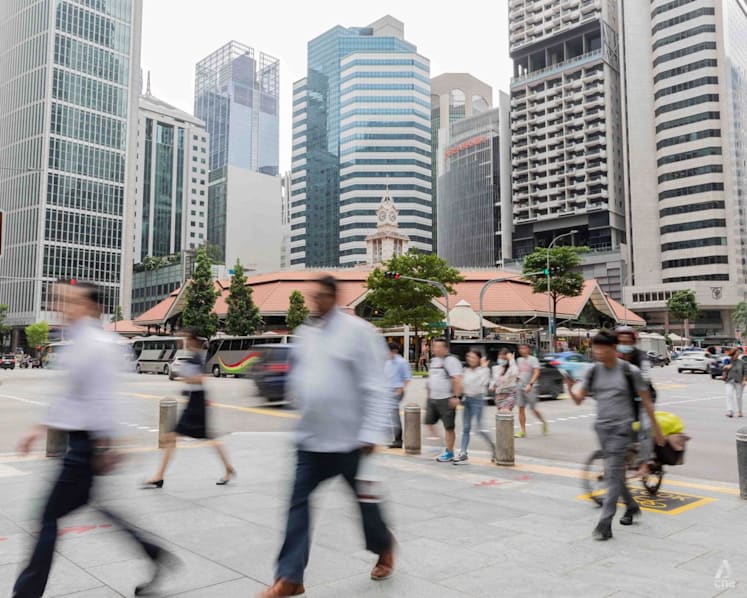
File photo of workers in Singapore's central business district.

This audio is generated by an AI tool.


SINGAPORE: Singapore’s core inflation held steady at 1.4 per cent in May, although higher energy costs are expected to raise imported costs over time, according to official data released on Tuesday (Jun 23).
While there was higher food as well as retail and other goods inflation, these were mostly offset by lower services inflation, the Monetary Authority of Singapore (MAS) and the Ministry of Trade and Industry (MTI) said in a joint media release.
May's core inflation rate was lower than the median forecast of 1.6 per cent in a Reuters poll.
Overall inflation, as measured by the Consumer Price Index-All Items, was also unchanged from April at 1.8 per cent, as the higher inflation in private transport and accommodation, food, as well as retail and other goods, was largely offset by lower services inflation, said MAS and MTI.





On a month-on-month basis, core prices - which exclude accommodation and private transport - were unchanged in May.
OUTLOOK
“As higher energy costs pass through global supply chains with a lag, they are expected to raise production and transport costs for a wider range of Singapore’s imported goods and services over time,” said MAS and MTI.
The authorities noted that while global energy prices have eased recently, they remain elevated in comparison to their 2025 levels.
“On the domestic front, services unit labour costs are likely to increase at a slower pace this year as nominal wage growth eases from the firm levels last year. Meanwhile, domestic consumer spending could turn more cautious amid the economic uncertainty.”
Taking into account these factors, core inflation and overall inflation are expected to average 1.5 per cent to 2.5 per cent in 2026, which is in line with MAS' full-year forecast range.
“At this juncture, the risks to the inflation outlook remain tilted to the upside. A slower-than expected resumption in global energy supplies or continued shortages in key intermediate inputs to regional supply chains could further raise imported costs for Singapore,” said MAS and MTI.
“However, downside risks are also present. A stronger-than-expected tightening in global financial conditions could lead to a slowdown in economic activity and thus lower inflation.”
SECTORS
Official data showed that services inflation fell from 1.5 per cent in April to 1.3 per cent in May, largely due to a steeper decline in telecommunication services prices.
Electricity and gas inflation remained unchanged at -3 per cent, with electricity prices falling at a similar pace in April and May.
Retail and other goods inflation edged up from 1.5 per cent in April to 1.6 per cent in May as the prices of both appliances for personal care and information and communication equipment increased at a faster rate.
Accommodation inflation also rose slightly, from 0.4 per cent in April to 0.5 per cent in May, due to a larger increase in housing rents.
Food inflation increased from 1.6 per cent in April to 1.8 per cent in May as the prices of non-cooked food and food services rose at a faster pace.
Private transport inflation increased from 8.1 per cent in April to 8.6 per cent in May due to higher increases in car and motorcycle prices.
Editor's note: An earlier version of this article stated that core prices had risen 0.7 per cent on a month-on-month basis in May. This was incorrect. Core prices were unchanged in May. We apologise for the error.




