Singapore must continue to 'pay particular attention' to defence if global order falls apart: PM Wong
Noting how modern battlefields have evolved, Prime Minister Lawrence Wong said it will be challenging to defend against cheap swarms of drones with expensive assets.
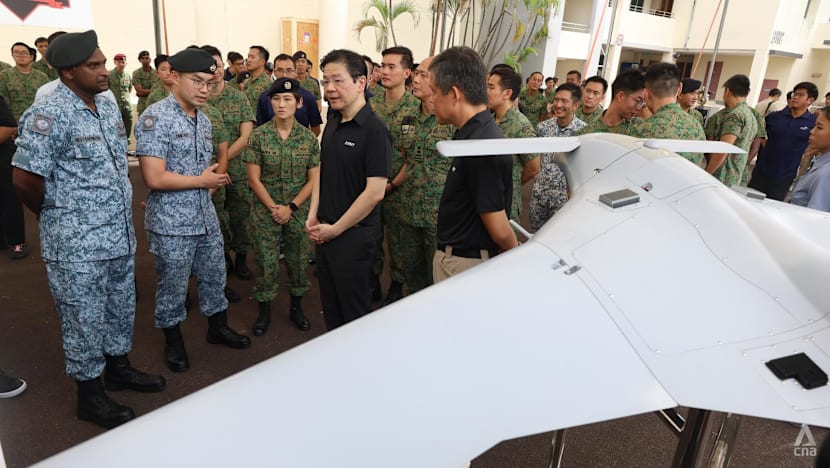
Prime Minister and Minister for Finance Lawrence Wong interacting with MAJ Dimir Pot (second from left) from the 128 Squadron, Unmanned Aerial Vehicle (UAV) Command, RSAF, and ME3 Karthikeyan (first from left) from the 801 Squadron, UAV Command, RSAF, during a visit to Mandai Hill Camp on Apr 9, 2026. (Photo: CNA/Ooi Boon Keong)

This audio is generated by an AI tool.


SINGAPORE: Singapore will need to pay particular attention to defence if the global order starts to fall apart, even as the country builds resilience across energy, food and other parts of the supply chain, said Prime Minister Lawrence Wong on Thursday (Apr 9).
If global order moves in that direction, there will be a "vacuum" which leads to disorder, he said.
"It means messiness. It means unpredictability," said Mr Wong.
Asked by reporters during a visit to the 6th Singapore Division/Headquarters Sense and Strike (6 Div/HQ SS) at Mandai Hill Camp about the Iran war's impact on defence, the prime minister spoke about a world where countries may resort to the use of force and coercion to get what they want.





"Small countries like Singapore will come under pressure," he said, which is why Singapore has to go beyond equipping and transforming the Singapore Armed Forces (SAF).
"It is also thinking hard about technology and thinking hard about defence supply chains and how we can be more resilient as a country," Mr Wong said.
He was joined by Defence Minister Chan Chun Sing at the visit. They observed how the SAF deployed drones on the battlefield, which Mr Wong said allowed him to learn how these capabilities are integrated with the rest of the military.
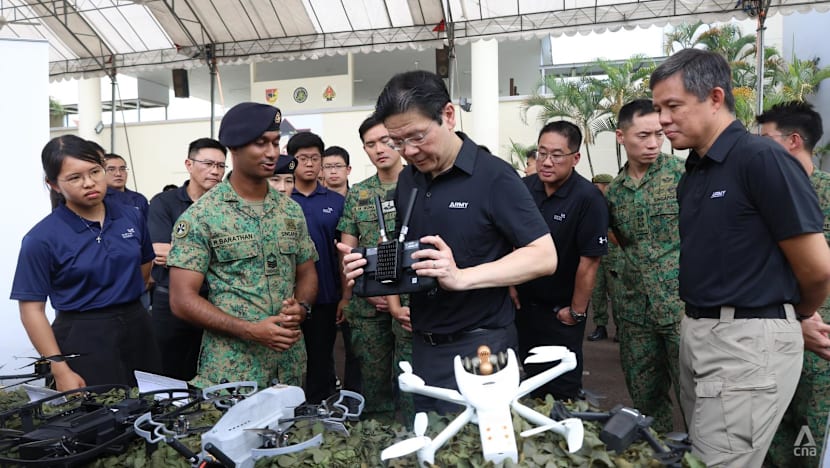
With recent conflicts in Ukraine and Iran showing that warfare is evolving through the use of unmanned systems, it has given Singapore "a lot of food for thought", said Mr Wong.
It is not just about buying new platforms, he noted.
"What was of more importance is how to integrate these new capabilities well across different domains - between the operations and the technology team - and across different services in the SAF, so that we can have a more effective SAF, and we can also be a more effective deterrent against potential aggressors," he added.
Singapore must be prepared for more conflicts and more fighting around the world in the years ahead, Mr Wong said.
"We wish it were not so, but this is the reality of the world we live in, and we must be prepared."
CHALLENGES OF DRONE WARFARE
With low-cost drones being used in Ukraine and Iran, Mr Wong noted that such a trend can pose challenges to countries with advanced defence technologies.
"You can have the most advanced interceptors, but when your aggressor is deploying cheap swarms of drones, it's very challenging for your interceptors to defend," he said, adding that it also takes time to replace the expensive assets.
This was an example of new threats Singapore will have to think about, which is why it is important for the country to build up its own capabilities, said Mr Wong.
During the visit, the prime minister was briefed on the unit's transformation to integrate capabilities across the Singapore Army’s intelligence and artillery teams, as well as the cross-service integration between the army, the Republic of Singapore Air Force (RSAF) and the Digital and Intelligence Service (DIS).
Mr Wong also interacted with soldiers undergoing the division's Advanced Competency Training to learn the new technologies and new concepts. It involves more than 1,200 national servicemen (NSmen), full-time NSmen and regulars.
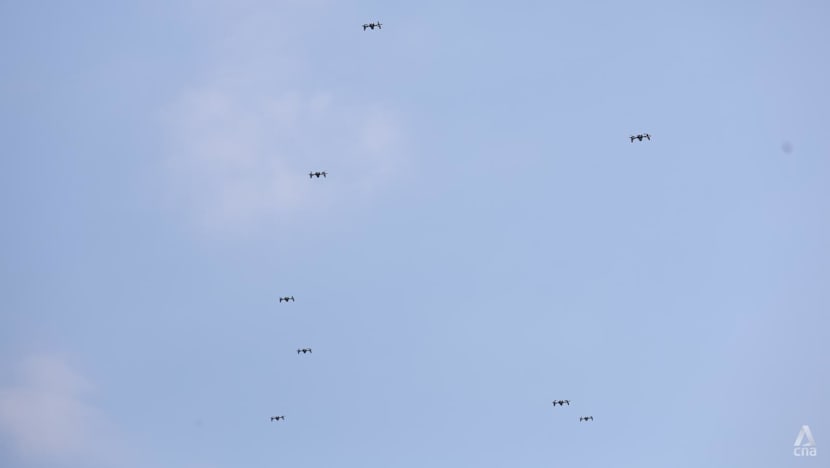
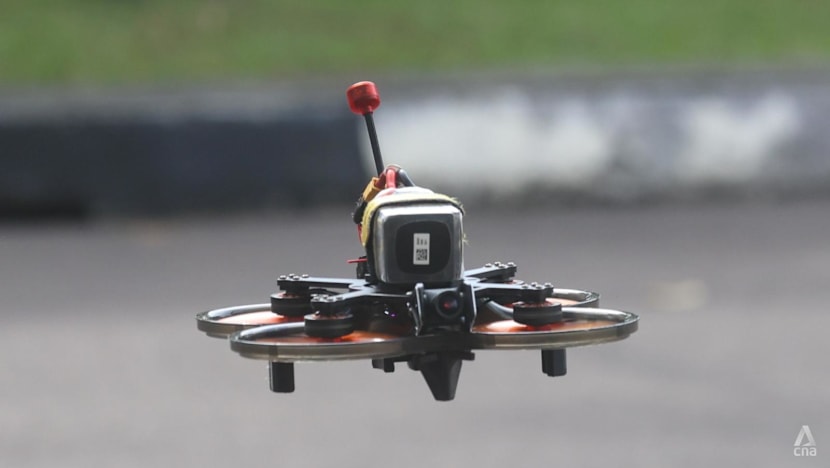
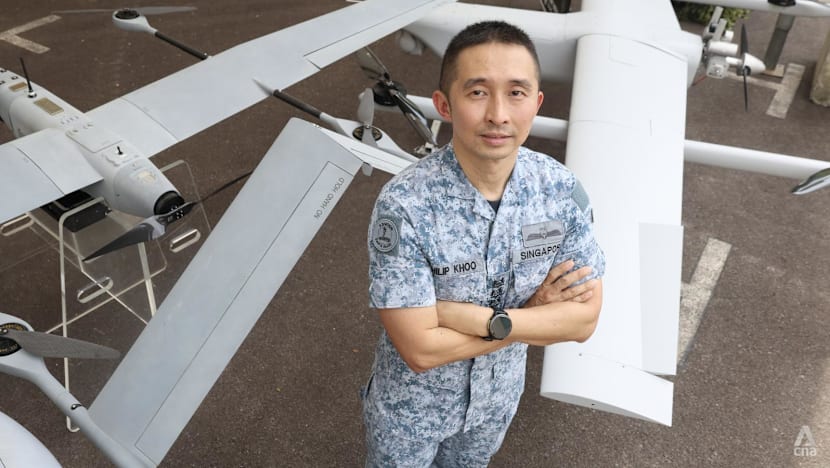
Colonel Philip Khoo Kok Hong, chief of staff of the 6 Div/HQ SS, noted that operations today are no longer confined to just a single domain, but span across air, land, sea and even the digital space.
He highlighted four evolving challenges - urban complexity, data overload, faster and smarter threats, and multi-domain operations.
Buildings and structures in the urban environment can make it difficult to pick up the targets present everywhere. More sensors are needed to cover as many blind spots as possible, said COL Khoo.
A good command and control information system is also necessary to collate all incoming data and filter the information that matters, he added.
To combat fast-moving targets, the "kill chain" needs to be shortened - from the time a target is picked up and determined as a potential threat, to the time taken to assign a shooter to take it down.
Lastly, with warfare no longer confined to a single domain, the SAF will need to bring in expertise such as from the army, air force and the DIS into a cohesive system to become an effective fighting force, COL Khoo said.
LEARNING FROM CONFLICTS
When asked about the ongoing conflicts, COL Khoo said the SAF always conducts operational learning on existing or new fighting concepts and how these apply to Singapore's context.
This includes looking at how new technologies can be incorporated into SAF's own fighting system. At the technical level, the armed forces also look into cheaper ways of carrying out missions and providing asymmetric and innovative options.
COL Khoo also spoke about opportunities to trial technology during overseas training exercises, such as the "one-to-many" control for drones. This allows an operator to control conceptually up to 200 drones at a time, rather than having one operator for a single drone.
This reduces workload and manpower. Artificial intelligence is also used to allow the drones to self-synchronise, where the assets head to areas selected by the operator and automatically detect and classify targets.
SAF's defence technology partners such as DSTA also closely monitor the conflicts, looking at various sources of information from online videos to determine technologies being used.
They are also able to see the components involved and try to replicate and adapt these to solutions provided to the SAF, said Mr Alex Lee, DSTA's Director of Land Systems.
"In exercises, we actually give some of these ideas and new concepts that we are learning from the recent conflicts, putting it into the hands of the soldiers and allowing them to experiment," he said.
Third Sergeant S Himeshan, an NSF who learned to fly the Veloce 15 (V15) mini unmanned aerial vehicle (UAV), said it was initially challenging to operate the drone as there were many features and scenarios to memorise and prepare for.
A lot of practice and simulations go into ensuring the V15 flies smoothly, and operating it requires a strong ability to think on the ground and adapt under pressure, he added.