Every Singaporean has a part to play in the fight against 'serious' terror threat: PM Lee
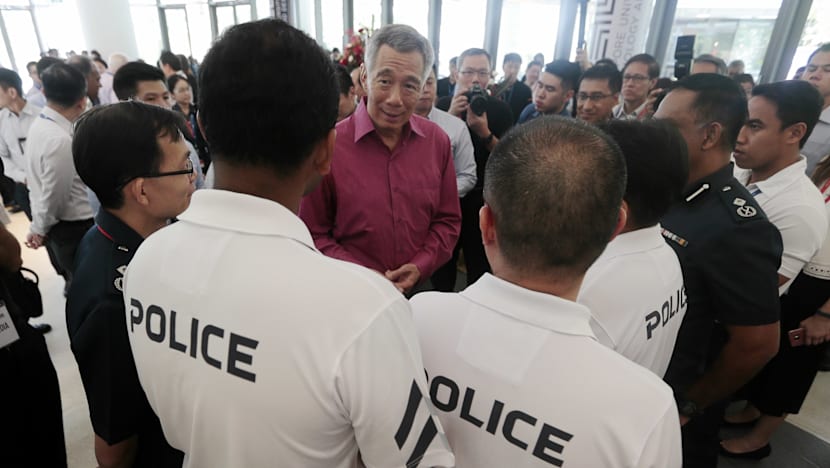
PM Lee Hsien Loong attends the official launch of SG Secure, at SUTD on Sept 24, 2016. Photo: Jason Quah/TODAY


SINGAPORE — Singaporeans must play a part to protect one another before, during, and after any terror attack, said Prime Minister Lee Hsien Loong as he launched the SGSecure movement on Saturday (Sept 24) and called for the country to stand united in the face of the terror threat.
As individuals, we can respond out of fear the day after terror strikes, or we can respond with courage, said Mr Lee, who outlined the roles that individuals can play when the inevitable happens. "I think if you ask Singaporeans which of those two they will do, it is quite clear what the answer will be. Stand up, do the right thing, get prepared, gird ourselves. It will happen, but we will be prepared when it happens," he said.
SGSecure will equip Singaporeans in three roles: To recognise and respond to suspicious behaviour, to help others in times of crisis, and mobilise the community to do the same.
While the authorities have stepped up measures against terrorism, the Government's efforts alone are not enough, Mr Lee said.





"Terrorism threatens not just our physical safety, but also our social harmony and way of life. To protect ourselves, every Singaporean has to play his part... You don't have to be a commando to make a difference, you can just be an ordinary person," he said.
Under the SGSecure initiative, at least 300 residents in every constituency with basic life-saving skills, such as how to administer cardiopulmonary resuscitation using automated external defibrillators (AEDs).
Another key feature is the revamped Emergency Preparedness Day, which simulate terrorist attacks in the heartlands and train residents in emergency skills. Crisis response exercises will also be conducted to train community leaders and emergency response teams on how to manage communal relations and "bounce back quickly" after an incident.
At the event, Mr Lee also launched the SGSecure mobile app, which will send out public alerts and advisories in the event of an emergency. Users who encounter suspicious characters - such as abruptly abandoned vehicles, old and dirty cars bearing new license plates, overly weighted vehicles, or parcels with wires sticking out - can also use it to send information and pictures to the police.
Mr Lee cited the recent example of a Malaysian man, Raejali Butnut, who spent 18 days in transit by using 31 forged mobile boarding passes to enter various lounges in Changi Airport's three terminals. A worker at a lounge he had visited four times saw through his ruse and called the police.
Raejali, a former business development manager with Royale Consultant Management in Singapore, was sentenced to two weeks' jail.
"(The incident) shows that it is possible for us to train people who can be alert and make a difference... You don't even have to be a big, hunky fellow. (In this case, it was) a young lady doing her job, keeping her eyes open, she made a difference," said Mr Lee.
Calling for the community to stay vigilant, Mr Lee said: "While these programmes are important, they are structured events, they are exercises, they are planned...Emergencies happen when we least expect them. Alertness must become a part of our daily lives."
Speaking to reporters at the sidelines of the event which was held at the Singapore University of Technology and Design, Home Affairs and Law Minister K Shanmugam reiterated that how Singaporeans respond to an attack is a indication of the Republic's "resilience and character".
He said: "Most people believe the likelihood of an attack in Singapore is not high. But nevertheless, I think an increasing number of people also recognise that it can happen. That awareness is increasing. The next level is, what is your role, how are you going to respond? I don't think a lot of people have thought about that. That's why we need to go house to house and bring it across... It's been a very safe and secure society. People are not used to thinking along these lines...A lot will continue to be done in the next few years. It's not a sprint. It's going to take time, it's going to take repetition, it's going to take continuous effort."
Echoing the authorities' call to action, grassroot leaders said men in the street are vital "eyes and ears on the ground" in times of emergency.
"Everyone must understand how to respond to make this work... Through their outreach efforts, the authorities have given us very straightforward steps which every body can understand. The man in the street, people on the ground okay an important role in looking out for suspicious signs," said Ms Phyllis Tng who serves in the Inter-Racial and Religious Confidence Circle in Tampines.
Mr Ahmad Helmi Mohamad, who volunteers with the Religious Rehabilitation Group, added that Singaporeans must make the effort to understand one another to live together in a secular state. "We cannot be complacent with the racial and religious harmony that we have," said the 28-year-old.