







Faces on the Subway: Broken but not down, b-boy Yohaki makes good as dance coach
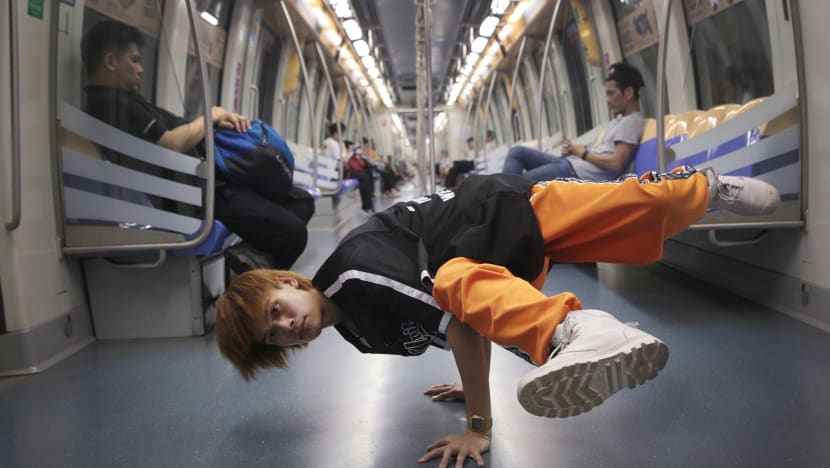
Freddy Yohaki demonstrates a dance move onboard the MRT. Photo: Jason Quah/TODAY


Every day, hundreds of thousands of passengers take the MRT, traversing across the island for work, school and leisure. The spate of disruptions and incidents, which the operators and authorities are looking to resolve, and the inconvenience caused to commuters, have brought into focus how the rail network has become a big part of our lives. So, too, are the countless faces we meet on the subway, some growing familiar over time and each with a story to tell.
In our Faces on the Subway weekly series, we speak to commuters who start their day while it is still dark, or call it a night when others are already fast asleep — people on the first or last train.
SINGAPORE — Singaporean dance instructor Freddy Yohaki, 32, often tells his students to be appreciative of what they have because “your parents paid money for you to attend these classes”. The parental support that some of his students receive is something that he still covets.





The full-time dance coach at private school 5th Avenue admitted that he was a delinquent in his teens and has trouble to this day winning his mother’s approval. To her, dancing is not a “decent” job, and she has not watched any of his performances.
Over more than 13 years, the young man had to beat out his own path while he aspired to be a dancer, eventually ending up where he is today, teaching hip-hop, jazz and street dance.
Already breakdancing when he was 15, he would observe other dancers at public spaces and then go home to try the moves secretly in his bedroom.
Making up his mind not to further his studies after secondary school, he pooled some money together through his own means and, against his mother’s wishes, went to attend dance courses in Japan and Taiwan.
It was in Tokyo that he met a mentor, who gave him his stage name “Yohaki”, meaning happiness in Japanese.
“He didn’t just teach me to dance, he taught me the values of life. At that time, because of the lack of support at home, I was feeling very unhappy while dancing. My mentor gave me that name because he wanted to change that. Without him, I don’t think I would be who I am today.”
The time away from Singapore also allowed Mr Yohaki to get away from bad influences. “I used to be involved in gang activities, skipping school and sometimes getting into fights,” he said.
His rebellious nature meant that there was constant reproach from his mother. “I always felt like I was a failure, and it didn’t help that my mother kept reminding me about how I would have to pick up rubbish on the streets if I did not do well in school.”
Later, it was a counsellor he met who encouraged him to pursue his dream to learn dancing. “He told me that other people’s opinion of you does not have to become your reality. So I told myself that if someone says I cannot do it, I will prove them wrong.”
.embed-container { position: relative; padding-bottom: 56.25%; height: 0; overflow: hidden; max-width: 100%; } .embed-container iframe, .embed-container object, .embed-container embed { position: absolute; top: 0; left: 0; width: 100%; height: 100%; }A SLIP-UP
After his overseas stints, Mr Yohaki returned home when he was 20 to work as a back-up dancer for performing artistes and bands and at other gigs to gain more experience on stage. He also scored spots as a back-up dancer for Mandopop singer JJ Lin and K-pop bands such as Super Junior and Big Bang, and was signed on for a similar role in the singing competition Project Superstar, which was aired on Channel U.
Just as it looked like he was making some headway, he got into an accident at one of the performances and hurt his back when another dancer slipped and fell on him.
He used pain relief patches to nurse his backache and did not see a doctor, thinking it was “common” for dancers to have sprains and minor injuries. About two years later, in 2015, a sharp pain in his back left him bedridden for two days.
“(The pain) was different. It was something I never felt before,” he said, adding that he told his mum he was in bed because of a flu.“I only managed to get an MRI scan done because my friends came to my house and literally carried me all the way to the hospital,” he recounted.
He was told that his slipped disc injury was so severe, he might never be able to dance again.
Though he was given the option to go for an operation, his doctor said that the chances of recovery were “50-50”.
Deciding against surgery, Mr Yohaki slipped into depression. “I thought this would be the end of my career, and I didn’t step out of home for two months… I just laid in bed, feeling resentful that this (injury) happened to me.”
FIGHTING BACK
Then, recalling what his mentor used to say about being positive, he finally picked himself up and went on a job search. He found one at an e-commerce firm, and worked as an account manager for about two years. Even though he had experience selling merchandise online, Mr Yohaki hated the “desk job” and felt like he was getting out of shape.
During that period, he tried the Chinese therapeutic massage tui na and learnt yoga to try and keep his backaches at bay.
Even today, he spends about an hour every day making sure he does recovery stretches after dance classes, which typically end at around 10.30pm, before taking the last train home. Depending on which of the school’s branches his classes are scheduled, he would either take the North-South Line from Jurong or Bishan station, or the Downtown Line from Bukit Panjang station.
The school, which is a member of Dancepointe Academy Singapore, offered Mr Yohaki a chance to go full-time in 2016.
In the short while since then, he has managed to build rapport with his students. “I think I can relate to my students well because of the experiences I’ve had,” he said, adding that they often tease him about his changing hairstyles.
He observed that many of the students at Dancepointe Academy would like to get into renowned dance schools, or to study performing arts at institutions here such as Lasalle College of the Arts or the Nanyang Academy of Fine Arts.
“But sometimes, they don’t get the appropriate support, or they don’t get good enough grades to qualify. Our academy gives them a chance to try and live their dreams,” he said. “It is difficult to make a name for yourself, especially when (there is no big scene for) dance or the arts in Singapore. Many don’t think it’s worth it and have a fear of failure. I see many potential dancers who give up because of this and other obstacles.”
MEETING PRANKSTERS
Besides teaching at the academy, Mr Yohaki has also been contracted to teach at several secondary schools. Being among the youth is one reason he loves teaching.
“There was one particular class I was teaching, which was made up of students who had bad discipline records. They were forced to attend the class and did not listen to me at all. They were playing pranks throughout the lesson.”
Frustrated, he decided to level with them. “I told them straight up, I knew where they hid their tattoos and what they were doing after class. They were quite surprised that I knew.”
From there on, the students began relating to him and paid more attention in class. He also finds opportunities to advise some of them against being involved in gang activities. Seeing his students gain confidence through dance gives him great satisfaction. “I feel like I have achieved my goal,” he said.
At 5th Avenue, he also takes an interest in what his students do. Chua Xin Lin, 19, an undergraduate from the National University of Singapore, said: “He’s a very patient instructor and stays back to guide us through the moves again if we have any questions. He makes an effort to ask us about our hobbies and encourages us to keep them up. Sometimes he tells us about himself, how he injured his back, and it’s very inspiring to know that someone can go through these obstacles and still lead a meaningful life. It teaches me that nothing is too hard to not overcome.”




