







Five-year disability awareness campaign launched
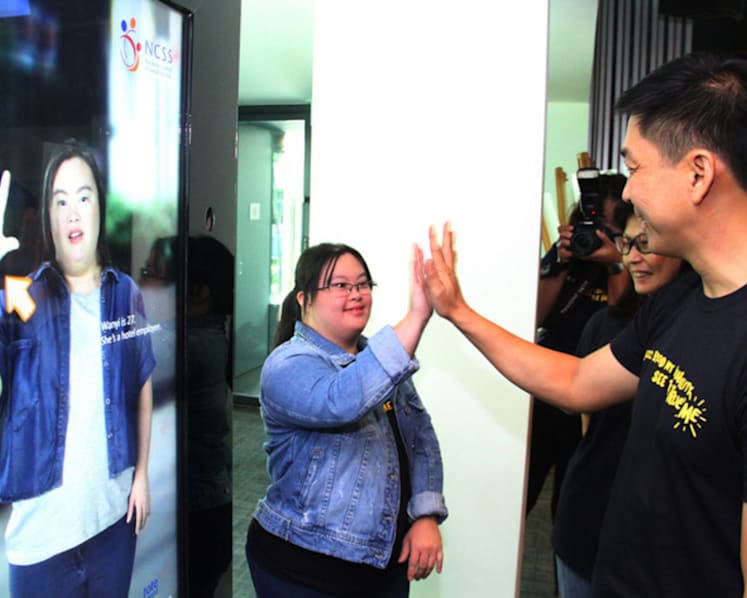
Minister for Social and Family Development, Mr Tan Chuan-Jin (at the right) looking at the interactive bus stop advertisement that features Chen Wanyi (at the left), 27 years old, who is one of the Campaign Ambassadors. Photo: Damien Teo/TODAY


SINGAPORE — Because he has cerebral palsy, Mr Ong Peng Kai, 24, moves around with the help of a roller walker. When he is out and about, people sometimes rush to hold doors open for him.
Such gestures by well-meaning strangers warm his heart but at the same time, Mr Ong feels conflicted because like many others with disabilities, he wants to feel independent and in control of his life.
A quantitative study of close to 1,000 people with disabilities conducted from January to March last year showed that seven in 10 respondents felt this way. Separately, focus group discussions with 100 people with disabilities conducted in November found that the general public view disabilities as limitations, for which they need to offer protection and different treatment.
This, in turn, could hinder people with disabilities from doing the things they can and want at the workplace, at social outings and during activities.





Mr Ong said that a way around the conundrum could be for members of the public to offer help instead of jumping in straightaway. “I’m quite glad that people have been looking out for us — looking out for us is nice — but (when) they end up reacting to help us with something we can do, it’s an overreaction,” said Mr Ong, an assistant manager at the National Council of Social Service (NCSS).
A five-year campaign called See The True Me was launched by the NCSS and the Tote Board yesterday to raise understanding of the abilities and thoughts of people with disabilities.
Speaking at the launch ceremony, NCSS chief executive officer Sim Gim Guan said the general public often “overcompensates” in helping people with disabilities because they do not factor in whether the latter need help doing the task. At the other extreme, some hesitate to interact and support this group. Both stem from a lack of understanding, he noted.
“There is a need to moderate both approaches. While we want the public to understand the challenges faced by persons with disabilities and be inclusive in our interactions with them, persons with disabilities also wish to live their lives independently and pursue their aspirations,” said Mr Sim.
Minister for Social and Family Development Tan Chuan-Jin, who also spoke at the ceremony, said that while there has been progress in terms of providing an inclusive physical environment and facilities for people with disabilities, this does not necessarily translate to having an inclusive mindset towards this group.
“Beyond the physical hardware and infrastructure, what is even more important is to raise awareness within the wider community on disability issues, and to nurture the right attitude when interacting with persons with disabilities among us,” he added.
An NCSS poll of 1,400 people between May and June last year found that the public held the most favourable attitudes towards people with sensory impairment, followed by those with physical impairment. Autism and intellectual impairment scored the least favourably.
This is particularly so in the realm of employment, compared to other areas like education, public access and social interaction.
The public also display “larger social distances” towards people with autism and intellectual impairment, compared to those with sensory or physical impairment.
Speaking to the media separately, Mr Tan said nurturing the right attitude requires sustained effort.
He cited an example of how he was corrected to use the term “persons with disabilities” instead of “someone who is disabled” in an online post, in which he congratulated para-swimmer Yip Pin Xiu.
“A constant reminder will remind you to use the right vocabulary to describe things in a right way ... the effort of pointing it out (reminded) me (to), first, put the person foremost and then deal with the disability,” he added.




