







Revised food production targets balance 'ambition and pragmatism', says Zaqy Mohamad
The new targets, which replace Singapore's "30 by 30" food sustainability goal, take into account what Singapore can produce and scale locally, said Senior Minister of State for Sustainability and the Environment Zaqy Mohamad.

This audio is generated by an AI tool.


SINGAPORE: Singapore's revised targets for local food production strike a balance between ambition and realism, Senior Minister of State for Sustainability and the Environment Zaqy Mohamad said on Tuesday (Jan 13).
They take into account what Singapore can produce and scale locally, as well as challenges that a nascent sector like alternative protein faces, he added.
Mr Zaqy was responding to two parliamentary questions about fibre and protein production targets for Singapore, which were announced in November last year.
The new targets replace Singapore's "30 by 30" food sustainability goal, under which the country aimed to produce 30 per cent of its nutritional needs by 2030.
The government's updated strategy – called Singapore Food Story 2 – sets targets for specific food categories. The aim is to boost overall food resilience through four pillars, including local production, import diversification, stockpiling and global partnerships.
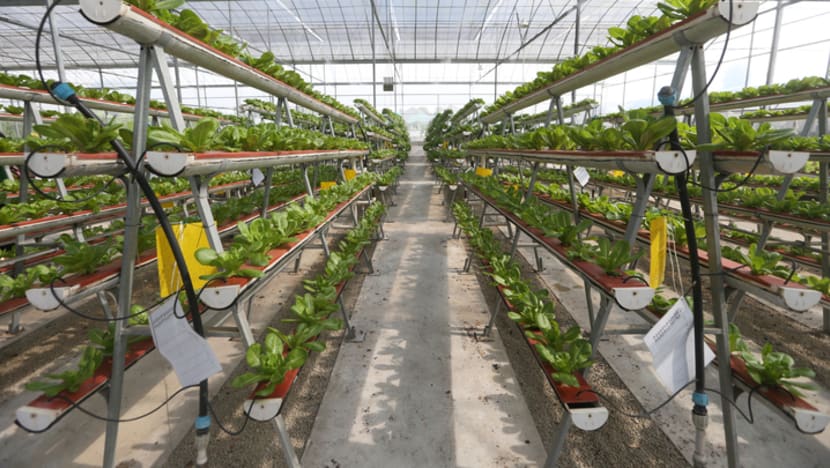
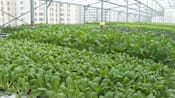
For local production, the goal now is for farms to supply 20 per cent of the local consumption of fresh leafy and fruited vegetables, beansprouts and mushrooms, and 30 per cent of the local consumption of eggs and seafood by 2035.
The targets take into account the important role of local production as a "regenerative and assured source of fresh food", the strengths of the local ecosystem and the potential for growth, said Mr Zaqy on Tuesday.
"We will focus on food types that are feasible to be produced at scale efficiently," he said, adding that this is "consistently applied in our grants and land tenders".
Meats are not part of the revised targets because of resource efficiency, land intensity and climate conditions, while alternative protein is excluded "given the nascency of this sector".
Singapore also does not intend to produce some food locally, such as rice and poultry. Instead, these will be considered under import diversification and stockpiling.
"The revised targets balance ambition and pragmatism, by considering what we can produce and scale locally as well as the challenges that our nascent sector faces, including higher production costs and the need for substitute demand," said Mr Zaqy.
He added that Singapore will continue to find new ways to support new and existing farms in lowering production costs, building capability, strengthening the supply resilience of inputs and securing buyers for the produce.
"We also need strong support from local consumers and businesses ... (which is) essential for our farms to achieve scale and commercial viability," he said, adding that more information will be provided after this year's Budget announcement.
INCREASING PRODUCTION THROUGH TECHNOLOGY
Mr Yip Hon Weng (PAP-Yio Chu Kang) asked whether the government has job creation or retention targets, given that some small farms and food producers are affected by high production costs and workforce shortages.
In response, Mr Zaqy said the Ministry of Sustainability and the Environment (MSE) supports farms by helping them build capability in new areas such as agri-tech.
Some farms have made use of technology to increase their yields and have become more competitive as a result. There are also facilities that do not need as much energy, and automation helps to reduce manpower needs, he said.
Ms He Ting Ru (WP-Sengkang) noted that the "30 by 30" goal was called "aspirational", and asked for clarity on whether the 2035 goal is a target or an aspiration.
Singapore launched its "30 by 30" campaign in 2019, but the local agri-food sector struggled with supply chain disruptions, inflationary pressures on energy and manpower costs, as well as a tougher financing environment. That led to delays in farm development, and some farms closed down.
Mr Zaqy said the "several rounds of challenges and disruption" since 2019 have helped Singapore to learn and grow.
For example, when borders were closed during the COVID-19 pandemic, Singapore had to think about supply diversification for eggs and chickens, and about the need to strengthen stockpiling. Singapore now imports chickens from Brazil and eggs from Ukraine, besides buying these from closer neighbours.
In terms of local production, Mr Zaqy said some yields have improved, and Singapore is only around 4 percentage points away from reaching the goal for protein.
"That gives very good promise in terms of whether we're able to meet a 2035 target ... more than just aspirations, we are tracking quite carefully," he said. "We are putting in programmes, schemes to ensure and help our farms transform to achieve those goals as well."
The other pillars of the strategy also give Singapore more options.
"Are we changing the goal posts? That's one question some people ask me all the time," he said. "I think maybe it's not so much thinking in terms of goal posts, but maybe perhaps I'm giving you a better goalkeeper."




