Foreign domestic workers to be better insured against accidents from Oct
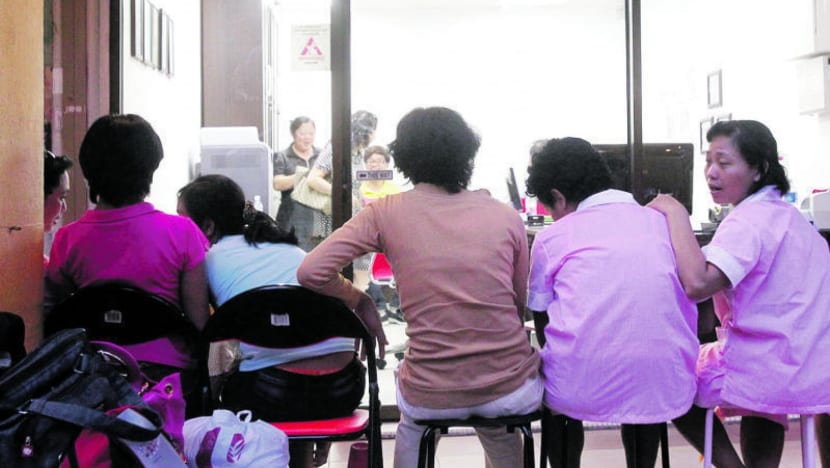
Foreign domestic helpers at a maid agency. TODAY file photo


SINGAPORE — From Oct 1, foreign domestic workers will receive greater personal accident insurance (PAI) protection, including a higher assured minimum sum in the event of death or permanent disability.
The changes, announced by the Ministry of Manpower (MOM) on Sunday (May 7), are meant to ensure these workers continue to be compensated sufficiently under such circumstances.
The assured minimum sum will be raised from S$40,000 to S$60,000 under the PAI, which protects foreign domestic workers and their families from income loss arising from the worker’s death or permanent disability while in employment here.
The MOM said the increased sum takes account of the rise in workers’ median wages since the last review of coverage in 2008. It is expected to raise yearly premiums by between S$7 and S$15.





To ensure uniformity in the protection received by all workers and their families, the ministry will require that PAI cover “all sudden, unforeseen and unexpected incidents” that cause death or permanent disability.
Insurers will not be allowed to slap extra conditions, exceptions or exclusions, save those specified by the Controller for Work Passes, such as pre-existing conditions and suicide, added the MOM.
Coverage now differs from insurer to insurer, and some use narrower definitions of accidents and impose more exclusions. This may result in some foreign domestic workers being compensated but others not, though they faced the same injuries and circumstances.
To ensure workers are protected throughout their employment, the MOM will specify that the coverage starts from the day the worker arrives here until the day she returns home, or where there is a switch of employers, the date when her new work permit is issued.
While employers are responsible for filing claims with insurers for accidents covered under the insurance, the MOM acknowledged there may be cases of them being unable to do so.
With the changes, foreign domestic workers or their legal representatives will be allowed to file claims directly with the insurers. Where the worker or her next of kin cannot file the claims themselves, a ministry-appointed representative can act on their behalf, said the MOM.
Speaking on Sunday (May 7) at the inaugural National Trades Union Congress (NTUC) May Day celebration for domestic employees, Minister of State (Manpower) Sam Tan said the NTUC’s Centre for Domestic Employees (CDE) had, since January, called on the Government to review the PAI.
The centre’s chairman, Mr Yeo Guat Kwang, said workers’ starting wages have climbed from an average of S$300 in 2012 to around S$550 last year. This, coupled with the rising cost of living in their home countries, “warrants a corresponding increase” in coverage, so their families would receive greater financial support in the event of an accident, Mr Yeo added.
Mr Tan said some employers also faced situations in which their domestic workers had met with accidents and were unable to work.
“(They) ... asked if more can be done to protect the families of their (workers) in such a situation,” he added.
Mr Yeo said a “handful” of the 600-odd cases the CDE handled in the past year were compensation-related and were flagged by employers. Some felt they could not compensate their workers fairly, while for others, coverage had lapsed.
There are more than 200,000 foreign domestic workers here, and Mr Yeo expects this to rise to 300,000 in the coming decades. With the growing demand for such workers, who are not covered by laws such as the Work Injury Compensation Act, a “holistic” approach is crucial to ensure their well-being, including after incidents, he added.
Some employers may worry about the higher premiums, but it is only “fair” to compensate workers’ families adequately, he said.
To employer Kong Yiling, 32, the increase is nominal and “absolutely not” a concern, as her helper’s well-being takes priority. “It’s a very small sum to pay for added peace of mind,” said the banking professional.
Domestic helper Cherry Salazar, 45, who has been here for nine years, said the increased sum would be a “big help” to workers’ families if something untoward happens. “You’ve something to leave for them. If you can’t work already, you’ve something to spend to start a business,” said the Filipina.
Employers must buy a PAI policy that meets the new requirements when they apply to hire a worker or renew her work permit from Oct 1.
The CDE is also urging the Government to raise the compulsory medical insurance coverage of S$15,000 for domestic workers, said Mr Yeo. He stressed that the focus was not only on the quantum but the entire “coverage and protection”.
When asked, Mr Tan said the MOM was looking into the issue and working with the CDE and other stakeholders such as employment agencies. It will announce the findings “at the right time”.