







Gan urges private hospitals to upgrade their IT systems
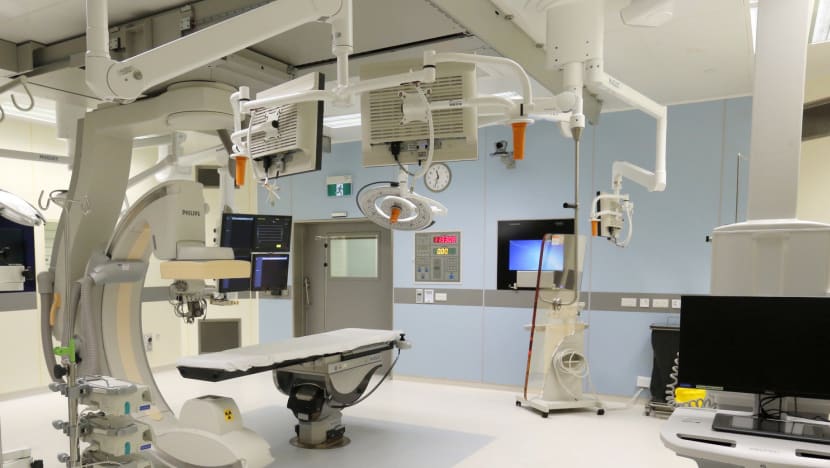
The operation theatre at the new Farrer Park Hospital. It is the latest in a growing number of luxury private hospitals here. Health Minister Gan Kim Yong said yesterday that healthcare affordability was a ‘perennial priority’. Photo: Ernest Chua


SINGAPORE — Private hospitals should plug into the national healthcare database to enable closer coordination with other healthcare providers, Health Minister Gan Kim Yong said yesterday, as he outlined the changes needed to the Republic’s approach to healthcare amid a greying population.
Speaking at the official opening of Farrer Park Hospital (FPH) — the latest addition to the private healthcare landscape here — Mr Gan called on private hospitals to upgrade their IT systems to not only allow them to view medical information in the National Electronic Health Record (NEHR), but also contribute to the patients’ records.
Tapping the NEHR, which contains information such as a patient’s allergies and care history, enables healthcare providers to check such details before deciding on treatment.
As Singapore’s population ages, Mr Gan said the private sector would be an important partner in meeting rising healthcare needs. Currently, it accounts for nearly 20 per cent of acute bed capacity and an even bigger share of specialist outpatient care.





Citing healthcare affordability as a “perennial priority”, Mr Gan added: “What we are aiming for is not the cheapest care, but good-value care — that is, both effective and affordable.”
While FPH has the necessary IT capabilities to contribute data to the NEHR, its chief executive officer Timothy Low said the hospital is still in discussions with the authorities to link its system to the national database.
FPH chairman Maurice Choo said that when the hospital was envisioned about a decade ago, a source of concern among private medical practitioners was the slow rate of improvement in capability, innovation and service amid a rapid escalation of prices, causing a “steady erosion” of their “value as providers of healthcare”.
This, he said, has harmed the private healthcare sector’s competitiveness and prompted some patients to seek treatment elsewhere.
“Faster improvements in capability, innovation and service, and a decrease or a slower increase in prices — this is the best way to improve our competitiveness, both internally and internationally,” Professor Choo said.
On the price front, FPH offers lower room rates, compared to other private hospitals. For instance, a stay in its four-bed suite costs S$196 a day with GST, compared with S$223.63 at Mount Alvernia Hospital, S$259 at Gleneagles Hospital, and S$276 at Mount Elizabeth Orchard.
FPH is the latest in a growing number of luxury private hospitals here.
In 2012, Parkway Pantai Group launched Mount Elizabeth Novena Hospital, whose rooms boast standard hotel-style features such as floor-to-ceiling windows, marble bathrooms and luxury linen.
Situated within an integrated healthcare and hospitality complex called Connexion, FPH connects directly to entities such as the five-star One Farrer Hotel and Spa and the Farrer Park Medical Centre. Costing more than S$800 million to build, Connexion is the first such facility of its kind in Singapore and the region.
The hospital, which began accepting patients in December 2014, has 220 beds — 145 of which are for inpatients. Of these, 103 beds are licensed by the Health Ministry.
Its occupancy rate stands at 50 per cent, a “reasonable figure” given that it attained this even before its official opening, the hospital said.
Half its patients are Singaporeans and permanent residents (PRs), while foreign patients make up the other half. The hospital has treated more than 1,000 Singaporeans and PRs thus far.




