CNA Explains: What's driving Singapore's exceptional economic growth, and can it last?
Singapore's economy has grown above 5 per cent for two consecutive years – a feat last achieved in 2010 and 2011.
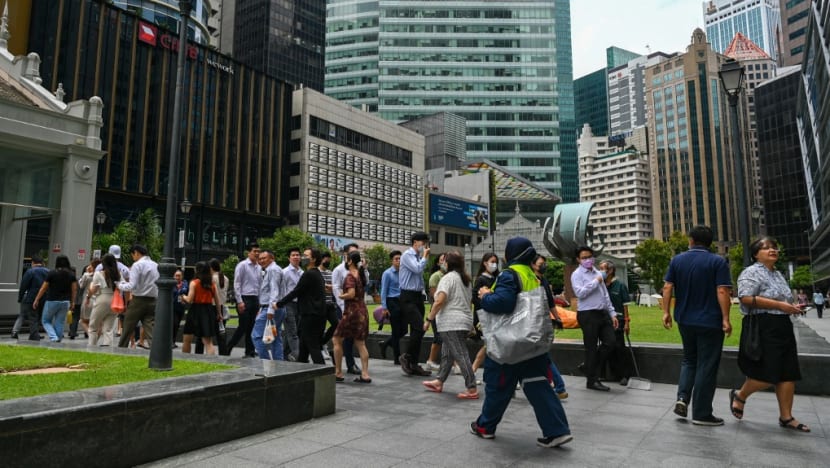
People walking in Raffles Place in Singapore. (Photo: AFP/Roslan Rahman)

This audio is generated by an AI tool.


SINGAPORE: Despite government projections that economic growth would slow as Singapore's economy matures, the country has defied expectations for two consecutive years.
In 2025, Singapore's economy expanded 5 per cent, exceeding forecasts even after the Ministry of Trade and Industry (MTI) upgraded its projections twice – in August and November. The year before, growth hit 5.3 per cent.
This marks the first time since 2010 and 2011 that Singapore has sustained annual growth above 5 per cent for two straight years.
On Tuesday (Feb 10), MTI raised its 2026 forecast to between 2 and 4 per cent, up from the previous forecast of 1 to 3 per cent.
CNA examines what drove this exceptional performance and whether Singapore can maintain its momentum.
How did Singapore do so well?
MTI attributed 2025's robust GDP expansion primarily to manufacturing, wholesale trade, and finance and insurance sectors.
The electronics cluster and machinery, equipment and supplies segment experienced particularly strong growth, driven by surging demand for artificial intelligence-related electronics.
Accommodative financial conditions supported growth in the finance and insurance sector.
Ms Selena Ling, chief economist and head of group research at OCBC, highlighted "very broad-based sectoral growth", citing robust foreign direct investment and safe haven capital inflows into Singapore.
Beyond semiconductors, construction remained resilient with strong public and private sector pipelines, while pharmaceuticals also contributed significantly, she added.
Singapore also benefited from "competitively lower" tariffs on exports to the United States compared to other Southeast Asian economies, Ms Ling noted.
Standard Chartered economists said relatively benign global monetary and fiscal conditions, robust AI-related demand, tariff truces and lower effective tariff rates likely combined to boost economic activity.
How unusual is this performance?
Economists agreed that Singapore's GDP performance over the past two years has been exceptional for a developed economy.
In recent history, Singapore has only recorded such high growth rates when recovering from major crises, said Ms Lee Yen Nee, senior country risk analyst at BMI Research.
"Last year, this growth rate was achieved without a preceding crisis, and it was almost entirely driven by the global capital spending on AI," she said, adding that while electronics manufacturing benefitted most, spillover effects reached services sectors involved in goods movement.
Ms Sheana Yue, senior economist at Oxford Economics, called it "particularly exceptional" that Singapore's economy expanded by 5 per cent despite "heightened external challenges amid US tariff hikes".
In April last year, MTI downgraded its GDP forecast to between 0 and 2 per cent on fears that US tariffs would severely impact Singapore.
Ms Lee said Singapore appeared largely shielded because semiconductors, pharmaceuticals and many high-tech products remained exempt from tariffs.
"Singapore’s high exposure to these areas means that the economy is largely shielded. Furthermore, Singapore benefitted from the flurry of front-loading activity to beat the implementation of higher US tariffs," she added.
Did other Asian economies see similar growth?
Several Asian economies also recorded strong growth in 2025, economists noted.
Taiwan's economy grew 8.63 per cent – its fastest pace in 15 years – while Malaysia's advance estimates indicated 4.9 per cent growth.
"The main driver was exports and investment related to electronics, AI in particular," said Ms Yue, describing Taiwan and Malaysia's performance as "stunning".
The surge in demand for AI products, coupled with tariff-related front-loading, benefited the wider Asian region where high-end chips are produced, she said.
Ms Yun Liu, senior ASEAN economist at HSBC, pointed out that Singapore's growth was almost the same as what Indonesia reported, and that Vietnam grew around 8 per cent.
Why did forecasts underestimate growth?
Singapore initially underestimated AI-related electronics demand, acknowledged Ms Yong Yik Wei, chief economist at MTI, during a media briefing on Tuesday.
"We underprojected because it's quite a nascent technology, and it's quite hard to get the exact trajectory with a high level of precision. So on hindsight, we did underproject that strength in the AI demand," she said in response to CNA's question about the ministry's two forecast upgrades last year.
That demand created positive spillover effects into related sectors such as wholesale trade, she added.

Tuesday's forecast upgrade takes into account "sustained momentum" in AI investment, aligning with the Economic Strategy Review committees' recommendations for Singapore to establish itself as a global AI leader.
MTI also underestimated pharmaceutical output due to unexpectedly large production of a high-value active pharmaceutical ingredient, Ms Yong said.
"It's actually quite difficult to forecast pharma output because it's quite volatile because of the nature of the production process," she said.
Can Singapore sustain this growth?
Analysts caution that maintaining similar growth in 2026 will be challenging, particularly given 2025's high baseline.
"If Singapore’s AI hub ambitions can materialise, then it is possible to see slightly better-than-expected growth potentially exceeding 3 per cent ... but 5 per cent may be a bit of a stretch," said Ms Ling of OCBC.
Ms Yue of Oxford Economics pointed to emerging slowdown signs, noting fourth-quarter GDP growth declined from the third quarter.
External sector risks, uneven domestic activity and a softening labour market could weigh on private consumption momentum, she added.
However, the Singapore Economic Development Board (EDB) remains optimistic about AI's prospects.
"One of the strengths for Singapore is really in our industry verticals. We have various strengths in key sectors, for example, semiconductors, in electronics, in healthcare and so on, that provides for that fertile ground for AI (application)," said Ms Jillian Lim, executive vice-president at EDB.
With leading tech companies establishing operations in Singapore, she expects AI to remain an important growth area.
"We do expect that AI will be a key pillar and a growth area for us that will sustain," she said.