







Singapore's economy grew 4.6% in Q1, down from 5.7% in previous quarter: Advance estimates
The Middle East conflict may weigh on economic activity in the coming quarters, says the Ministry of Trade and Industry.
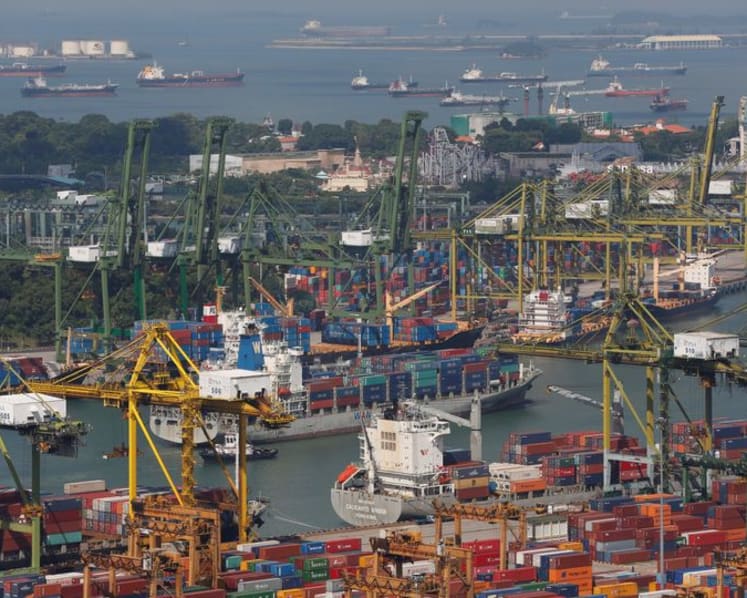
A container ship arrives in a port in Singapore. (File photo: Reuters/Darren Whiteside)

This audio is generated by an AI tool.


SINGAPORE: Singapore’s gross domestic product (GDP) expanded by 4.6 per cent year-on-year in the first quarter of 2026, below expectations, moderating from the 5.7 per cent growth recorded in the previous quarter, according to advanced estimates released by the Ministry of Trade and Industry (MTI) on Tuesday (Apr 14).
Economists polled by Reuters had expected annual growth of 5.9 per cent in the January-March period.
On a quarter-on-quarter seasonally adjusted basis, the economy contracted by 0.3 per cent, reversing the 1.3 per cent expansion in the final quarter of 2025.
MTI said that while overall growth "remained resilient" in the first quarter of 2026, the Middle East conflict could weigh on economic activity in the coming months.





The preliminary GDP estimates for the first quarter of 2026, including performance by sectors, sources of growth, inflation, employment and productivity, will be released in the Economic Survey of Singapore in May.
SECTORAL PERFORMANCE
Growth in the manufacturing sector increased by 5 per cent year-on-year, down from 11.4 per cent expansion in the previous quarter.
“Growth during the quarter was driven by output expansions in the electronics, transport engineering and precision engineering clusters, which more than offset output declines in the biomedical manufacturing, general manufacturing and chemicals clusters,” said MTI.
On a quarter-on-quarter seasonally-adjusted basis, the sector contracted by 4.9 per cent, reflecting a pullback from the 4.5 per cent expansion in the fourth quarter of 2025.
The construction expanded by 9 per cent year-on-year, up from 4.6 per cent in the previous quarter. The growth was supported by a step-up in both public and private sector construction works, said MTI.
On a quarter-on-quarter seasonally-adjusted basis, the sector increased by 3.7 per cent, faster than the 0.2 per cent expansion in the preceding quarter.
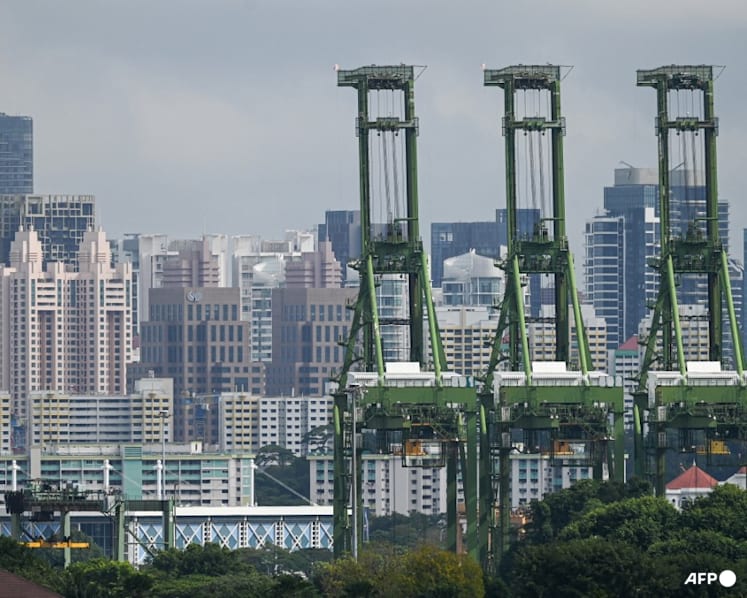
The services, wholesale and retail trade, as well as transportation and storage sectors collectively expanded by 6.7 per cent year-on-year in the first quarter, extending the 6.8 per cent growth in the previous quarter.
All sectors within the group recorded growth.
Wholesale trade was supported by stronger activity in machinery, equipment and supplies, while transportation and storage benefited from gains in storage and other support services segments.
On a quarter-on-quarter seasonally-adjusted basis, growth in the group grew by 1 per cent, down from 1.8 per cent in the final quarter of 2025.
The information and communications, finance and insurance, and professional services sectors expanded by 3.9 per cent year-on-year, slightly higher than the previous quarter, which saw 3.7 per cent growth.
"Growth in the information & communications sector was bolstered by continued strong demand for IT and digital solutions, while that in the professional services sector was supported by the head offices & business representative offices and accounting segments," said MTI.
"Meanwhile, the finance and insurance sector expanded mainly due to the strong performance of the banking and insurance
segments," the ministry added.
On a quarter-on-quarter seasonally-adjusted basis, the group contracted by 4 per cent, reversing from the 4.6 per cent growth in the previous quarter.
Other service sectors, including accommodation and food services, real estate, and administrative and support services, grew by 2.3 per cent year-on-year, moderating from the 2.9 per cent growth in the previous quarter.
"All sectors within the group posted growth during the quarter," said MTI, adding that the real estate sector expanded on the back of steady growth in developer activities.
"Meanwhile, growth of the other services industries such as health and social services and education remained resilient," the ministry said.
On a quarter-on-quarter seasonally-adjusted basis, these sectors grew by 0.1 per cent, rebounding from a slight contraction of 0.4 per cent in the previous quarter.
REACTIONS FROM ANALYSTS
Ms Yun Liu, senior ASEAN economist at HSBC, said that the latest GDP data came in as "a downside surprise" and that the slight pull of 0.3 per cent reflects a "natural and healthy" pull down from the previous three to four quarters.
"We should still expect to see some resilience in Singapore's economy," Ms Liu told CNA's Asia First.
For the full year, HSBC expects Singapore’s economy to grow 2.9 per cent, near the midpoint of MTI's forecast range.
Mr Zavier Wong, market analyst at eToro, said that while manufacturing expanded on a year-on-year basis, the sector saw a sharp pullback on a quarter-on-quarter basis following strong gains in previous quarters.
"The drag came primarily from the biomedical and chemicals clusters, both of which are more exposed to energy input costs and supply chain disruptions," he said, adding that this coincided with the closure of the Strait of Hormuz.
In contrast, construction posted one of its strongest performances in recent quarters, supported by both public and private sector activity, and was "largely insulated" from the conflict in the Middle East, said Mr Wong.
"One important caveat on the recent data is that advance estimates are computed largely from January and February figures, with March only partially in scope," Mr Wong added.
"MTI itself flags that the Middle East conflict, which started late February, could have started weighing on activity in March.
"The quarterly contraction may have already carried some of that, but the cleaner read on conflict will only come with the full Q1 Economic Survey in May."
Deputy Prime Minister Gan Kim Yong, who is also the Minister for Trade and Industry, said last week that the war on Iran will likely slow down economic activity and push prices up.
Manufacturing companies that rely on natural gas, crude oil and crude oil derivatives will be affected more, along with energy-intensive industries such as electronics and precision engineering.
Higher costs and weaker demand will impact air and sea transport as well as tourism, while sectors focused on domestic markets will also see rising operating costs, said Mr Gan on Apr 7.
“Taken together, these sectoral impacts will weigh on economic activities in the coming quarters, although the extent remains uncertain as the conflict is still unfolding,” he said.
Singapore had earlier upgraded its GDP growth forecast for this year to between 2 and 4 per cent, on the back of exceptional economic growth of 5 per cent in 2025. That forecast was made before the war broke out.




