







CNA Explains: How electricity prices are calculated in Singapore
The tariff adjustment is based on a rolling three-month average, which means recent fuel price surges take time to feed through to household bills.
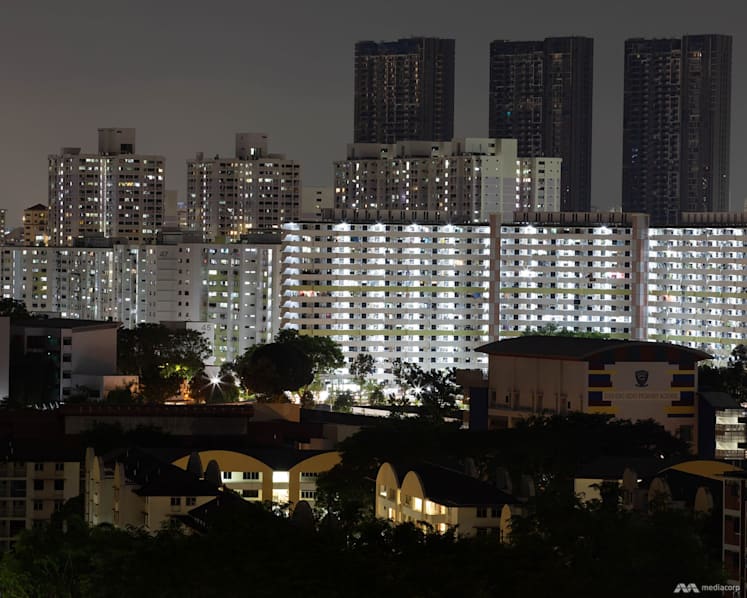
HDB flats in Singapore. (File photo: CNA/Ili Nadhirah Mansor)

This audio is generated by an AI tool.


SINGAPORE: Electricity prices for households in Singapore have crept up since the conflict in the Middle East began – with no signs of slowing down yet.
In April, the household electricity tariff rose 2.1 per cent or 0.56 cents per kWh compared with the previous quarter, before Goods and Services Tax (GST).
But Singapore should expect a "much sharper increase" in the July tariff adjustment, which will fully reflect higher fuel costs, Deputy Prime Minister and Minister for Trade and Industry Gan Kim Yong said in a ministerial statement in parliament on Apr 7.
As households brace for higher bills, CNA looks at how electricity prices are calculated.
Why are electricity prices rising?





About 95 per cent of Singapore’s electricity is generated using imported natural gas, whose price is mostly pegged to market prices.
Since the outbreak of conflict in the Middle East, global fuel supply chains have been disrupted, pushing up the cost of gas used to generate electricity.
Singapore has taken steps to reduce disruption, including diversifying sources and setting up a centralised gas procurement for the power sector, Coordinating Minister for National Security and Minister for Home Affairs K Shanmugam said in parliament last week.
Power plants here can also switch from natural gas to diesel when needed, and the country has fuel reserves, he added.
“Nevertheless, if the supply disruptions increase, and if more suppliers are unable to supply fuel or gas, then potential disruptions to our domestic energy and electricity supply cannot be ruled out,” he said.
This remains a low-probability scenario for now, he said. But prices will rise.
How are electricity tariffs calculated?
The current rate of 27.27 cents per kWh is comparable to rates over the past seven quarters, which ranged from 26.71 cents per kWh in January this year to 29.88 cents per kWh in July 2024, based on data from national grid operator SP Group.
The tariff comprises two main cost components: fuel cost and non-fuel cost.
Fuel cost makes up about 76 per cent of the tariff. It is calculated using the average of daily natural gas prices in the first two-and-a-half months of the preceding quarter.
According to the Energy Market Authority (EMA), this method helps smooth out large swings in the oil market – meaning changes in global energy prices take time to feed into electricity bills.
As such, only a small portion of the recent price surge was captured in April’s tariff adjustment, which is based on prices from January to mid-March.
Non-fuel cost refers to the cost of delivering electricity to consumers, including operating the power system and stations, and billing and meter reading.
What about electricity retailers?
A majority of Singapore households – 63.1 per cent – are on the regulated tariff, latest data from the Open Electricity Market (OEM) showed.
Another 36.9 per cent are on retail price plans offered by OEM retailers.
Singapore's electricity market represents the region's closest fully liberalised market, said Mr David Chew, a senior consultant at Rystad Energy.
The sector is competitive, with retailers buying electricity in bulk from the market and competing for end-user customer demand, he added.
Unlike those on the regulated tariff, who see rate changes every quarter, households buying electricity from retailers can subscribe to fixed-price plans – which offer a fixed rate for a 12- or 24-month contract – or discounts off the regulated tariff.
Retailers in the OEM are either the retail arm of power generators or independent retailers that buy electricity in bulk from the wholesale market. Prices on the wholesale market fluctuate every 30 minutes, depending on demand and supply.
Conditions in the wholesale market play a key role in determining the business strategies of the latter group of retailers. The ability to hedge against fluctuations is another important factor.
How do tariffs affect prices in the Open Electricity Market?
Retailers typically benchmark their rates against the tariff rate, charging just below it to attract customers, Dr David Broadstock, a partner at energy consultancy The Lantau Group, previously told CNA.
Prices have edged up since the war broke out. On Feb 27, a day before the war began, fixed-price retail plans for residences ranged from 22.83 to 26.30 cents per kWh, before GST.
As of Monday (Apr 13), prices ranged from 26.42 to 27.61 cents per kWh before GST, data from the OEM's price comparison website showed.
This represents an increase of between 1.2 and 14.8 per cent, depending on the plan and retailer.

What should households look out for?
While households still on fixed-price contracts may not see increases in their electricity bills immediately, they are likely to face higher rates when their contracts come up for renewal.
Dr Broadstock said households looking to renew their contracts should carefully review available options.
Consumers should also consider whether a company may risk going out of business under a given pricing strategy, as companies are raising prices to manage costs.
In 2021, six electricity retailers exited the Singapore market within weeks amid global energy price spikes. EMA has since strengthened regulatory requirements to ensure retailers can better handle gas price volatility.
Rystad’s Mr Chew added that consumers should also look at contract terms.
Early termination fees, auto-renewal clauses and ancillary charges can affect overall costs, particularly in a volatile pricing environment where switching decisions are more frequent, he said.
Ultimately, retail plans from retailers tend to be forward-looking and anticipatory, accounting for future fuel costs and a hedge premium for insulating customers from volatility, he noted.
“When a household signs a fixed contract, it is effectively paying the retailer to hedge on its behalf,” he said.




